Gauging Interest vs Gaging Interest: Which One Is Correct? 🤔
Have you ever typed a sentence like “We’re gauging interest in the new project” and suddenly wondered whether it should actually be “gaging interest”? You are not alone. Many writers pause when they encounter Gauging Interest vs Gaging Interest, especially because both words appear online and seem surprisingly similar.
English often creates confusion when two spellings look almost identical. Sometimes one form is completely wrong, while other times both are technically acceptable in different contexts. That is exactly why people struggle with this phrase. You may see one spelling in business emails, another in technical fields, and still another in casual writing.
The confusion becomes even greater because spelling conventions can vary depending on industry usage and dictionary standards. A missing letter may seem small, but tiny differences can change how professional and accurate your writing appears.
In this guide, we will break down Gauging Interest vs Gaging Interest in simple language. You will learn which form works best, where each spelling comes from, and how to avoid making mistakes. Let’s settle the debate once and for all. ✍️
Quick Answer Section: Gauging Interest vs Gaging Interest
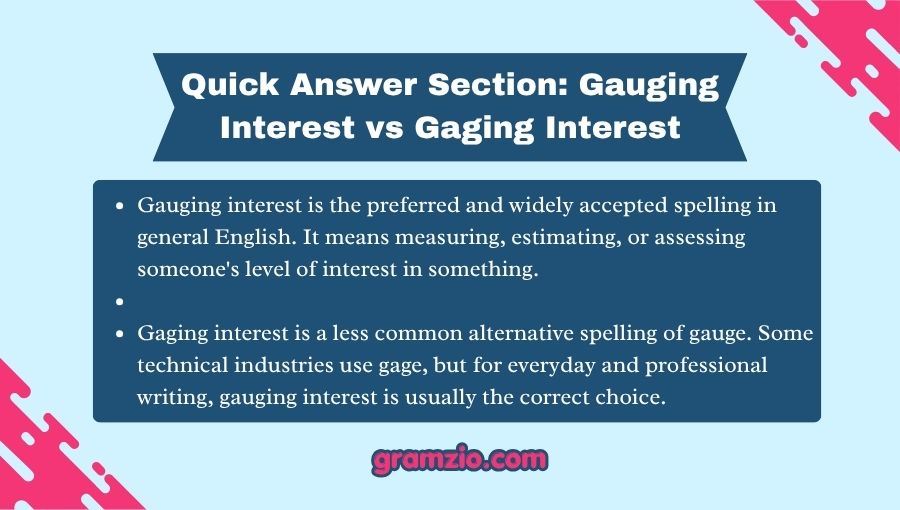
Gauging interest is the preferred and widely accepted spelling in general English. It means measuring, estimating, or assessing someone’s level of interest in something.
Gaging interest is a less common alternative spelling of gauge. Some technical industries use gage, but for everyday and professional writing, gauging interest is usually the correct choice.
Understanding the Basics: Gauging Interest vs Gaging Interest
The debate comes down to spelling preference and usage history.
The verb gauge means:
- To measure
- To estimate
- To assess
- To judge a response
When people say gauging interest, they mean checking how interested people are before making a decision.
Example:
“We are gauging interest before launching the course.”
The spelling gage exists too, but it is much less common and often appears in specialized fields.
Comparison Table
| Form | Type | Meaning | Example | Correct/Incorrect |
|---|---|---|---|---|
| Gauging interest | Verb phrase | Measuring or estimating interest | We are gauging interest among customers. | ✅ Correct |
| Gaging interest | Alternative spelling | Same meaning but uncommon | We are gaging interest. | ⚠️ Rare |
| Gauge | Verb | Measure or estimate | Gauge audience reactions. | ✅ Correct |
| Gage | Alternative spelling | Less common form of gauge | Gage public response. | ⚠️ Limited use |
For most writers, gauging interest is the safest and best choice. 👍
Correct Meanings & Uses
Gauging Interest Meaning
When someone says they are gauging interest, they are trying to determine how people feel before moving ahead.
Examples:
Sentence:
“The company is gauging interest in a new subscription plan.”
Breakdown:
- company = who is acting
- gauging = measuring or assessing
- interest = people’s level of enthusiasm
Meaning:
The company wants to know whether customers actually want the product.
Gauging Public Opinion
Businesses and organizations often test ideas before making decisions.
Example:
“The mayor is gauging interest in the city’s new transportation plan.”
This means officials are checking whether citizens support the proposal.
Gauging Customer Demand
Businesses commonly use this phrase.
Example:
“We posted a survey to gauge customer interest.”
Meaning:
The business wants feedback before spending money.
Test Tip 📝
Replace gauging with measuring.
If the sentence still makes sense, you probably used it correctly.
Example:
“We are measuring customer interest.”
Works perfectly.
Case Study Section 📊
Imagine a marketing manager preparing to launch an online course.
Before investing thousands of dollars, she sends an email:
“Hello everyone, we’re gauging interest in a beginner photography program launching next month.”
The goal is not to sell immediately.
The goal is to:
- Measure excitement
- Collect feedback
- Estimate demand
- Reduce risk
Suppose 2,000 people respond positively.
Now she has data showing there is enough interest to move forward.
This is a real-world example of how gauging interest works in professional communication.
Grammar Rules Explanation
The main issue behind Gauging Interest vs Gaging Interest comes from spelling history.
Standard dictionaries, including Merriam-Webster, recognize gage as a spelling variant of gauge. However, gauge became the dominant form in modern English.
The word originally entered English from French influences, which partly explains its unusual spelling.
Today:
✅ gauge → standard usage
⚠️ gage → alternate and less common
When adding -ing:
- gauge → gauging
- gage → gaging
Both are technically possible.
However, most style guides and professional publications strongly favor gauging.
Common Mistakes ❌
People make mistakes for several reasons:
Fast typing
People often omit letters while typing quickly.
Autocorrect issues
Some systems mistakenly suggest uncommon alternatives.
Lack of knowledge
Many people simply assume shorter spellings are better.
Similar Grammar Confusions
| Confusion | Correct Form | Reason |
|---|---|---|
| it’s / its | Depends on context | Apostrophe confusion |
| your / you’re | Depends on meaning | Contraction mistake |
| affect / effect | Depends on function | Verb versus noun |
| then / than | Different meanings | Comparison issue |
| gauging / gaging | Gauging usually | Standard usage preference |
Usage in Different Contexts
Everyday Conversation 🗣️
People use the phrase naturally:
“I’m just gauging interest before planning a group trip.”
This sounds normal and conversational.
Professional Writing 💼
Business communication strongly favors:
“We are gauging market interest before expansion.”
Professional writing values standardized spelling.
Creative Writing ✨
Writers may use it descriptively:
“She studied the crowd, gauging interest from every expression.”
This creates a sense of observation.
Social Media and Texting 📱
People frequently write:
“Just gauging interest—who wants pizza tonight?”
Short and casual.
Why It Matters (Important)
Small spelling differences affect more than grammar.
Using the correct form helps with:
Clarity in communication
Readers instantly understand your meaning.
Professionalism
Correct spelling creates trust.
Writing accuracy in digital communication
Online writing often shapes first impressions.
Consider this quote:
“Good writing reflects clear thinking.”
Tiny spelling details can influence how others see your message.
Imagine receiving two emails:
❌ We’re gaging client response.
✅ We’re gauging client response.
The second often looks more polished.
Special Exception ⭐
There is one important exception.
Certain technical industries use gage as a noun.
Examples:
- pressure gage
- wire gage
- thickness gage
Engineering and manufacturing fields sometimes prefer these spellings.
However, this does not usually affect the phrase gauging interest.
For general communication:
Stick with gauging interest.
Quick Recap Checklist ✅
| Question | If Yes → Use |
|---|---|
| Are you measuring someone’s level of interest? | Gauging |
| Are you writing a professional email? | Gauging |
| Are you using everyday English? | Gauging |
| Are you writing technical equipment terminology? | Possibly gage |
Practice Examples
- We are _____ interest before creating the app.
Answer: gauging
- The company is _____ customer demand.
Answer: gauging
- She posted a survey for _____ audience reaction.
Answer: gauging
FAQs
Is “gaging interest” wrong?
Not completely. It is an alternative spelling, but it is uncommon. Gauging interest is preferred in standard English.
Which spelling do businesses use?
Most businesses use gauging interest because it follows common dictionary and style-guide standards.
Why do some industries use “gage”?
Engineering and manufacturing sometimes use gage for specialized terminology and tools.
Can I use “gaging” in formal writing?
You technically can, but it may look unusual. Gauging is safer and more professional.
Is “gauge” American or British English?
Both American and British English commonly use gauge.
How can I remember the correct spelling?
Think of gauge as the standard dictionary version. If uncertain, choose gauging.
Conclusion
The confusion around Gauging Interest vs Gaging Interest is understandable because both spellings exist. However, modern English strongly favors gauging interest in most situations. It is the standard form used in business communication, everyday writing, marketing, and professional documents.
While gaging survives in some technical and specialized contexts, it remains uncommon for general use. Choosing the standard spelling helps your writing appear cleaner, clearer, and more polished.
Language often includes small details that create big questions. Fortunately, this one has a straightforward answer: if you are assessing enthusiasm, measuring demand, or checking reactions, gauging interest is usually your best choice. 🎯
Remember this simple rule: When measuring curiosity, gauge it—don’t second-guess it.
Also read: Strongly Recommend vs Highly Recommend

Hi, I’m Willa Sterling. I work at gramzio.com as a senior editor. With 15 years of experience in academic and formal grammar, I provide the expert insights you need to make your writing flawless.