Gases or Gasses: Which One Is Correct? 🤔💨
Have you ever typed a sentence like, “Different gasses are released during the experiment,” and then paused for a second? Something feels strange. Is it gases or gasses? You are not alone. Many English learners, students, writers, and even native speakers get confused by these two spellings.
The confusion happens because English often changes words in unexpected ways. Some plural words simply add -s, while others double letters or follow special patterns. To make things even trickier, both gases and gasses actually exist in English—but they do not mean the same thing.
Understanding the difference matters because using the wrong word can make your writing look careless or confusing. Whether you are writing a school report, a work email, a science paper, or a social media post, choosing the correct form improves clarity and professionalism.
In this guide, we will break down Gases or Gasses in simple language, explore grammar rules, review real examples, and make sure you never mix them up again. 🚀
Quick Answer: Gases or Gasses
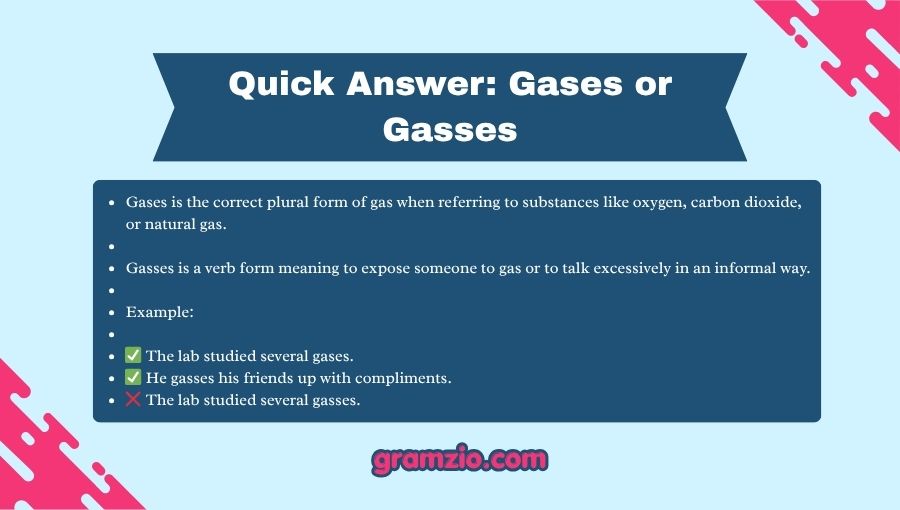
Gases is the correct plural form of gas when referring to substances like oxygen, carbon dioxide, or natural gas.
Gasses is a verb form meaning to expose someone to gas or to talk excessively in an informal way.
Example:
✅ The lab studied several gases.
✅ He gasses his friends up with compliments.
❌ The lab studied several gasses.
Understanding the Basics: Gases or Gasses
The confusion comes from the fact that both words are real English words, but they perform different jobs in a sentence.
| Form | Type | Meaning | Example | Correct/Incorrect |
|---|---|---|---|---|
| Gases | Noun (plural) | Multiple kinds of gas substances | The scientist examined gases. | ✅ Correct |
| Gasses | Verb | To expose to gas or talk excessively | She gasses everyone up. | ✅ Correct in verb use |
| Gasses | Noun | Incorrect plural of gas | Different gasses escaped. | ❌ Incorrect |
Core Difference
Think of it this way:
- Gases = things
- Gasses = action
That simple trick can prevent most mistakes. 🎯
Correct Meanings & Uses
Gases as a Plural Noun
Gases refers to more than one gas substance.
Examples:
✅ Oxygen and helium are important gases.
✅ Harmful gases entered the atmosphere.
✅ Scientists measured greenhouse gases.
Sentence breakdown:
Scientists → subject
measured → action
greenhouse gases → object
Since multiple gas substances are discussed, the plural noun gases is needed.
Test Tip 💡
Ask yourself:
“Am I talking about more than one gas substance?”
If yes, choose gases.
Gasses as a Verb
The word gasses functions as a verb.
Examples:
✅ The factory gasses waste materials.
✅ He gasses up his teammates before games.
Sentence breakdown:
Subject: He
Verb: gasses up
Object: teammates
The word describes an action, not a thing.
Test Tip 💡
Replace the word with another action:
“He talks up his teammates.”
If it still works as an action, gasses may be correct.
Informal Meaning: “Gasses Someone Up”
Modern slang sometimes uses gasses up.
Meaning:
To overpraise or hype someone.
Example:
✅ Social media often gasses people up.
This is especially common online. 📱
Case Study Section
Imagine a workplace email:
Incorrect:
“Several dangerous gasses leaked from the storage area.”
A manager reads it and notices the mistake immediately.
Correct:
“Several dangerous gases leaked from the storage area.”
Why?
Because the sentence refers to multiple substances, not an action.
Small spelling differences can affect credibility. In scientific or professional writing, accuracy matters.
Grammar Rules Explanation
English spelling rules can seem confusing because some words double consonants while others do not.
According to grammar standards and dictionary authorities such as Merriam-Webster, the plural of gas is:
gas → gases
Examples:
- class → classes
- bus → buses
- gas → gases
The extra -es creates a natural pronunciation.
Why not gasses?
Because gasses already developed a separate grammatical role as a verb.
English sometimes creates words that look similar but serve different functions.
Examples:
- practices (noun)
- practices (verb)
Context determines meaning.
Why Does the Mistake Happen?
Several factors create confusion.
1. Fast Typing ⌨️
People often type quickly and accidentally add extra letters.
Example:
gas → gasses
2. Autocorrect Problems 📱
Technology does not always understand context.
A phone might suggest the wrong form.
3. Lack of Grammar Knowledge 📚
Many people assume every word ending in s follows identical plural rules.
English rarely behaves that simply.
Common Mistakes
Here are grammar confusions similar to Gases or Gasses:
| Confusion | Correct Difference |
|---|---|
| Its / It’s | Possession vs contraction |
| Your / You’re | Possession vs “you are” |
| Affect / Effect | Verb vs noun |
| Then / Than | Time vs comparison |
| Lose / Loose | Misplace vs not tight |
| Gases / Gasses | Noun vs verb |
These mistakes happen because words sound similar but function differently.
Usage in Different Contexts
Everyday Conversation 🗣️
People usually say:
✅ Different gases exist in Earth’s atmosphere.
Not:
❌ Different gasses exist.
Professional Writing 💼
Business and technical writing requires accuracy.
Example:
✅ Toxic gases require careful monitoring.
Professional documents should avoid grammar errors.
Creative Writing ✍️
Authors may use either form depending on meaning.
Example:
“Strange gases floated through the cave.”
Or:
“The villain gasses the room.”
Social Media and Texting 📲
Internet slang sometimes changes usage.
Example:
“Bro gasses everybody up.”
This verb use is increasingly common.
Why It Matters (Important)
Choosing gases instead of gasses may seem like a tiny difference, but words shape communication.
Clarity
Correct words prevent misunderstanding.
Professionalism
Spelling affects credibility.
Accuracy
Precise writing matters online and offline.
As writer William Zinsser once suggested:
“Clutter is the disease of writing.”
Clear language removes confusion.
Small details create stronger communication. 🌟
Special Exception
There are a few unusual situations.
Slang Exception
In casual speech:
“He gasses me up.”
This does not involve chemistry.
It means encouraging or praising someone.
Rare Technical Use
In specialized contexts:
“The chamber gasses the specimen.”
Again, this is an action verb.
Outside those cases, plural references use gases.
Quick Recap Checklist
| Question | If Yes → Use |
|---|---|
| Talking about multiple gas substances? | Gases |
| Describing an action involving gas? | Gasses |
| Referring to praise or hype slang? | Gasses |
| Writing about science? | Gases |
Practice examples:
- Scientists examined several ______.
Answer: gases - Social media sometimes ______ celebrities up.
Answer: gasses - Toxic ______ escaped from the factory.
Answer: gases
Frequently Asked Questions (FAQs)
Is gases the correct plural of gas?
Yes. Gases is the standard plural noun form of gas.
Why does gasses exist?
Gasses exists as a verb. It means exposing something to gas or informally praising someone.
Is “different gasses” wrong?
Usually yes. If referring to multiple substances, use different gases.
Can gasses ever be correct?
Yes. It is correct when used as a verb.
Example:
“He gasses up his teammates.”
Why do people confuse gases and gasses?
Reasons include:
- Fast typing
- Autocorrect
- Similar pronunciation
- Grammar uncertainty
Is gases used in scientific writing?
Absolutely. Science writing consistently uses gases as the plural noun.
Example:
“Greenhouse gases contribute to climate change.”
Conclusion
The Gases or Gasses debate becomes easy once you understand the grammar behind it. Gases is the plural noun used for multiple gas substances. Gasses is a verb describing an action, such as exposing something to gas or hyping someone up in casual speech.
Most of the time, if you are discussing science, chemistry, the environment, or everyday substances, gases is the word you want. Remember the quick rule: things equal gases; actions equal gasses.
Language is full of small details, but mastering these details strengthens your writing and improves your confidence. ✨
The next time you hesitate between Gases or Gasses, you will know exactly which one belongs on the page.
Also read: Agreed vs Agree

Hi, I’m Axton Vane. I work at gramzio.com and bring over 11 years of experience in professional grammar. I specialize in refining complex syntax to help writers achieve perfect clarity in every sentence.