Dammit vs Damn It: What’s the Difference and Which One Should You Use? 🤔
Have you ever typed “dammit” in a text message and suddenly wondered whether it should actually be written as “damn it”? You are not alone. Many English speakers get confused between dammit vs damn it because both expressions sound almost identical in everyday speech. 😅
The confusion becomes even more common in texting, social media posts, movies, and casual conversations where fast typing and spoken pronunciation blur the difference. Some people think “dammit” is simply a misspelling, while others believe it is a completely separate word.
In reality, both forms are connected, but they are used slightly differently depending on tone, style, and context. Understanding when to use each expression can improve your writing clarity and help you sound more natural in both casual and professional communication.
This guide will explain everything you need to know about dammit vs damn it, including meanings, grammar rules, common mistakes, practical examples, and professional usage tips. By the end, you will know exactly which form fits your sentence best. ✅
Quick Answer: Dammit vs Damn It
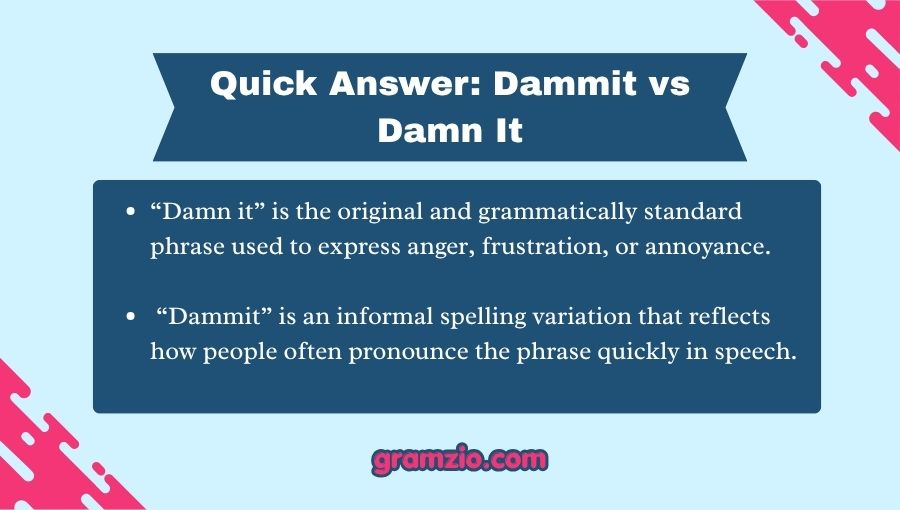
- “Damn it” is the original and grammatically standard phrase used to express anger, frustration, or annoyance.
- “Dammit” is an informal spelling variation that reflects how people often pronounce the phrase quickly in speech.
In formal writing, “damn it” is usually preferred. In casual texting, dialogue, or creative writing, “dammit” is widely accepted. 👍
Understanding the Basics of Dammit vs Damn It
The core difference between dammit vs damn it is mostly about formality and spelling style rather than meaning.
- Damn it = the traditional two-word phrase
- Dammit = a shortened, informal variation based on pronunciation
Both expressions communicate frustration, disappointment, irritation, or anger.
Comparison Table
| Form | Type | Meaning | Example | Correct/Incorrect |
|---|---|---|---|---|
| Damn it | Standard phrase | Expression of frustration | “Damn it, I forgot my keys.” | Correct |
| Dammit | Informal variation | Casual emotional expression | “Dammit, my phone died.” | Correct in informal writing |
| Damnit | Misspelling | Incorrect form | “Damnit, I’m late.” | Incorrect |
| Dam it | Different meaning | Refers to a physical dam | “The workers repaired the dam.” | Correct but unrelated |
Correct Meanings and Uses
What Does “Damn It” Mean? 😤
“Damn it” is an exclamation used to express strong frustration, anger, annoyance, or disappointment.
The phrase combines:
- Damn → a curse word or expression of condemnation
- It → refers to the frustrating situation
Examples
- “Damn it, I missed the train again.”
- “Damn it, why is the internet so slow?”
- “He whispered, ‘Damn it,’ under his breath.”
Sentence Breakdown
In the sentence:
“Damn it, I forgot the report.”
The speaker is reacting emotionally to forgetting the report.
Test Tip ✅
If the phrase sounds like a natural emotional reaction and you are writing formally, use damn it.
What Does “Dammit” Mean? 📱
“Dammit” means exactly the same thing as “damn it,” but it is written as one word to imitate casual pronunciation.
People often say “dammit” quickly, blending the sounds together. Over time, the informal spelling became popular in:
- Text messages
- Social media
- Fiction dialogue
- Informal communication
Examples
- “Dammit, I dropped my coffee.”
- “Oh dammit, not again.”
- “She yelled, ‘Dammit!’ when the screen froze.”
Sentence Breakdown
In:
“Dammit, my battery is dead.”
The emotional meaning is identical to “damn it,” but the tone feels more conversational and relaxed.
Test Tip ✅
If you are writing casual dialogue or texting friends, “dammit” usually sounds more natural.
Case Study Section 📝
Workplace Email Example
Imagine an employee accidentally sends the wrong attachment in a company email.
Incorrect Professional Usage
“Dammit, I attached the wrong file.”
This sounds overly emotional and informal for professional communication.
Better Professional Usage
“I apologize, but I attached the incorrect document.”
Now imagine the same employee texting a close coworker privately:
“Dammit, I sent the wrong file again.”
In casual conversation, this sounds perfectly natural.
Key Lesson
- Use damn it carefully in formal writing
- Use dammit mainly in casual or creative contexts
- Avoid both expressions in highly professional communication unless quoting speech
Grammar Rules Explanation
According to standard English dictionaries such as Merriam-Webster, “damn it” is the traditional phrase form.
“Dammit” developed as an informal spelling variant because spoken English often combines the two words into one sound.
Why “Damn It” Is Grammatically Standard
The phrase is composed of:
- Verb/interjection: “damn”
- Pronoun: “it”
Because they are separate words grammatically, traditional English writing keeps them separated.
Example
- “Damn it, I forgot.”
Here, “it” functions as the object of “damn.”
Why “Dammit” Became Popular
English speakers naturally compress sounds during fast speech.
Instead of saying:
“damn it”
many speakers pronounce it more like:
“dammit”
This pronunciation-inspired spelling eventually became common in informal writing.
Common Mistakes ❌
Why Do People Confuse Dammit vs Damn It?
Several factors cause confusion:
1. Fast Typing ⌨️
People type quickly in texts and social media posts, merging the words automatically.
2. Pronunciation
The spoken phrase naturally sounds like one word.
3. Autocorrect
Phones and apps sometimes accept both spellings.
4. Lack of Grammar Knowledge
Many writers do not realize one form is more formal than the other.
Similar Grammar Confusions Table
| Confusing Pair | Correct Difference |
|---|---|
| It’s vs Its | “It’s” = it is, “Its” = possession |
| Your vs You’re | “Your” = possession, “You’re” = you are |
| Everyday vs Every Day | “Everyday” = common, “Every day” = each day |
| Alright vs All Right | “All right” is traditionally preferred |
| Dammit vs Damn It | “Damn it” = standard, “Dammit” = informal |
Usage in Different Contexts
Everyday Conversation 🗣️
Both forms are common in spoken English.
Examples
- “Damn it, I lost my wallet.”
- “Dammit, the store is closed.”
In speech, there is almost no noticeable difference.
Professional Writing 💼
In professional settings, both expressions should usually be avoided because they may sound offensive or emotionally unprofessional.
Better Alternatives
- “That’s frustrating.”
- “Unfortunately, there was an error.”
- “I’m disappointed with the outcome.”
If you must use the expression in professional writing, “damn it” is the safer grammatical choice.
Creative Writing ✍️
Authors often choose “dammit” in novels and scripts because it reflects realistic speech patterns.
Example
“Dammit, Jack, listen to me!”
This style helps dialogue feel authentic and emotional.
Social Media and Texting 📱
“Dammit” is extremely popular online because it is fast, expressive, and conversational.
Examples
- “Dammit, Monday already?”
- “Dammit 😂 I forgot my password again.”
In casual online communication, the one-word form feels natural.
Why It Matters 🌟
Some people think the difference between dammit vs damn it is unimportant, but correct usage still matters.
1. Clarity in Communication
Using the right form helps readers understand your tone immediately.
2. Professionalism
Correct grammar creates a stronger impression in emails, reports, and formal writing.
3. Writing Accuracy
Understanding standard versus informal forms improves overall language skills.
4. Digital Communication
Online communication moves quickly. Choosing the appropriate style helps match the tone of the platform.
“Good writing is clear thinking made visible.”
Even small grammar choices shape how others perceive your communication.
Special Exception Section ⚠️
When “Dammit” Is Intentionally Preferred
There are situations where “dammit” is the better stylistic choice.
Fiction and Screenwriting
Writers often use “dammit” to reflect emotional speech realistically.
Branding and Entertainment
Some media titles, usernames, or brand names intentionally use “dammit” because it sounds catchy and modern.
Comedy and Internet Culture
Memes and online humor frequently use “dammit” because the informal spelling feels more expressive.
Quick Recap Checklist ✅
| Question | If Yes → Use |
|---|---|
| Are you writing formally? | Damn it |
| Are you texting friends? | Dammit |
| Are you writing realistic dialogue? | Dammit |
| Are you following standard grammar rules? | Damn it |
| Are you writing professionally? | Usually avoid both |
Practice Examples
Example 1
“_____ , I forgot the tickets.”
✅ Correct Answer: Damn it (formal standard)
Example 2
“_____ 😂 my phone just crashed again.”
✅ Correct Answer: Dammit (casual texting)
Example 3
“The actor shouted, ‘_____!’ during the scene.”
✅ Correct Answer: Either works depending on style.
FAQs: Dammit vs Damn It
Is “dammit” a real word?
Yes. “Dammit” is recognized as an informal spelling variation of “damn it.” It is commonly used in casual writing and dialogue.
Which is more correct: dammit or damn it?
“Damn it” is the grammatically standard form. “Dammit” is informal but widely accepted in casual communication.
Can I use “dammit” in professional emails?
It is best to avoid both forms in professional emails because they may sound emotional or offensive.
Why do people spell it “dammit”?
People spell it “dammit” because that reflects how the phrase is commonly pronounced in fast speech.
Is “dammit” slang?
Yes, “dammit” is considered informal slang-style writing based on spoken pronunciation.
Are “dammit” and “damn it” interchangeable?
In meaning, yes. In tone and formality, no. “Damn it” is more formal and traditional, while “dammit” is more casual.
Final Thoughts on Dammit vs Damn It
Understanding dammit vs damn it is easier once you recognize that the difference is mainly about formality and writing style. “Damn it” is the traditional, grammatically standard phrase, while “dammit” is an informal spelling that mirrors natural speech patterns. 😊
In professional or formal writing, “damn it” is generally the safer choice, although avoiding both expressions entirely is often better. In texting, casual conversations, creative writing, and social media, “dammit” feels more natural and expressive.
The key is matching your wording to your audience and context. Good grammar is not only about rules — it is also about tone, clarity, and communication style.
Remember this simple rule:
Formal writing prefers “damn it.” Casual writing often prefers “dammit.”
Mastering small distinctions like this can make your English writing sound clearer, sharper, and more polished every day. ✨
Also read: Afterward vs Afterwards

Hi, I’m Dexter Rhodes. At gramzio.com, I apply my 10 years of experience in copy-editing to ensure every guide we publish is accurate, professional, and follows the highest editorial standards.