Incoming vs Upcoming vs Oncoming: What’s the Difference? 📩🚆
Have you ever paused while writing and wondered about incoming vs upcoming vs oncoming? You are not alone. These three words look similar, sound alike, and all suggest that something is happening soon or moving in some way. Because of that, many English learners and even native speakers confuse them in daily writing and speech.
Imagine writing “upcoming message,” “oncoming event,” or “incoming traffic jam.” These phrases sound strange because each word has a different meaning and should be used in a specific context. Using the wrong one can make your sentence unclear or unnatural.
The good news is that understanding incoming vs upcoming vs oncoming is actually simple once you know the main difference. Incoming usually means arriving now. Upcoming refers to something scheduled in the near future. Oncoming describes something physically moving toward you.
In this complete grammar guide, you will learn meanings, examples, grammar rules, common mistakes, and easy memory tips so you can use these words correctly and confidently every time. 😊
Quick Answer: Incoming vs Upcoming vs Oncoming
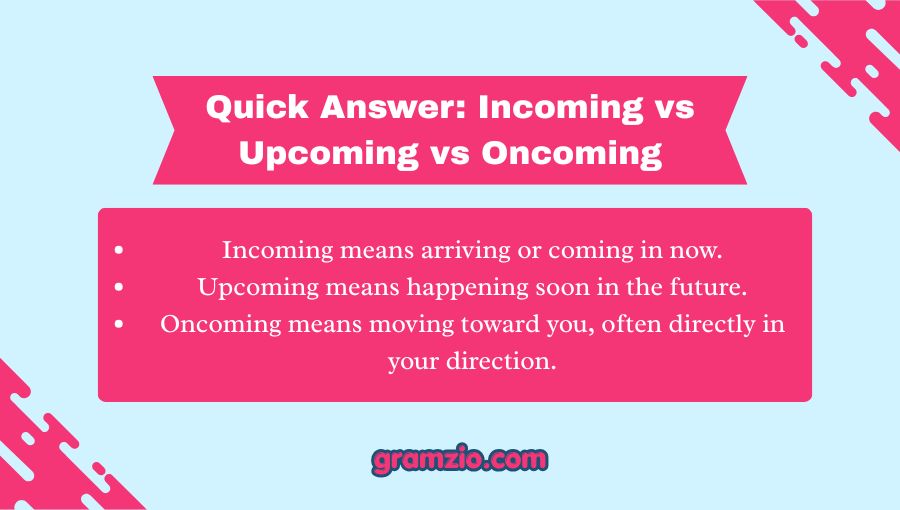
- Incoming means arriving or coming in now.
- Upcoming means happening soon in the future.
- Oncoming means moving toward you, often directly in your direction.
Example:
- Incoming email 📩
- Upcoming meeting 📅
- Oncoming car 🚗
Understanding the Basics of Incoming vs Upcoming vs Oncoming
The easiest way to remember these words is by thinking about direction and time.
| Word | Type | Meaning | Example | Correct/Incorrect |
|---|---|---|---|---|
| Incoming | Adjective | Arriving or coming in | Incoming call | ✅ Correct |
| Upcoming | Adjective | Happening soon | Upcoming event | ✅ Correct |
| Oncoming | Adjective | Coming toward you | Oncoming traffic | ✅ Correct |
| Incoming meeting | Phrase | Sounds unnatural in most cases | Incoming meeting | ❌ Usually Incorrect |
| Oncoming birthday | Phrase | Wrong context | Oncoming birthday | ❌ Incorrect |
| Upcoming package | Phrase | Usually not ideal | Upcoming package | ❌ Usually Incorrect |
Core Difference
- Incoming = Arrival
- Upcoming = Future schedule
- Oncoming = Moving toward you
Correct Meanings & Uses
What Does Incoming Mean?
Incoming describes something that is arriving, entering, or being received.
Common uses:
- Incoming call
- Incoming message
- Incoming students
- Incoming president
- Incoming shipment
Examples
- I answered the incoming call quickly.
- A call was arriving on the phone.
- The company welcomed its incoming CEO.
- A new CEO is about to take office.
- We tracked the incoming package online.
- The package is on the way to us.
Test Tip ✅
If something is being received, entering, or arriving, use incoming.
What Does Upcoming Mean?
Upcoming refers to something expected to happen soon in the future, especially events, plans, or scheduled activities.
Common uses:
- Upcoming exam
- Upcoming concert
- Upcoming holiday
- Upcoming project
- Upcoming release
Examples
- I am preparing for the upcoming exam.
- The exam will happen soon.
- She posted about her upcoming book launch.
- The launch is scheduled soon.
- Our team discussed the upcoming deadline.
- The deadline is approaching in time.
Test Tip ✅
If it is on a calendar or schedule, upcoming is often the right word.
What Does Oncoming Mean?
Oncoming describes something approaching you physically, often in motion.
Common uses:
- Oncoming traffic
- Oncoming train
- Oncoming storm
- Oncoming vehicle
- Oncoming wave
Examples
- He moved aside for the oncoming bus.
- The bus was moving toward him.
- Drivers slowed because of oncoming traffic.
- Cars were coming from the opposite direction.
- We watched the oncoming storm from the porch.
- The storm was approaching.
Test Tip ✅
If something is physically coming toward you, use oncoming.
Case Study Section
Workplace Email Example
Incorrect Email:
Please prepare for the incoming meeting next Friday.
Better Email:
Please prepare for the upcoming meeting next Friday.
Why?
The meeting is scheduled in the future, so upcoming is correct. Incoming would sound odd because the meeting is not “arriving” like a message or package.
Another Example
We are receiving many incoming emails about the upcoming conference.
This sentence uses both words correctly:
- Incoming emails = emails arriving now
- Upcoming conference = future event
Grammar Rules Explanation
According to standard dictionary usage, these words are adjectives formed from verbs and directional ideas.
- Incoming comes from “come in.”
- Upcoming comes from “come up,” meaning approach in time.
- Oncoming comes from “come on,” meaning advance toward.
Why One Form Is Correct
Use the word that matches the noun logically.
- Emails arrive → incoming emails
- Events happen soon → upcoming events
- Cars approach physically → oncoming cars
Why One Form Is Incorrect
Words are not interchangeable just because they look similar.
Example:
- ❌ Oncoming wedding
- ✅ Upcoming wedding
A wedding approaches in time, not in physical motion.
Merriam-Webster and standard English dictionaries define these words with clear distinctions involving arrival, future timing, and movement toward something.
Common Mistakes
Why Mistakes Happen
Many people confuse these words because of:
- Fast typing ⌨️
- Autocorrect errors
- Similar spelling
- Lack of vocabulary knowledge
- Translation from another language
Frequent Errors
| Incorrect Phrase | Correct Phrase | Why |
|---|---|---|
| Incoming event | Upcoming event | Event is future, not arriving |
| Oncoming email | Incoming email | Email arrives |
| Upcoming traffic | Oncoming traffic | Traffic moves toward you |
| Incoming birthday | Upcoming birthday | Birthday is future date |
Similar Grammar Confusions
| Confusing Pair | Correct Use |
|---|---|
| it’s / its | it is / possession |
| your / you’re | possession / you are |
| then / than | time / comparison |
| affect / effect | verb / noun |
| incoming / upcoming | arrival / future |
Usage in Different Contexts
Everyday Conversation
- I got an incoming call.
- My upcoming trip is next week.
- Watch for oncoming traffic.
Professional Writing
- We reviewed all incoming applications.
- Please attend the upcoming training session.
- Staff were warned about oncoming weather conditions.
Creative Writing
- She stared at the oncoming storm.
- He feared the upcoming trial.
- The phone flashed with an incoming message.
Social Media / Texting
- Incoming drama 😂
- So excited for my upcoming vacation 🌴
- Avoid oncoming traffic guys 🚗
Note: Informal speech may bend rules, but formal writing should stay accurate.
Why It Matters
Choosing the correct word matters because language creates clarity.
Clarity in Communication
Wrong word choice can confuse readers.
- “Incoming wedding” sounds strange.
- “Upcoming wedding” is clear.
Professionalism
Correct grammar improves emails, reports, and business communication.
Digital Accuracy
Today, much communication happens online. Precise wording helps avoid misunderstandings in texts, messages, and announcements.
“The right word saves time and prevents confusion.”
Strong writing depends on exact vocabulary.
Special Exception Section
Informal or Humorous Usage
Sometimes people say things like:
- Incoming joke
- Incoming chaos
- Incoming rain
This casual use means “something is about to arrive soon.” It is common in speech or online posts. While informal, it is widely understood.
Example:
Incoming drama in 3…2…1 😂
This is stylistic, not strict formal grammar.
Quick Recap Checklist
| Question | If Yes → Use |
|---|---|
| Is it arriving now? | Incoming |
| Is it scheduled soon? | Upcoming |
| Is it moving toward you? | Oncoming |
| Is it a future event? | Upcoming |
| Is it traffic or a vehicle approaching? | Oncoming |
Practice Examples
- The ___ train was loud.
✅ Oncoming - We planned the ___ seminar.
✅ Upcoming - I ignored the ___ call.
✅ Incoming
FAQs: Incoming vs Upcoming vs Oncoming
What is the main difference between incoming vs upcoming vs oncoming?
Incoming means arriving, upcoming means happening soon, and oncoming means approaching physically.
Can I say incoming event?
Usually no. Upcoming event is the natural phrase because events happen in the future.
Is oncoming only used for traffic?
No. It is common with traffic, but it can also describe storms, trains, waves, or anything moving toward you.
What does incoming mean in business English?
It often refers to things being received, such as incoming calls, incoming payments, or incoming applications.
Can upcoming be used for people?
Sometimes. Example: upcoming actor means a rising or soon-to-be-famous actor.
Why do people say incoming joke online?
It is informal slang meaning something is about to happen or be said soon.
Advanced Usage Tips
Incoming for New Roles
You may hear:
- Incoming president
- Incoming manager
- Incoming freshman
This means a person is about to enter a role or position.
Upcoming for Trends
Writers may say:
- Upcoming artist
- Upcoming talent
This means someone gaining attention soon.
Oncoming for Danger
Often used when warning people:
- Oncoming traffic
- Oncoming storm
- Oncoming danger
This creates urgency.
Memory Tricks 🧠
Incoming = In
Think: coming in to you.
Upcoming = Up Ahead in Time
Think: next on the calendar.
Oncoming = On Toward You
Think: moving straight at you.
Mini Quiz
Choose the correct word.
- We are excited about the ___ vacation.
Answer: Upcoming - The driver stopped for ___ traffic.
Answer: Oncoming - She answered the ___ call.
Answer: Incoming - The company welcomed its ___ director.
Answer: Incoming - Everyone prepared for the ___ festival.
Answer: Upcoming
Conclusion
Understanding incoming vs upcoming vs oncoming is easier than it first appears. The key is to focus on meaning. Use incoming for something arriving or being received, such as calls, messages, or new staff. Use upcoming for events, deadlines, and plans that will happen soon. Use oncoming for things physically moving toward you, especially traffic, storms, or vehicles.
These small vocabulary choices make a big difference in clear communication. They help your writing sound polished, natural, and professional. When in doubt, ask yourself one simple question: Is it arriving, scheduled, or approaching me?
That one question will guide you to the right answer almost every time. ✨
Master these three words today, and your English will instantly become sharper tomorrow.
Also read: Become vs Became

Hi, I’m Elara Quinn. Working at gramzio.com, I use my 8 years of experience in linguistics to simplify difficult English rules, making them accessible and easy to learn for our global community.