Froze vs Frozen: The Complete Grammar Guide You Need to Stop Getting Confused 😅❄️
If you’ve ever paused while writing and wondered whether to use “froze vs frozen”, you’re definitely not alone. This pair of words confuses many English learners, students, and even native speakers because both come from the same verb freeze, yet they are used in completely different grammatical situations. The difference is subtle but very important for clear and correct English communication.
Understanding froze vs frozen is not just about memorizing forms—it’s about knowing how English tenses and sentence structures work. Using the wrong form can easily make your writing sound incorrect, especially in professional emails, academic writing, or everyday communication.
In this complete guide, you will learn everything about froze vs frozen, including meanings, grammar rules, real-life examples, common mistakes, and simple memory tricks. By the end, you’ll confidently know exactly when to use each form and how to avoid confusion forever. ✨
Quick Answer: Froze vs Frozen
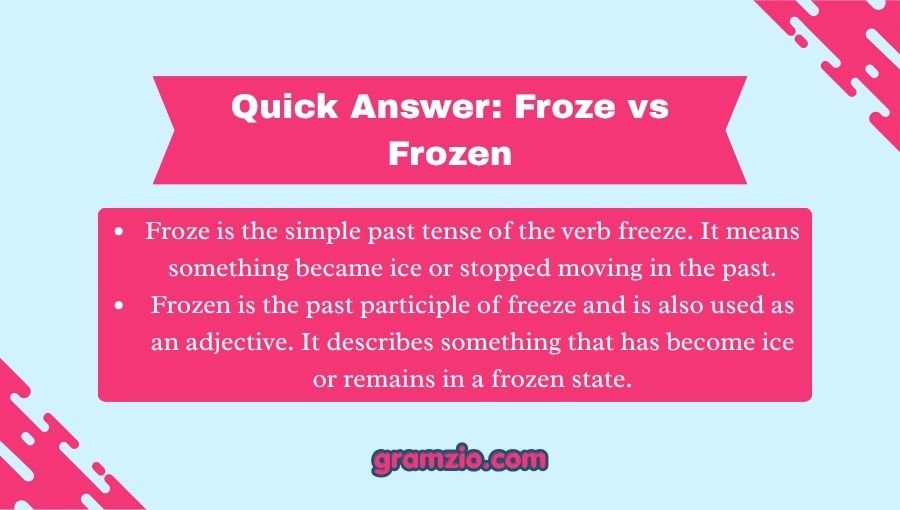
The difference between froze and frozen is based on verb tense.
- Froze is the simple past tense of the verb freeze. It means something became ice or stopped moving in the past.
- Frozen is the past participle of freeze and is also used as an adjective. It describes something that has become ice or remains in a frozen state.
👉 In short:
- Froze = action in the past
- Frozen = completed state or description
Example:
- The lake froze last night. ❄️ (past action)
- The lake is frozen now. 🧊 (current state)
Understanding the Basics of Froze vs Frozen
To truly understand froze vs frozen, you need to understand how English verbs work. The verb freeze has three main forms:
| Base Form | Past Tense | Past Participle |
|---|---|---|
| freeze | froze | frozen |
Let’s break it down:
1. Freeze (Base Form)
Used in present or general situations.
- Water freezes at 0°C.
2. Froze (Past Simple)
Used for completed actions in the past.
- The pipes froze last winter.
3. Frozen (Past Participle / Adjective)
Used with helping verbs or as a description.
- The pond is frozen.
- The food has frozen.
Comparison Table: Froze vs Frozen
| Form | Type | Meaning | Example Sentence | Correct/Incorrect |
|---|---|---|---|---|
| Froze | Past tense | Something became ice in the past | The river froze overnight. | Correct ✔️ |
| Frozen | Past participle | Something in a frozen state | The river is frozen today. | Correct ✔️ |
| Froze | Adjective | ❌ Incorrect usage | The river is froze today. | Incorrect ❌ |
| Frozen | Verb alone | ❌ Cannot replace past tense | I frozen the water yesterday. | Incorrect ❌ |
Correct Meanings & Uses
1. Using “Froze” (Simple Past) ❄️
“Froze” describes something that happened and finished in the past.
Examples:
- The temperature dropped and the lake froze overnight.
- I froze when I heard the loud noise.
- His computer froze during the update.
👉 Sentence breakdown:
- Subject: The lake
- Action: froze
- Time: overnight (past indicator)
💡 Test Tip:
If you can add words like yesterday, last night, last year, use froze.
2. Using “Frozen” (Past Participle / Adjective) 🧊
“Frozen” is used to describe a state or condition.
Examples:
- The lake is completely frozen.
- She has frozen vegetables in her freezer.
- My hands were frozen after the walk.
👉 Sentence breakdown:
- “is frozen” = current state
- “has frozen” = completed action with result
💡 Test Tip:
If you are describing how something is now, use frozen.
Case Study: Real-Life Usage Example 📧
Workplace Email Example
❌ Incorrect:
The system has froze and we cannot access data.
✔️ Correct:
The system has frozen and we cannot access data.
Why?
“Has” requires a past participle, not a simple past tense. So frozen is correct.
Grammar Rules Behind Froze vs Frozen 📘
To understand this deeply, let’s refer to standard English grammar principles recognized by dictionaries like Merriam-Webster and Cambridge English.
Rule 1: Froze = Simple Past Verb
Used without helping verbs:
- She froze in fear.
Rule 2: Frozen = Past Participle
Used with:
- Has / have / had
- Is / was / were
Examples:
- The food has frozen.
- The lake is frozen.
Rule 3: Frozen = Adjective
Used to describe nouns:
- Frozen food 🍕
- Frozen lake ❄️
Common Mistakes with Froze vs Frozen ❌
People often confuse these words for several reasons:
- Fast typing ⌨️
- Autocorrect errors 📱
- Lack of grammar knowledge 📚
- Spoken English confusion 🗣️
Common Confusion Table
| Confusing Pair | Correct Usage Example |
|---|---|
| it’s / its | It’s raining vs The cat licked its paw |
| your / you’re | You’re right vs Is this your book? |
| froze / frozen | The lake froze vs The lake is frozen |
| lose / loose | I lose keys vs Loose shirt |
Usage in Different Contexts
1. Everyday Conversation 🗣️
- I froze when I saw the dog.
- My drink is frozen.
2. Professional Writing 💼
- The database has frozen due to an error.
- The system froze during testing.
3. Creative Writing ✍️
- She froze like a statue in the dark.
- The world felt frozen in time.
4. Social Media Texting 📱
- My phone froze again 😩
- This smoothie is frozen and perfect 🧊
Why It Matters (Important Section) ⭐
Using froze vs frozen correctly improves:
- Clarity in communication
- Professional impression
- Grammar accuracy
- Writing confidence
📌 As communication expert George Orwell said:
“Good writing is clear thinking made visible.”
Incorrect grammar can confuse readers or make writing look unpolished.
Special Exception Section
There are no major exceptions for froze vs frozen, but note:
- “Frozen” is widely used as a brand name, such as Frozen (Disney movie) ❄️
- In titles, grammar rules may not strictly apply.
Quick Recap Checklist ✅
| Question | If Yes → Use |
|---|---|
| Is it past action? | Froze |
| Is it describing current state? | Frozen |
| Used with has/have/had? | Frozen |
| Used alone in past sentence? | Froze |
Practice Examples:
- The pipe ___ last night. → froze
- The water is ___ today. → frozen
- She ___ during the speech. → froze
FAQs: Froze vs Frozen ❓
1. What is the main difference between froze and frozen?
“Froze” is past tense, while “frozen” is past participle or adjective.
2. Is it correct to say “I have froze”?
No. The correct form is “I have frozen.”
3. Can frozen be used alone in a sentence?
Yes, but usually as an adjective (e.g., The lake is frozen).
4. Why do people confuse froze and frozen?
Because both come from the same verb “freeze” and sound similar in speech.
5. Is frozen always correct with “has” or “have”?
Yes, you should always use “frozen” with has/have/had.
6. What is an easy trick to remember?
Think:
- Froze = finished action in past
- Frozen = still in that state
Conclusion
Understanding froze vs frozen is essential for clear and correct English communication. While both words come from the same verb freeze, they serve very different grammatical roles. Froze is used for actions completed in the past, while frozen is used for describing states or forming perfect tenses.
By mastering this difference, your writing becomes more accurate, natural, and professional. Whether you’re writing emails, essays, or everyday messages, using the correct form helps you communicate with confidence.
So next time you think about ice, cold weather, or something stopping suddenly—remember this simple rule:
👉 Action in the past = froze
👉 State or description = frozen ❄️
Keep practicing, and soon this confusion will be completely frozen out of your grammar mistakes! 🧊
Also read: Appreciative of vs Appreciative for

Hi, I’m Willa Sterling. I work at gramzio.com as a senior editor. With 15 years of experience in academic and formal grammar, I provide the expert insights you need to make your writing flawless.