Proud for You vs Proud of You: The Complete Grammar Guide 😊
Have you ever typed a message like “I’m proud for you!” and then paused, wondering if it actually sounds right? 🤔 You’re not alone. The confusion between “proud for you” vs “proud of you” is more common than you might think, especially in fast-paced digital conversations.
At first glance, both phrases seem similar. They both express happiness, appreciation, and emotional support. But here’s the truth: only one of them is grammatically correct in standard English. The other may sound acceptable in casual speech, but it doesn’t follow proper grammar rules.
Understanding the difference is important, especially if you want to communicate clearly and professionally. Whether you’re writing an email, sending a congratulatory message, or posting on social media, choosing the correct phrase makes a strong impression.
In this detailed guide, we’ll break down everything you need to know about “proud for you” vs “proud of you”, using simple explanations, examples, and practical tips. Let’s clear up the confusion once and for all! ✨
Quick Answer Section: Proud for You vs Proud of You
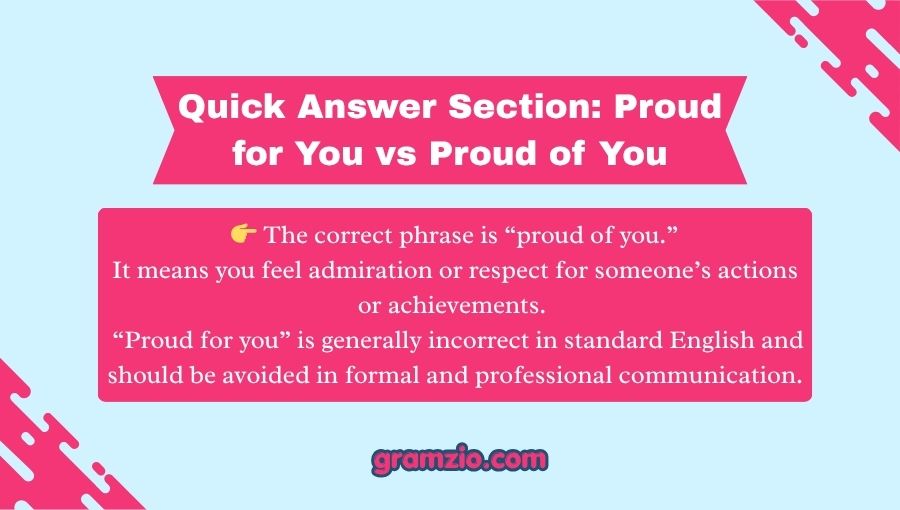
👉 The correct phrase is “proud of you.”
It means you feel admiration or respect for someone’s actions or achievements. 🎉
❌ “Proud for you” is generally incorrect in standard English and should be avoided in formal and professional communication.
Understanding the Basics: Proud for You vs Proud of You
The difference comes down to preposition usage, which plays a big role in English grammar.
Comparison Table
| Form | Type | Meaning | Example | Correct/Incorrect |
|---|---|---|---|---|
| Proud of you | Adjective phrase | Feeling admiration for someone | I’m proud of you for graduating 🎓 | ✅ Correct |
| Proud for you | Incorrect usage | Non-standard or awkward expression | I’m proud for you | ❌ Incorrect |
💡 Key Insight:
The adjective “proud” is always followed by “of”, not “for,” when referring to a person.
Correct Meanings & Uses
✅ “Proud of You” — The Correct Form
When you say “proud of you,” you’re expressing admiration, respect, or approval. 💯
Examples:
- I’m proud of you for finishing your project. 🏆
- Your parents must be proud of you. ❤️
- We are proud of you for your hard work.
Sentence Breakdown:
- Subject: I
- Verb: am
- Adjective: proud
- Preposition: of
- Object: you
✔ This structure is grammatically correct and widely accepted.
❌ “Proud for You” — Why It’s Incorrect
“Proud for you” may sound okay in casual speech, but it doesn’t follow standard grammar rules.
Why it feels wrong:
- The preposition “for” does not correctly connect “proud” with a person.
- It creates an awkward or unclear meaning.
Incorrect Example:
- ❌ I’m proud for you.
👉 It may be confused with expressions like:
- “I’m happy for you” 😊
- “I feel excited for you” 🎉
These are correct because “happy” and “excited” can take “for,” but “proud” cannot.
✅ Test Tip 🧠
If you can replace the phrase with “admire you,” then use “proud of you.”
✔ I admire you → I’m proud of you
❌ I admire for you → I’m proud for you (incorrect)
Case Study Section 📧
Real-Life Example: Workplace Email
Incorrect Version:
Hi Sarah,
I’m proud for you on completing the presentation.
Best,
John
❌ This sounds unnatural and slightly unprofessional.
Correct Version:
Hi Sarah,
I’m proud of you for completing the presentation. Great job! 🎉
Best,
John
✔ This version is clear, professional, and grammatically correct.
Grammar Rules Explanation 📚
According to standard grammar authorities like Merriam-Webster, adjectives often pair with specific prepositions.
👉 The adjective “proud” requires the preposition “of.”
Rule:
- Proud + of + person/thing
✔ Examples:
- She is proud of her son.
- They are proud of their achievements.
❌ Incorrect pairing:
- Proud + for (when referring to a person)
Common Mistakes Section 🚫
Why Do People Say “Proud for You”?
Here are the main reasons:
- ⌨️ Fast typing
- 📱 Autocorrect errors
- 🤷 Lack of grammar awareness
- 🗣️ Influence from similar phrases like “happy for you”
Table of Similar Grammar Confusions
| Incorrect Pair | Correct Pair |
|---|---|
| It’s / Its | Know the difference |
| Your / You’re | Use properly |
| Then / Than | Context matters |
| Affect / Effect | Meaning differs |
| Proud for you | Proud of you |
Usage in Different Contexts 🌍
1. Everyday Conversation
- I’m proud of you for trying your best 😊
2. Professional Writing
- We are proud of you for your contribution to the team.
3. Creative Writing
- She whispered, “I’m proud of you,” with tears in her eyes.
4. Social Media / Texting
- So proud of you!! 🎉🔥
Why It Matters 💡
Using the correct phrase improves:
- ✅ Clarity in communication
- ✅ Professionalism
- ✅ Writing accuracy
📌 Quote:
“Good grammar is credibility.” — It reflects how clearly you think and communicate.
Special Exception Section ⚠️
There are no standard grammar exceptions where “proud for you” is considered correct.
However, in rare cases:
- It may appear in informal speech
- It might be used stylistically in creative writing
Still, it is not recommended in correct English usage.
Quick Recap Checklist ✅
| Question | If Yes → Use |
|---|---|
| Are you expressing admiration for someone? | Proud of you |
| Are you writing professionally? | Proud of you |
| Are you unsure about grammar correctness? | Proud of you |
Practice Examples 📝
- I’m proud ___ you. → of
- We are proud ___ your success. → of
- She felt proud ___ her team. → of
FAQs: Proud for You vs Proud of You❓
1. Is “proud for you” ever correct?
No, it is not considered correct in standard English.
2. Why do people say “proud for you”?
Because they confuse it with phrases like “happy for you.”
3. What is the correct phrase?
The correct phrase is “proud of you.”
4. Can I use “proud for you” in casual texting?
You can, but it is not grammatically correct and should be avoided.
5. Is “proud of you” formal or informal?
It works in both formal and informal contexts.
6. What preposition always follows “proud”?
The correct preposition is “of.”
Conclusion
The difference between “proud for you” vs “proud of you” is simple but important. While both may sound similar, only “proud of you” is grammatically correct and widely accepted in English. It clearly expresses admiration, respect, and appreciation for someone’s achievements.
On the other hand, “proud for you” is non-standard and should be avoided, especially in professional or formal communication.
By understanding this small but powerful grammar rule, you can improve your writing, sound more confident, and communicate more clearly. ✨
👉 Final takeaway:
Whenever you want to express admiration, always say — “I’m proud of you.” 💯
Also read: Passerbyers vs Passersby

Hi, I’m Grayson Finch. I’m part of the gramzio.com team with 9 years of experience in grammar education. I am dedicated to teaching professional communication and helping you master the art of writing.