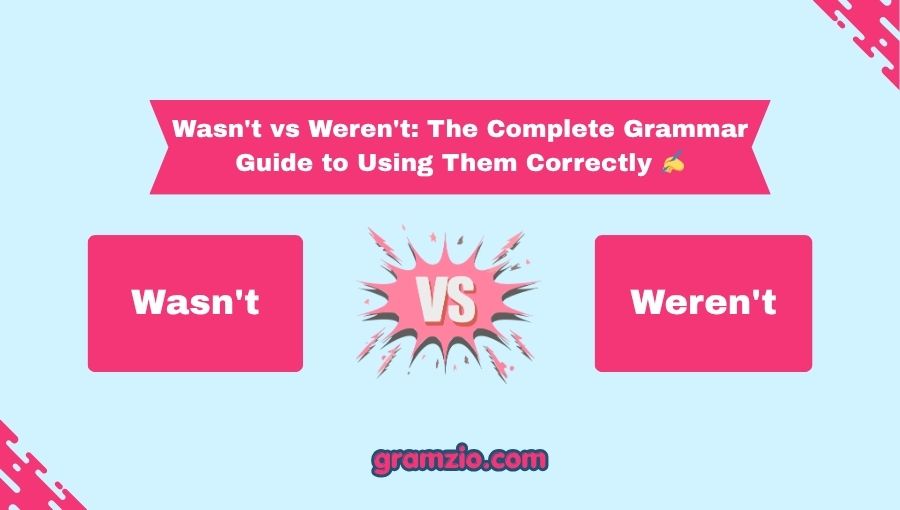
Wasn’t vs Weren’t: The Complete Grammar Guide to Using Them Correctly ✍️
The confusion between Wasn’t vs Weren’t is very common for English learners and even native speakers. Many people stop for a moment while writing and wonder which one is correct. Although both words are negative forms of the past tense verb to be, they are used in different grammatical situations, which often leads to mistakes.
Have you ever paused while writing a message and wondered, Should I write “wasn’t” or “weren’t”? 🤔 You are not alone. These two words look similar, sound related, and both refer to the past, which makes them easy to mix up.
The Wasn’t vs Weren’t question appears because each word follows a different subject-verb agreement rule. Using the wrong form can make a sentence sound incorrect or unprofessional.
For example:
❌ She weren’t ready.
✅ She wasn’t ready.
Small grammar differences like this can significantly affect clarity, confidence, and communication quality. In this guide, you will learn the exact difference between Wasn’t vs Weren’t, along with rules, examples, mistakes, and practical usage tips to master it easily.
Quick Answer: Wasn’t vs Weren’t
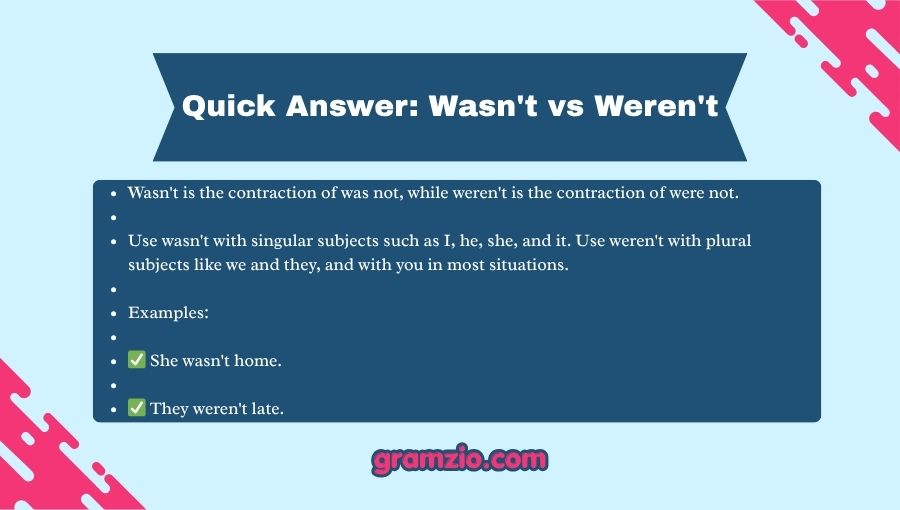
Wasn’t is the contraction of was not, while weren’t is the contraction of were not.
Use wasn’t with singular subjects such as I, he, she, and it. Use weren’t with plural subjects like we and they, and with you in most situations.
Examples:
✅ She wasn’t home.
✅ They weren’t late.
Understanding the Basics: Wasn’t vs Weren’t
The core difference is simple:
- Wasn’t = was not
- Weren’t = were not
The choice depends on the subject of your sentence.
| Form | Type | Meaning | Example | Correct/Incorrect |
|---|---|---|---|---|
| Wasn’t | Contraction | Was not | He wasn’t tired | ✅ Correct |
| Weren’t | Contraction | Were not | They weren’t tired | ✅ Correct |
| Weren’t | Wrong singular usage | Incorrect with he/she/it | She weren’t ready | ❌ Incorrect |
| Wasn’t | Wrong plural usage | Incorrect with they/we | They wasn’t happy | ❌ Incorrect |
Think of it this way:
Singular → wasn’t
Plural → weren’t
Simple and effective ✔️
Correct Meanings & Uses
Using “Wasn’t”
Use wasn’t with:
- I
- He
- She
- It
- Singular nouns
Examples:
✅ I wasn’t feeling well yesterday.
Breakdown:
- Subject: I
- Past tense verb: was
- Negative form: was not → wasn’t
Another example:
✅ The movie wasn’t interesting.
Subject = movie (singular)
Correct choice = wasn’t
Test Tip 💡
Replace the contraction:
If was not sounds correct, use wasn’t.
Example:
The dog was not hungry.
→ The dog wasn’t hungry.
Works perfectly.
Using “Weren’t”
Use weren’t with:
- You
- We
- They
- Plural nouns
Examples:
✅ They weren’t at school.
Breakdown:
Subject = they
Past verb = were
Negative form = were not
Another example:
✅ The students weren’t ready.
Plural subject = students
Correct choice = weren’t
Test Tip 💡
Expand the contraction:
If were not sounds natural, use weren’t.
Special Note: “You” Always Uses Were
Even if you refers to one person:
✅ You weren’t listening.
Not:
❌ You wasn’t listening.
This rule surprises many learners.
Case Study Section: Real-Life Workplace Example 📧
Imagine this workplace email:
Incorrect Email:
“The client weren’t satisfied with the presentation, and the manager wasn’t aware of the issue.”
Something feels off.
Why?
Client is singular.
Correct version:
Correct Email:
“The client wasn’t satisfied with the presentation, and the managers weren’t aware of the issue.”
Notice the difference:
Singular noun → wasn’t
Plural noun → weren’t
This small correction makes writing more professional and easier to understand.
Grammar Rules Explanation
According to standard English grammar references such as Merriam-Webster, was and were are past-tense forms of the verb to be.
Rules:
Was is used with:
- I
- He
- She
- It
- Singular nouns
Were is used with:
- You
- We
- They
- Plural nouns
Negative contractions follow the same pattern:
| Positive | Negative |
|---|---|
| Was | Wasn’t |
| Were | Weren’t |
Examples:
✅ She was here.
✅ She wasn’t here.
✅ They were late.
✅ They weren’t late.
Grammar consistency keeps sentences correct.
Common Mistakes 🚫
People confuse Wasn’t vs Weren’t for several reasons:
Fast typing
People write quickly and choose the wrong form.
Autocorrect
Technology sometimes replaces words unexpectedly.
Lack of grammar knowledge
Some speakers learn phrases by sound instead of rules.
Similar Grammar Confusions
| Confusing Pair | Correct Difference |
|---|---|
| It’s / Its | It’s = it is; Its = possession |
| Your / You’re | Your = ownership; You’re = you are |
| Their / There | Different meanings |
| To / Too | Too means also |
| Wasn’t / Weren’t | Depends on subject |
Examples:
❌ They wasn’t ready.
✅ They weren’t ready.
❌ He weren’t home.
✅ He wasn’t home.
Usage in Different Contexts
Everyday Conversation 🗣️
People commonly use contractions in speech.
Examples:
“I wasn’t hungry.”
“They weren’t interested.”
Contractions make speech sound natural.
Professional Writing 💼
Formal communication values accuracy.
Example:
“The reports weren’t submitted on time.”
Correct grammar creates credibility.
Creative Writing 📚
Authors use contractions to create realistic dialogue.
Example:
“I wasn’t expecting you,” Sarah whispered.
Social Media and Texting 📱
People often shorten sentences online.
“You weren’t kidding 😂”
Even casual writing benefits from proper grammar.
Why It Matters ⭐
Some people think grammar rules are small details. They are not.
Correct usage affects:
Clarity in communication
Readers understand your message instantly.
Professionalism
Correct writing creates a stronger impression.
Accuracy in digital communication
Emails, messages, and social media posts become easier to read.
Consider this quote:
“Good grammar is the foundation of clear communication.”
A single word choice can change how readers perceive your writing.
Special Exception
There is one interesting exception: the subjunctive mood.
English sometimes uses were even with singular subjects when discussing hypothetical situations.
Examples:
✅ If I were rich, I would travel the world.
Not:
❌ If I was rich…
Negative version:
✅ If she weren’t busy, she could help.
This is a special grammar structure and not ordinary past tense usage.
Quick Recap Checklist ✔️
| Question | If Yes → Use |
|---|---|
| Is the subject he, she, it, I, or singular? | Wasn’t |
| Is the subject they, we, you, or plural? | Weren’t |
| Is it hypothetical using “if”? | Usually weren’t/were |
| Does “was not” fit naturally? | Wasn’t |
| Does “were not” fit naturally? | Weren’t |
Practice Examples
- She ___ at school yesterday.
Answer: wasn’t
- They ___ invited.
Answer: weren’t
- We ___ prepared for the meeting.
Answer: weren’t
FAQs: Wasn’t vs Weren’t
1. Is “I weren’t” ever correct?
Usually no. Standard grammar requires:
✅ I wasn’t
However, some dialects may use I weren’t informally.
2. Why does “you” use weren’t?
English always pairs you with were in past tense, whether singular or plural.
✅ You weren’t late.
3. Can “weren’t” be used with singular nouns?
Normally no.
Exception:
Hypothetical situations:
“If he weren’t busy…”
4. Is “wasn’t” formal or informal?
Wasn’t is a contraction and slightly informal.
Formal writing may use:
“was not”
5. Why do people confuse wasn’t and weren’t?
Reasons include:
- speech habits
- typing speed
- regional dialects
- lack of grammar instruction
6. Which is more common in conversation?
Both are common because each serves a different purpose depending on the subject.
Conclusion
The Wasn’t vs Weren’t debate becomes easy once you understand the subject rule. Use wasn’t with singular subjects like he, she, it, and I. Use weren’t with plural subjects and you. The choice depends entirely on grammar agreement.
Remember the shortcut:
Singular = wasn’t
Plural = weren’t
Also watch for special situations like hypothetical statements using were and weren’t.
Grammar may seem like a collection of tiny details, but small details create powerful writing. Mastering one distinction at a time improves your confidence, clarity, and communication skills. ✨
The next time you hesitate between Wasn’t vs Weren’t, you will know exactly which one belongs in your sentence.
Also read: Northeast vs North-East vs North East

Hi, I’m Axton Vane. I work at gramzio.com and bring over 11 years of experience in professional grammar. I specialize in refining complex syntax to help writers achieve perfect clarity in every sentence.