Listen to Music vs Listen to the Music 🎵 Which One Is Correct and When Should You Use It?
Listen to Music vs Listen to the Music is a common English grammar confusion that many learners face while speaking or writing. 🎧 At first, both phrases look almost identical, but the small difference of the article “the” changes the meaning completely.
Have you ever paused while writing a sentence and wondered which one is correct? You are not alone. Many English learners and even native speakers get confused by these two expressions because they seem interchangeable.
In reality, English articles like “a,” “an,” and “the” play a very important role in showing whether we are talking about something general or specific. That tiny word “the” can shift the entire meaning of a sentence.
Understanding the difference between Listen to Music vs Listen to the Music helps you write more naturally, improve fluency, and avoid common grammar mistakes in everyday communication, emails, and academic writing.
Quick Answer: Listen to Music vs Listen to the Music
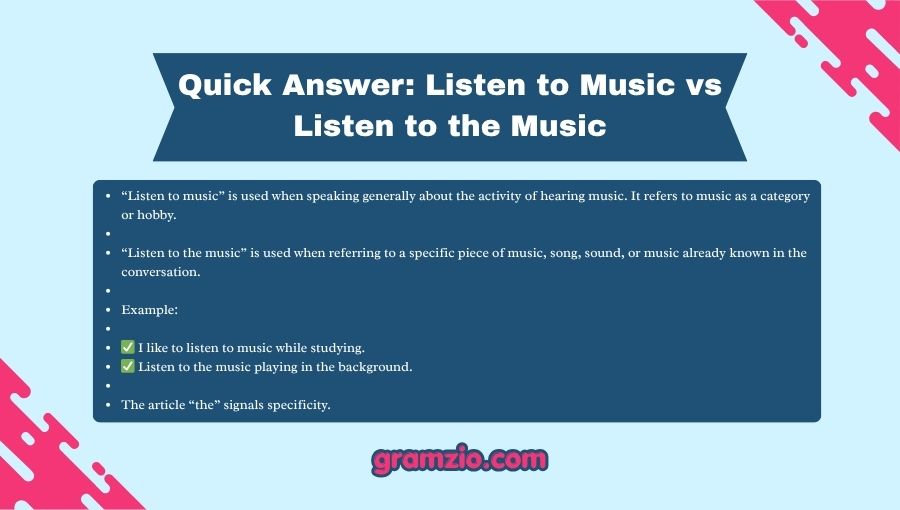
“Listen to music” is used when speaking generally about the activity of hearing music. It refers to music as a category or hobby.
“Listen to the music” is used when referring to a specific piece of music, song, sound, or music already known in the conversation.
Example:
✅ I like to listen to music while studying.
✅ Listen to the music playing in the background.
The article “the” signals specificity.
Understanding the Basics: Listen to Music vs Listen to the Music
The difference is simple:
- Listen to music → general idea 🎵
- Listen to the music → specific music 🎼
Think of it this way:
If music means music in general, no article is needed.
If music means particular music, use the.
Comparison Table
| Form | Type | Meaning | Example | Correct/Incorrect |
|---|---|---|---|---|
| Listen to music | General noun phrase | Music overall | I listen to music every evening. | ✅ Correct |
| Listen to the music | Specific noun phrase | Particular music | Listen to the music from that movie. | ✅ Correct |
| Listen to music from the room | General | Refers broadly | I can hear people listen to music. | ✅ Correct |
| Listen to music playing now | Missing specificity | Should reference known music | Listen to the music playing now. | ❌ Incorrect |
Correct Meanings & Uses
Using “Listen to Music” 🎧
Use this phrase when discussing music generally as an activity or habit.
Examples:
✅ I listen to music during workouts.
✅ She listens to music before sleeping.
✅ They enjoy listening to music on road trips.
Sentence Breakdown
I listen to music during workouts.
Subject: I
Verb: listen
Object: music
The sentence talks about music generally.
There is no specific song identified.
Test Tip 💡
Ask:
Am I talking about music in general?
If yes → use listen to music
Using “Listen to the Music” 🎼
Use this when the listener already knows which music is being discussed.
Examples:
✅ Listen to the music from that concert.
✅ Listen to the music coming from the next room.
✅ Please listen to the music in this video.
Sentence Breakdown
Listen to the music coming from outside.
The speaker points toward a particular sound.
Not all music. Specific music.
Test Tip 💡
Ask:
Can I identify the exact music?
If yes → use listen to the music
Additional Examples
General:
✅ I love listening to music at night.
✅ Children listen to music in class.
Specific:
✅ Listen to the music from the wedding video.
✅ Did you hear the music from the festival?
Notice how specificity changes everything.
Case Study Section 📧
Imagine a workplace email:
Employee A writes:
“I listen to music while working.”
Meaning:
Music generally helps productivity.
Now imagine:
“Please listen to the music attached to this presentation.”
Meaning:
A specific audio file accompanies the project.
Small word. Big difference.
Using the wrong form could confuse coworkers.
Grammar Rules Explanation
According to standard English grammar principles and dictionaries such as Merriam-Webster, articles define whether nouns are general or specific.
English has:
- a
- an
- the
“The” is called the definite article.
Definite means identified or known.
Examples:
General:
I like coffee.
Specific:
I like the coffee you made.
The same principle applies:
General:
I listen to music.
Specific:
Listen to the music from the movie.
That article changes the scope of meaning.
Common Mistakes ❌
People make mistakes for several reasons:
Fast typing ⌨️
People rush and skip articles.
Autocorrect 📱
Technology sometimes inserts or removes words.
Lack of knowledge 📚
Many learners are unaware that article usage changes meaning.
Similar Grammar Confusions
| Confusing Pair | Difference |
|---|---|
| It’s vs Its | Contraction vs possession |
| Your vs You’re | Possession vs “you are” |
| Their vs There | Possession vs location |
| Affect vs Effect | Verb vs noun |
| Listen to music vs Listen to the music | General vs specific |
These tiny differences create big meaning changes.
Usage in Different Contexts
Everyday Conversation ☕
General:
“I usually listen to music while cooking.”
Specific:
“Listen to the music coming from that car.”
Professional Writing 💼
General:
“Employees may listen to music during breaks.”
Specific:
“Please listen to the music included in the presentation.”
Creative Writing ✍️
General:
“He sat by the lake and listened to music.”
Specific:
“She listened to the music drifting through the fog.”
Social Media and Texting 📱
General:
“Listening to music and relaxing 😌”
Specific:
“Listen to the music in my new video!”
Why It Matters (Important)
Using Listen to Music vs Listen to the Music correctly matters because communication depends on precision.
Benefits:
Clarity in communication
People instantly understand what you mean.
Professionalism
Correct grammar creates credibility.
Writing accuracy in digital communication
Clear writing prevents misunderstandings.
Here is a helpful quote:
“Good grammar is the foundation of clear thinking.”
A single article may seem tiny, but it creates smoother communication.
Special Exception ⭐
There are rare cases where titles or names influence usage.
Examples:
✅ Listen to The Music by a band or project title.
✅ Listen to The Music soundtrack.
When The Music becomes part of a title, the article belongs to the official name.
Always preserve official titles.
Quick Recap Checklist
| Question | If Yes → Use |
|---|---|
| Are you discussing music generally? | Listen to music |
| Are you referring to specific music? | Listen to the music |
| Has the music already been identified? | Listen to the music |
| Is music a general hobby/activity? | Listen to music |
Practice Examples
Choose the correct phrase:
- I like to _____ while exercising.
Answer:
✅ listen to music
- Please _____ in the background of the film.
Answer:
✅ listen to the music
- My sister listens to _____ every morning.
Answer:
✅ music
FAQs
Is “listen to music” grammatically correct?
Yes. It refers to music generally and is commonly used in everyday English.
Is “listen to the music” also correct?
Yes. Use it when talking about a particular piece or source of music.
Why does adding “the” change meaning?
“The” makes the noun specific. It tells readers or listeners exactly which music you mean.
Can both phrases appear in one paragraph?
Absolutely.
Example:
“I usually listen to music while studying, but today I listened to the music from that new movie soundtrack.”
Which phrase is more common?
Listen to music is generally more common because people often discuss music as an activity.
Is this rule used with other nouns?
Yes.
Examples:
General:
I read books.
Specific:
I read the books you gave me.
The same pattern applies throughout English.
Conclusion
The difference between Listen to Music vs Listen to the Music comes down to one simple grammar concept: general versus specific meaning. 🎵
Use listen to music when speaking broadly about music as an activity, hobby, or category. Use listen to the music when referring to particular music that both speaker and listener can identify.
Although the difference seems tiny, the article “the” carries significant meaning. Understanding this rule helps improve speaking, writing, and overall communication accuracy.
The next time you hesitate, ask yourself one question:
Am I talking about music in general or specific music?
That single question will guide you to the correct answer every time. 🎧
Also read: Disoriented vs Disorientated

Hi, I’m Grayson Finch. I’m part of the gramzio.com team with 9 years of experience in grammar education. I am dedicated to teaching professional communication and helping you master the art of writing.