Headed vs Heading: What’s the Difference and When Should You Use Each?
Have you ever paused while writing and wondered about the difference between headed vs heading? 🤔 You are not alone. Many English learners and even native speakers occasionally confuse these two words because they come from the same verb, head, but serve different grammatical purposes.
The confusion often happens in everyday conversations, emails, social media posts, and professional writing. For example, should you write, “I am headed to the office” or “I am heading to the office”? Both may seem similar, but they are used differently depending on the sentence structure and intended meaning.
Understanding the difference between headed vs heading is important because using the correct form makes your writing clearer, more professional, and grammatically accurate. Fortunately, the distinction is not complicated once you understand how each word functions.
In this guide, you’ll learn the meanings, grammar rules, examples, common mistakes, practical applications, and expert tips to confidently use headed and heading in any situation.
Quick Answer: Headed vs Heading
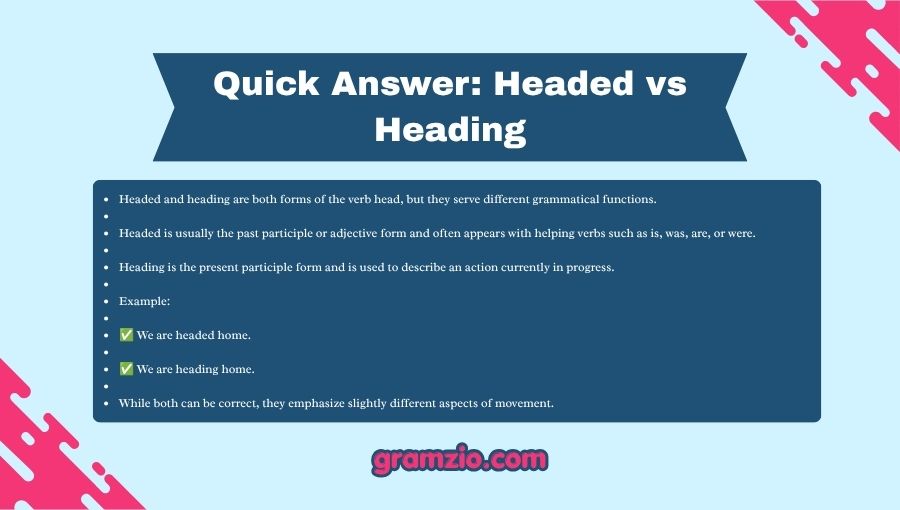
Headed and heading are both forms of the verb head, but they serve different grammatical functions.
- Headed is usually the past participle or adjective form and often appears with helping verbs such as is, was, are, or were.
- Heading is the present participle form and is used to describe an action currently in progress.
Example:
✅ We are headed home.
✅ We are heading home.
While both can be correct, they emphasize slightly different aspects of movement.
Understanding the Basics of Headed vs Heading
The easiest way to understand the difference is to recognize the grammatical role of each word.
| Form | Type | Meaning | Example | Correct/Incorrect |
|---|---|---|---|---|
| Headed | Past participle / Adjective | Directed toward a destination | We are headed north. | Correct |
| Heading | Present participle / Gerund | Currently moving toward a destination | We are heading north. | Correct |
| Headed | Noun | Not used as a noun | The headed was late. | Incorrect |
| Heading | Noun | A title or section heading | Read the heading carefully. | Correct |
Core Difference
Think of it this way:
- Headed often describes a state or condition.
- Heading often describes an ongoing action.
Correct Meanings and Uses
What Does “Headed” Mean?
Headed is the past participle form of the verb head.
It commonly means:
- Directed toward a destination
- Going in a certain direction
- Characterized by a particular type of leadership or feature
Examples
✅ The train is headed east.
Breakdown:
- Subject: The train
- Helping verb: is
- Past participle: headed
- Destination: east
Meaning: The train’s direction is east.
✅ We are headed to New York tomorrow.
Breakdown:
- Subject: We
- Helping verb: are
- Past participle: headed
Meaning: Our destination is New York.
Test Tip 💡
If you can replace the word with directed toward, headed is probably correct.
What Does “Heading” Mean?
Heading is the present participle form of the verb head.
It indicates movement or action that is occurring right now.
Examples
✅ She is heading to the airport.
Breakdown:
- Subject: She
- Helping verb: is
- Present participle: heading
Meaning: She is currently traveling toward the airport.
✅ We are heading out for dinner.
Meaning:
The action is actively happening.
Test Tip 💡
If the sentence focuses on the action of moving, heading is usually the better choice.
When Both Can Work
Interestingly, some sentences allow either word.
Example
✅ We are headed home.
✅ We are heading home.
Difference in Feel
Headed home
- Emphasizes destination.
Heading home
- Emphasizes movement.
Both are grammatically correct.
Case Study Section
Workplace Email Example
Imagine an employee sending a message to a manager.
Version 1
“I am heading to the client meeting now.”
This emphasizes the action currently taking place.
Version 2
“I am headed to the client meeting.”
This emphasizes the destination.
Which Is Better?
Both are acceptable.
However:
- Use heading when emphasizing movement.
- Use headed when emphasizing destination.
In professional communication, either choice sounds natural and correct.
Grammar Rules Explanation
According to standard English grammar and dictionary authorities such as Merriam-Webster, headed and heading are valid forms of the verb head, but they function differently.
Rule 1: Headed as a Past Participle
Examples:
✅ The team is headed in the right direction.
✅ She was headed downtown.
The word functions as a participial adjective.
Rule 2: Heading as a Present Participle
Examples:
✅ The team is heading in the right direction.
✅ She is heading downtown.
The word functions as part of a continuous verb phrase.
Rule 3: Heading Can Also Be a Noun
Examples:
✅ Read the chapter heading.
✅ The heading explains the topic.
Here, heading refers to a title or section label.
Rule 4: Headed Cannot Function as a Noun
Incorrect:
❌ Read the chapter headed.
Correct:
✅ Read the chapter heading.
Common Mistakes
Many mistakes happen because the two words sound similar and often appear in similar sentence structures.
Why Errors Occur
- Fast typing ⌨️
- Autocorrect mistakes 📱
- Lack of grammar knowledge 📚
- Confusion between participles
Common Errors
| Incorrect | Correct |
|---|---|
| We are headed to leave now. | We are heading to leave now. |
| Read the headed carefully. | Read the heading carefully. |
| She is heading east yesterday. | She was headed east yesterday. |
Similar Grammar Confusions
| Confusing Pair | Correct Usage |
|---|---|
| It’s vs Its | Contraction vs Possessive |
| Your vs You’re | Possessive vs Contraction |
| Their vs There vs They’re | Possessive, Place, Contraction |
| Affect vs Effect | Verb vs Noun |
| Headed vs Heading | State vs Ongoing Action |
Usage in Different Contexts
Everyday Conversation
People often use both forms interchangeably.
Examples:
✅ I’m headed home.
✅ I’m heading home.
Both sound natural.
Professional Writing
Business communication tends to favor precision.
Examples:
✅ The shipment is headed to Chicago.
✅ Our representative is heading to the conference.
Creative Writing
Authors may choose based on style.
Example:
“The travelers were headed toward the mountains as darkness fell.”
Example:
“The travelers were heading toward the mountains while discussing their plans.”
Social Media and Texting
Short messages frequently use both.
Examples:
📱 Heading out now!
📱 Headed to the gym.
📱 Heading home after work.
📱 Headed for vacation! ✈️
Why It Matters
Using headed and heading correctly improves communication.
Clarity
Readers immediately understand your meaning.
Professionalism
Correct grammar creates a positive impression.
Employers, teachers, and clients notice polished writing.
Accuracy in Digital Communication
Emails, reports, blogs, and social media posts all benefit from precise language.
Quote
“Good grammar is the foundation of clear communication.”
This principle applies perfectly to choosing between headed and heading.
Special Exception
One interesting exception involves heading as a noun.
Examples:
✅ Newspaper heading
✅ Section heading
✅ Main heading
In these cases, heading has nothing to do with movement.
Instead, it means a title or label.
Meanwhile, headed can appear in compound adjectives.
Examples:
✅ Strong-headed
✅ Level-headed
✅ Hard-headed
These expressions describe personality traits rather than direction.
Quick Recap Checklist
Which Word Should You Use?
| Question | If Yes → Use |
|---|---|
| Are you describing an ongoing action? | Heading |
| Are you emphasizing a destination? | Headed |
| Are you referring to a title or section label? | Heading |
| Are you describing a state of movement? | Headed |
| Is the action happening right now? | Heading |
Practice Examples
Example 1
The bus is _____ downtown.
✅ headed
✅ heading
Both can work depending on emphasis.
Example 2
Read the chapter _____.
✅ heading
❌ headed
Correct answer: heading
Example 3
We are _____ to the airport now.
✅ heading
Most natural answer: heading
Frequently Asked Questions (FAQs)
Is “headed” grammatically correct?
Yes. Headed is a standard English word used as a past participle and adjective.
Is “heading” grammatically correct?
Yes. Heading is the present participle form of the verb head and can also function as a noun.
Which is better: headed or heading?
Neither is inherently better. The correct choice depends on context and the meaning you want to convey.
Can I say “I am headed home”?
Absolutely. This is a common and grammatically correct expression in American English.
Can I say “I am heading home”?
Yes. This is equally correct and emphasizes the action of traveling home.
Why does “heading” sometimes mean a title?
English words often have multiple meanings. As a noun, heading refers to a title, label, or section name.
Conclusion
Understanding the difference between headed vs heading is easier than many people think. Both words come from the verb head, but they serve different grammatical roles. Headed usually emphasizes direction or destination, while heading focuses on movement or ongoing action. Additionally, heading can function as a noun that refers to a title or section label.
When deciding which word to use, consider what you want to emphasize. If you’re describing where someone is going, headed often works well. If you’re describing the act of moving somewhere, heading is usually the better choice.
Mastering small grammar distinctions like this can significantly improve your writing, boost your confidence, and help you communicate more clearly in both personal and professional settings. Remember: great writing is built on small details, and choosing the right word is one of them. ✨
Also read: If He Was vs If He Were

Hi, I’m Grayson Finch. I’m part of the gramzio.com team with 9 years of experience in grammar education. I am dedicated to teaching professional communication and helping you master the art of writing.