Assume vs Presume vs Infer: Clear Differences, Correct Usage, and Expert Guide
Have you ever paused while writing or speaking and wondered whether to use assume, presume, or infer? You’re not alone. These three words often create confusion because they all relate to forming conclusions—but they are not interchangeable. Misusing them can subtly change the meaning of your sentence or make your communication sound less precise. The confusion around assume vs presume vs infer usually comes from their overlapping meanings.
All three involve thinking something is true without full proof, but the basis and direction of reasoning differ. Understanding these differences is essential, especially if you want to communicate clearly in professional writing, academic work, or even everyday conversations.
In this guide, we’ll break down the meanings, explain the grammar rules, and provide real-life examples so you can confidently use each term. Whether you’re a student, writer, or professional, mastering assume vs presume vs infer will significantly improve your clarity and accuracy.
Quick Answer: Assume vs Presume vs Infer
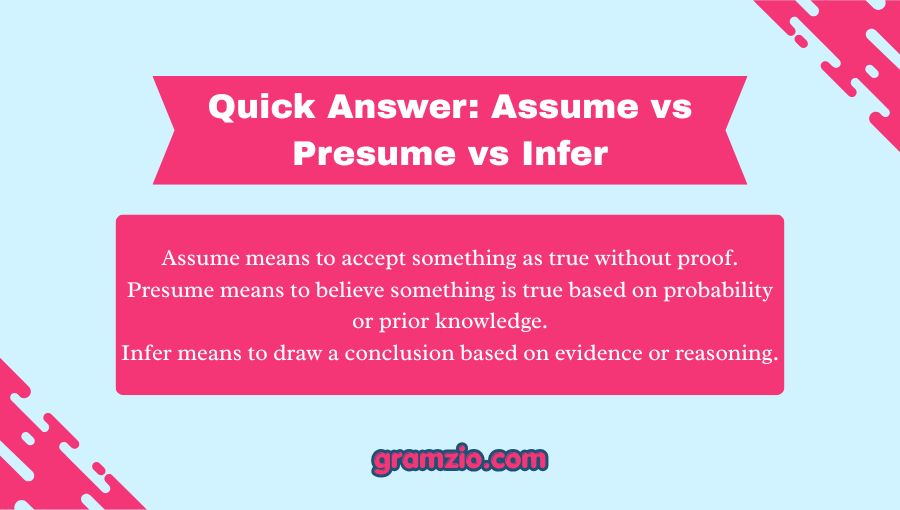
- Assume means to accept something as true without proof.
- Presume means to believe something is true based on probability or prior knowledge.
- Infer means to draw a conclusion based on evidence or reasoning.
👉 In short:
- You assume without evidence
- You presume with some expectation
- You infer from evidence
Understanding the Basics of Assume vs Presume vs Infer
At their core, these three words differ in how conclusions are formed and who is doing the reasoning.
| Form | Type | Meaning | Example Sentence | Correct/Incorrect |
|---|---|---|---|---|
| Assume | Verb | Accept something as true without proof | I assume he is at home. | Correct |
| Presume | Verb | Believe something based on probability or logic | I presume she received the message. | Correct |
| Infer | Verb | Deduce information from evidence or clues | I infer he is upset from his tone. | Correct |
Core Difference Simplified:
- Assume = guess without evidence
- Presume = guess with reasonable belief
- Infer = conclude based on evidence
Correct Meanings & Uses
What Does “Assume” Mean?
To assume is to accept something as true without checking or verifying it.
Example:
- I assumed the meeting was canceled.
Breakdown:
- The speaker did not confirm the cancellation.
- The belief is based on no strong evidence.
Test Tip:
If there is no evidence or reasoning, use assume.
What Does “Presume” Mean?
To presume is to believe something is true based on probability, past experience, or logic.
Example:
- I presume the train is late because it usually arrives late.
Breakdown:
- The belief is not random.
- It is based on past patterns or reasonable expectation.
Test Tip:
If there is some logical reason or pattern, use presume.
What Does “Infer” Mean?
To infer is to draw a conclusion based on evidence or observations.
Example:
- I inferred from his silence that he disagreed.
Breakdown:
- There is observable evidence (silence).
- The conclusion is based on interpretation.
Test Tip:
If you are analyzing clues or evidence, use infer.
Case Study: Real-Life Usage
Workplace Email Scenario
Situation:
You receive no reply to an urgent email.
- “I assume they are ignoring me.” ❌ (no evidence, emotional guess)
- “I presume they are busy.” ✅ (reasonable expectation)
- “I infer they are unavailable because they are in meetings all day.” ✅ (based on schedule evidence)
Takeaway:
Use infer when you have data, presume when you have reasonable belief, and assume when you’re guessing.
Grammar Rules Explanation
According to standard English usage guidelines (such as those found in dictionaries like Merriam-Webster):
- Assume often implies lack of evidence
- Presume implies confidence based on likelihood
- Infer requires evidence or reasoning
Key Rule:
- Infer = reader/listener action
- Imply (not in this topic) = speaker action
This distinction is important because many learners confuse infer with imply. Remember:
- Speaker implies
- Listener infers
Common Mistakes in Assume vs Presume vs Infer
Why Do These Mistakes Happen?
- Fast typing habits
- Autocorrect errors
- Lack of grammar knowledge
- Similar meanings causing confusion
Common Confusion Table
| Confusing Pair | Difference |
|---|---|
| Assume vs Presume | No evidence vs probable belief |
| Infer vs Imply | Receiver concludes vs speaker suggests |
| It’s vs Its | Contraction vs possessive |
| Your vs You’re | Possessive vs “you are” |
| Then vs Than | Time vs comparison |
Usage in Different Contexts
1. Everyday Conversation
- “I assume you’re coming tonight.”
- “I presume he forgot.”
- “I infer she’s upset.”
👉 Casual speech often uses assume more frequently, even when not fully correct.
2. Professional Writing
- Use presume for polite assumptions
- Use infer when presenting analysis
Example:
- “We infer from the data that sales increased.”
3. Creative Writing
Writers use these words to shape tone:
- Assume = uncertainty
- Presume = expectation
- Infer = deduction
4. Social Media & Texting
People often misuse these words:
- “I assume you hate me now 😂”
- This is emotionally driven, not logically accurate.
Why It Matters (Important Section)
Using assume vs presume vs infer correctly improves:
- Clarity in communication
- Professionalism in writing
- Accuracy in digital communication
When you choose the right word, your message becomes more precise and credible.
“Clear language leads to clear thinking—and clear thinking leads to better communication.”
In business, academic writing, and even personal conversations, precision matters. Misusing these words may lead to misunderstandings or weaken your argument.
Special Exception Section
In legal and formal contexts, presume is often preferred over assume.
Example:
- “The court presumes innocence until proven guilty.”
Here, presume reflects a structured belief based on principle—not a random assumption.
Quick Recap Checklist
| Question | If Yes → Use |
|---|---|
| Am I guessing without evidence? | Assume |
| Do I have a reasonable expectation? | Presume |
| Am I analyzing evidence or clues? | Infer |
Practice Examples:
- I ______ he forgot my birthday. → (Assume)
- I ______ she arrived safely because she texted me. → (Presume)
- I ______ from his tone that he was angry. → (Infer)
FAQs: Assume vs Presume vs Infer
1. What is the main difference between assume, presume, and infer?
Answer:
Assume is a guess without evidence, presume is a belief based on likelihood, and infer is a conclusion drawn from evidence.
2. Can assume and presume be used interchangeably?
Answer:
Sometimes in casual speech, yes—but in formal writing, they are different. Presume implies more confidence or reasoning than assume.
3. Is “infer” the same as “imply”?
Answer:
No. Infer means to conclude, while imply means to suggest. The listener infers; the speaker implies.
4. Which word is more formal: assume or presume?
Answer:
Presume is generally more formal and is often used in legal or professional contexts.
5. Why do people confuse these words?
Answer:
Because they all involve forming conclusions, but the level of evidence differs. Their meanings overlap, which causes confusion.
6. How can I remember the difference easily?
Answer:
Use this trick:
- Assume = no proof
- Presume = probable
- Infer = evidence
Conclusion
Understanding assume vs presume vs infer is essential for clear and accurate communication. While these words may seem similar, their differences lie in how conclusions are formed. Assume involves guessing without evidence, presume relies on reasonable expectation, and infer requires logical reasoning based on facts.
By mastering these distinctions, you can improve your writing, avoid common grammar mistakes, and communicate more effectively in both personal and professional contexts. The next time you’re unsure which word to use, pause and ask yourself: Do I have evidence, probability, or just a guess?
Choose wisely—and your language will reflect precision and confidence.

Hi, I’m Dexter Rhodes. At gramzio.com, I apply my 10 years of experience in copy-editing to ensure every guide we publish is accurate, professional, and follows the highest editorial standards.