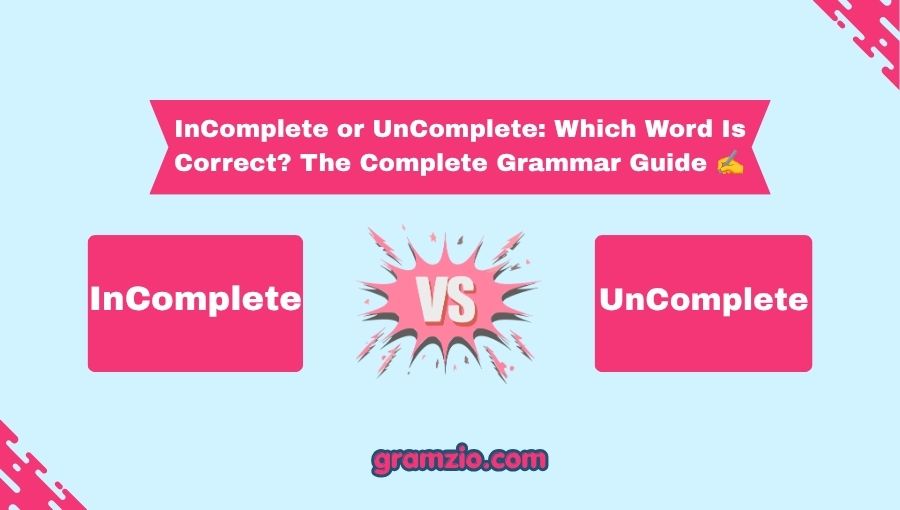
InComplete or UnComplete: Which Word Is Correct? The Complete Grammar Guide ✍️
Have you ever typed a sentence and suddenly wondered whether you should use incomplete or uncomplete? 🤔 You are not alone. Many English learners, students, writers, and even native speakers occasionally pause when choosing between these two similar-looking words.
At first glance, both words appear logical. After all, English often uses prefixes like in- and un- to create opposites. This makes many people assume that both incomplete and uncomplete are acceptable alternatives.
However, English grammar does not always follow simple patterns. Some words become standard and widely accepted, while others remain rare, obsolete, or incorrect in modern usage.
Understanding the difference between incomplete or uncomplete is important because using the wrong term can make your writing look unprofessional or awkward. Whether you’re writing an email, school assignment, business report, social media post, or creative story, choosing the correct word improves clarity and credibility.
In this comprehensive guide, you’ll learn exactly which form is correct, why it is correct, and how to avoid common mistakes.
Quick Answer: InComplete or UnComplete?
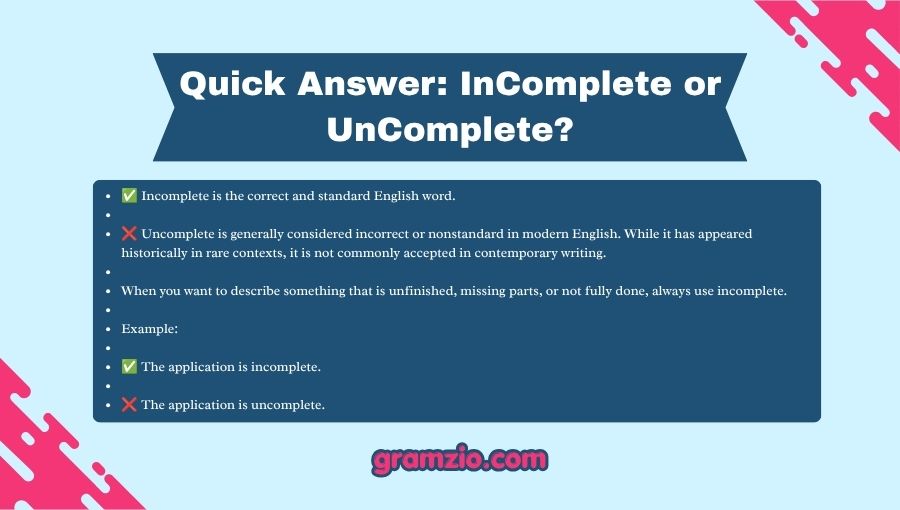
✅ Incomplete is the correct and standard English word.
❌ Uncomplete is generally considered incorrect or nonstandard in modern English. While it has appeared historically in rare contexts, it is not commonly accepted in contemporary writing.
When you want to describe something that is unfinished, missing parts, or not fully done, always use incomplete.
Example:
✅ The application is incomplete.
❌ The application is uncomplete.
Understanding the Basics of InComplete or UnComplete
The confusion comes from the prefixes in- and un-, both of which can create negative meanings.
However, standard English recognizes incomplete as the accepted adjective, while uncomplete is largely obsolete and rarely used.
Comparison Table
| Form | Type | Meaning | Example | Correct/Incorrect |
|---|---|---|---|---|
| Incomplete | Adjective | Not finished or lacking parts | The report is incomplete. | ✅ Correct |
| Uncomplete | Nonstandard adjective | Intended to mean unfinished | The report is uncomplete. | ❌ Incorrect in modern English |
Key Difference
- Incomplete = accepted standard English
- Uncomplete = uncommon, outdated, and generally avoided
Correct Meanings & Uses
What Does Incomplete Mean?
Incomplete means something is not finished, lacks required parts, or is not fully developed.
Examples
✅ The homework assignment is incomplete.
Breakdown:
- Homework = subject
- Is = linking verb
- Incomplete = describes unfinished status
✅ The information provided was incomplete.
Breakdown:
- Information was missing details.
- Therefore, incomplete is the correct adjective.
✅ Her explanation felt incomplete.
Breakdown:
- The explanation lacked sufficient details.
Test Tip 🎯
Ask yourself:
“Is something unfinished or missing parts?”
If yes, use incomplete.
Why Do People Use UnComplete?
Many writers assume that adding un- creates the opposite of complete.
Examples of valid pairs:
- happy → unhappy
- fair → unfair
- clear → unclear
Because these patterns exist, some people incorrectly form:
- complete → uncomplete
However, English has already established incomplete as the accepted opposite.
Test Tip 🎯
If a dictionary or style guide recommends incomplete, choose it over uncomplete.
The History Behind the Words
Language evolves over time. Historically, some writers occasionally used uncomplete, especially in older English texts.
However, modern dictionaries overwhelmingly prefer incomplete.
Today:
✅ incomplete = standard
❌ uncomplete = obsolete, rare, or nonstandard
This is similar to how many older English words disappeared while more accepted forms survived.
Case Study Section
Workplace Email Example
Imagine an employee submits a project update.
Incorrect Email
The attached report is uncomplete. I will finish it tomorrow.
While readers understand the meaning, the wording sounds awkward and unprofessional.
Correct Email
The attached report is incomplete. I will finish it tomorrow.
This version follows modern grammar standards and sounds natural.
Why It Matters
Business communication requires accuracy.
Using incomplete demonstrates professionalism and language competence.
Grammar Rules Explanation
Why Is Incomplete Correct?
The adjective incomplete comes from established English vocabulary patterns and has been accepted for centuries.
According to standard dictionary authorities such as the Merriam-Webster tradition of English lexicography, incomplete means:
Not complete; lacking some part.
Modern dictionaries consistently recognize incomplete as the standard adjective.
Why Is UnComplete Incorrect?
The issue is not grammar alone.
The issue is usage.
Although English often allows un- prefixes, language develops through common acceptance.
Native speakers overwhelmingly use:
- incomplete
- incomplete information
- incomplete work
- incomplete sentence
They rarely use:
- uncomplete information
- uncomplete work
Because it is not standard usage, most editors and grammar checkers flag uncomplete as incorrect.
Common Mistakes
Why Do Mistakes Happen?
Several factors contribute to confusion.
1. Fast Typing ⌨️
Writers often type quickly and rely on instinct.
2. Autocorrect Issues 📱
Some devices fail to flag uncommon words immediately.
3. Lack of Knowledge 📚
Many learners assume every opposite can be formed with un-.
4. Similar Word Patterns
English contains many valid un- words, creating confusion.
Similar Grammar Confusions
| Incorrect or Confusing Pair | Correct Choice | Reason |
|---|---|---|
| Uncomplete vs Incomplete | Incomplete | Standard usage |
| Its vs It’s | Depends on meaning | Possession vs contraction |
| Your vs You’re | Depends on meaning | Possession vs “you are” |
| Affect vs Effect | Context matters | Verb vs noun |
| Then vs Than | Different functions | Time vs comparison |
| Lose vs Loose | Different meanings | Verb vs adjective |
Usage in Different Contexts
Everyday Conversation
People commonly use incomplete in casual speech.
Examples
✅ My registration form is incomplete.
✅ Your answer seems incomplete.
✅ The puzzle is still incomplete.
Professional Writing
Professional documents require standard language.
Examples
✅ The proposal is incomplete.
✅ The application remains incomplete.
✅ Several sections of the report are incomplete.
Avoid:
❌ The proposal is uncomplete.
Creative Writing
Authors use incomplete to describe emotions, events, and situations.
Examples
✅ He felt incomplete without his family.
✅ The story ended with an incomplete explanation.
✅ Their mission remained incomplete.
Social Media and Texting
Even informal communication favors incomplete.
Examples
✅ Profile incomplete.
✅ Application incomplete.
✅ Registration incomplete.
You will rarely encounter uncomplete among skilled writers.
Why It Matters
Choosing between incomplete or uncomplete may seem like a small issue, but it affects communication quality.
Clarity in Communication
Readers instantly recognize incomplete.
There is no confusion about its meaning.
Professionalism
Employers, teachers, and clients expect correct English.
Using standard vocabulary creates a stronger impression.
Writing Accuracy in Digital Communication
Online communication happens quickly.
Correct word choices help maintain credibility.
Quote 💡
“Clear language builds trust, while confusing language creates doubt.”
This principle applies perfectly to choosing incomplete instead of uncomplete.
Special Exception
Is UnComplete Ever Acceptable?
Technically, uncomplete has appeared in historical writings and rare literary contexts.
You may occasionally encounter it:
- In old books
- In historical documents
- As a deliberate stylistic choice
- In certain brand or product names
However, these situations are exceptions rather than the rule.
For modern English:
✅ Use incomplete
❌ Avoid uncomplete
InComplete vs Other Related Words
Many writers also confuse incomplete with similar terms.
| Word | Meaning |
|---|---|
| Incomplete | Missing parts or unfinished |
| Unfinished | Not finished yet |
| Partial | Only partly completed |
| Deficient | Lacking something necessary |
| Imperfect | Having flaws |
| Fragmentary | Existing in incomplete pieces |
Example
“The report is incomplete.”
means some required information is missing.
“The report is unfinished.”
means work is still ongoing.
Quick Recap Checklist
Which Word Should You Use?
| Question | If Yes → Use |
|---|---|
| Is something unfinished? | Incomplete |
| Is information missing? | Incomplete |
| Is part of a task not done? | Incomplete |
| Are you writing professional English? | Incomplete |
| Are you considering uncomplete? | Usually avoid it |
Practice Examples
Example 1
The application is _____.
✅ Incomplete
❌ Uncomplete
Example 2
The project remained _____ after the deadline.
✅ Incomplete
❌ Uncomplete
Example 3
Your response appears _____ because several questions were skipped.
✅ Incomplete
❌ Uncomplete
Memory Tricks to Remember the Difference 🧠
A simple trick:
Think of Common Phrases
You often hear:
- incomplete assignment
- incomplete report
- incomplete application
- incomplete sentence
You almost never hear:
- uncomplete assignment
- uncomplete report
If it sounds unusual, it is probably not the standard choice.
Frequently Asked Questions (FAQs)
Is incomplete or uncomplete correct?
Incomplete is the correct and standard English word. Uncomplete is generally considered nonstandard and should be avoided.
Why is uncomplete considered incorrect?
It is not widely accepted in modern English usage. Dictionaries and style guides overwhelmingly prefer incomplete.
Can uncomplete ever be used?
It may appear in historical texts or rare literary contexts, but it is not recommended for modern writing.
What does incomplete mean?
Incomplete means unfinished, lacking required parts, or not fully developed.
Is incomplete formal or informal?
It works in both formal and informal contexts. It is appropriate for academic, business, and everyday writing.
What is the opposite of complete?
The standard opposite is incomplete.
Example:
- Complete report ✅
- Incomplete report ✅
Conclusion
When deciding between incomplete or uncomplete, the answer is straightforward: incomplete is the correct choice in modern English. ✅
The word incomplete is recognized by dictionaries, accepted by grammar experts, and used by native speakers in everyday conversation, professional communication, academic writing, and digital content. On the other hand, uncomplete is outdated, extremely rare, and generally viewed as incorrect in contemporary English.
Whenever something is unfinished, missing information, lacking required parts, or not fully developed, use incomplete with confidence.
Remember this simple rule:
✔️ Complete → Incomplete
❌ Complete → Uncomplete
Mastering small grammar distinctions like this strengthens your writing, improves professionalism, and helps your message remain clear and effective. The next time you hesitate between these two words, you’ll know exactly which one belongs on the page: incomplete, every time. 🎯
Also read: Passerbyers or Passers-by vs Passerby

Hi, I’m Willa Sterling. I work at gramzio.com as a senior editor. With 15 years of experience in academic and formal grammar, I provide the expert insights you need to make your writing flawless.