Stationary vs Stationery: What’s the Real Difference? 📚✏️
Have you ever written a sentence and suddenly stopped, wondering whether it should be stationary vs stationery? You are not alone. These two words sound almost identical, look very similar, and are often mixed up—even by native English speakers. The confusion around stationary vs stationery is so common that it has become one of the most searched grammar doubts online.
The problem is simple: one letter changes everything. Stationary refers to something that does not move, while stationery refers to writing materials like pens, notebooks, and paper. Despite their similar pronunciation, their meanings are completely different.
Understanding this difference is important, especially in professional writing, exams, emails, and content creation. A small spelling mistake can change your entire message and reduce clarity. In this article, you will learn the correct meanings, real-life examples, grammar rules, and easy tricks to never confuse them again. Let’s clear up the confusion once and for all! ✨
Quick Answer: Stationary vs Stationery
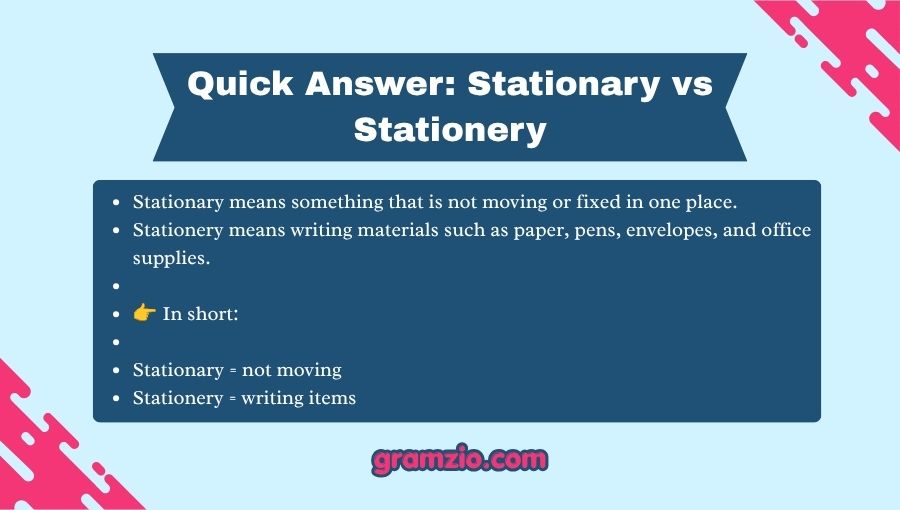
- Stationary means something that is not moving or fixed in one place.
- Stationery means writing materials such as paper, pens, envelopes, and office supplies.
👉 In short:
- Stationary = not moving
- Stationery = writing items
Understanding the Basics: Stationary vs Stationery
The confusion between stationary and stationery comes from pronunciation. Both sound almost identical, but their spelling and meanings differ completely.
Let’s break it down simply:
| Form | Type | Meaning | Example Sentence | Correct/Incorrect |
|---|---|---|---|---|
| Stationary | Adjective | Not moving or fixed in place | The car remained stationary at the light. | Correct |
| Stationery | Noun | Writing materials and supplies | I bought new stationery for school. | Correct |
Key Insight 💡
- Stationary describes a condition (no movement).
- Stationery describes objects (paper, pens, etc.).
Correct Meanings & Uses
1. Stationary (Not Moving) 🚗
The word stationary is an adjective. It is used when something is still, fixed, or not moving.
Examples:
- The train remained stationary for 10 minutes.
- Birds were stationary on the electric wire.
- The cyclist was stationary at the traffic signal.
Sentence Breakdown:
- “The train remained stationary”
- Subject: Train
- Verb: remained
- Meaning: The train did not move
Test Tip 🧠:
If you can replace the word with still or not moving, then stationary is correct.
2. Stationery (Writing Materials) ✏️📄
The word stationery is a noun. It refers to office or school supplies used for writing.
Examples:
- She bought colorful stationery for her journal.
- The office ordered new stationery for employees.
- I love collecting aesthetic stationery items.
Sentence Breakdown:
- “She bought stationery”
- Subject: She
- Verb: bought
- Object: stationery (items like pens, paper)
Test Tip 🧠:
If the sentence is about pens, notebooks, or paper, use stationery.
Case Study Section 📌
Imagine this workplace email:
❌ Incorrect:
“Please order more stationary for the office.”
✔ Correct:
“Please order more stationery for the office.”
What went wrong?
The writer used stationary (not moving), which changes the meaning completely. It sounds like the office is ordering “non-moving” objects instead of writing supplies.
Real-life impact:
- Miscommunication in professional emails
- Poor impression in business writing
- Grammar mistakes in official documents
Grammar Rules Explanation 📖
The distinction between these two words is recognized in all major dictionaries, including Merriam-Webster and Oxford English Dictionary.
Root Origin:
- Stationary comes from Latin stationarius, meaning “standing still.”
- Stationery comes from “stationer,” referring to a seller of books and writing materials.
Why the confusion happens:
- They are homophones (sound the same)
- Only one letter difference (a vs e)
- Fast typing leads to mistakes
👉 Grammar Rule:
- If it is an adjective describing movement → stationary
- If it is a noun referring to writing items → stationery
Common Mistakes ⚠️
Why people confuse them:
- Fast typing ⌨️
- Autocorrect errors 📱
- Lack of grammar awareness 📚
- Similar pronunciation 🔊
Similar Grammar Confusions Table:
| Confusing Words | Correct Usage 1 | Correct Usage 2 | Reason for Confusion |
|---|---|---|---|
| It’s / Its | It’s = it is | Its = possession | Apostrophe confusion |
| Your / You’re | Your = belonging | You’re = you are | Sound similar |
| Stationary / Stationery | Not moving | Writing materials | Same pronunciation |
Usage in Different Contexts 🌍
1. Everyday Conversation 🗣️
- The bus stayed stationary for a while.
- I need new stationery for school.
2. Professional Writing 💼
- Please keep the machine stationary during maintenance.
- The company ordered branded stationery.
3. Creative Writing ✍️
- The moon looked stationary in the night sky.
- Her desk was filled with elegant stationery.
4. Social Media/Texting 📱
- “Obsessed with my new stationery set ✨”
- “My bike was stationary in traffic 😅”
Why It Matters ❗
Using the correct word improves clarity and professionalism. Small spelling mistakes can change meaning and affect how others perceive your writing.
“Clear writing is clear thinking made visible.”
Importance:
- Improves communication clarity
- Enhances professional image
- Prevents misunderstanding
- Builds grammar confidence
Special Exception 📌
There are no major exceptions in standard English usage. However:
- In branding or product names, companies may creatively use spelling variations.
- In British and American English, meanings remain the same.
Quick Recap Checklist ✅
| Question | If Yes → Use |
|---|---|
| Is it about movement or being still? | Stationary |
| Is it about pens, paper, or writing tools? | Stationery |
Practice Examples:
- The airplane remained ______ on the runway.
- I bought new ______ for school.
- The bicycle was ______ during the race pause.
Answers:
- Stationary
- Stationery
- Stationary
FAQs (Stationary vs Stationery) ❓
1. What is the main difference between stationary and stationery?
Stationary means not moving, while stationery refers to writing materials like pens and paper.
2. Why do people confuse stationary and stationery?
Because they sound the same and differ by only one letter, making them easy to mix up.
3. Is stationery always plural?
No, stationery is an uncountable noun used for writing materials in general.
4. Can stationary be used for objects?
Yes, but only when describing something that is not moving.
5. What is a simple trick to remember the difference?
Remember: E = Envelope = stationery (writing items).
6. Is this mistake common in exams?
Yes, it is one of the most common English grammar mistakes in school exams and competitive tests.
Conclusion
The difference between stationary and stationery is small in spelling but huge in meaning. One describes something that does not move, while the other refers to essential writing materials used in daily life.
Remember this simple rule: if it moves, think stationary; if it writes, think stationery. This tiny distinction can dramatically improve your grammar accuracy and writing confidence.
Mastering such confusing word pairs helps you communicate more clearly and professionally. So next time you write, pause for a second and choose the right word—you’ll never mix them up again. ✨
Also read: Principal vs Principle

Hi, I’m Dexter Rhodes. At gramzio.com, I apply my 10 years of experience in copy-editing to ensure every guide we publish is accurate, professional, and follows the highest editorial standards.