Imply vs Infer: The Complete Guide to Understanding the Difference (Grammar Explained Simply)
Have you ever been in a conversation where someone said, “I’m not saying it directly, but you should understand it”—and then another person responded, “Yes, I inferred that”? 🤔 If yes, you’ve already encountered one of the most commonly confused grammar pairs in the English language: imply vs infer.
Many English learners—even native speakers—mix up these two words because they are closely related in meaning but completely different in usage. One refers to what the speaker suggests, while the other refers to what the listener understands. This small difference changes the entire direction of communication.
In professional writing, exams, emails, and everyday conversations, using imply vs infer correctly is important for clarity and credibility. Misusing them can make your message confusing or grammatically incorrect.
In this detailed guide, you will learn the exact difference between imply and infer, how to use them correctly, common mistakes, real-life examples, and simple tricks to never confuse them again. Let’s clear up this grammar confusion once and for all 😊
Quick Answer: Imply vs Infer
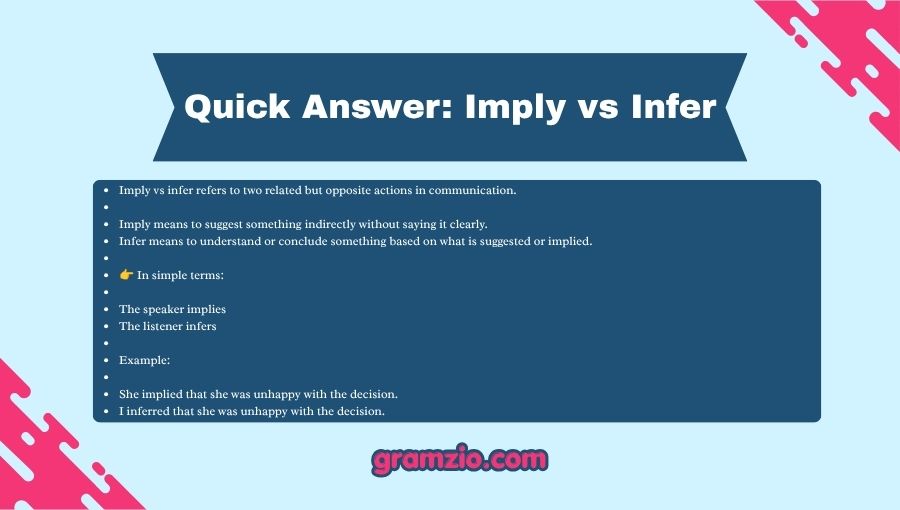
Imply vs infer refers to two related but opposite actions in communication.
- Imply means to suggest something indirectly without saying it clearly.
- Infer means to understand or conclude something based on what is suggested or implied.
👉 In simple terms:
- The speaker implies
- The listener infers
Example:
- She implied that she was unhappy with the decision.
- I inferred that she was unhappy with the decision.
Understanding the Basics of Imply vs Infer
To fully understand imply vs infer, you need to see how they work in communication flow.
1. Imply (The Sender’s Action)
When someone implies, they are sending a hidden or indirect message.
- It is about expression
- The speaker does not say everything directly
- The meaning is suggested
✔ Example:
- “It’s getting late…” (implying we should leave)
2. Infer (The Receiver’s Action)
When someone infers, they interpret or understand a hidden message.
- It is about interpretation
- The listener decodes meaning
- It depends on context and understanding
✔ Example:
- From “It’s getting late…”, I inferred that we should leave.
Comparison Table: Imply vs Infer
| Feature | Imply | Infer |
|---|---|---|
| Form | Verb | Verb |
| Role | Speaker/writer | Listener/reader |
| Meaning | To suggest indirectly | To understand indirectly |
| Direction | Outgoing message | Incoming interpretation |
| Example | He implied he was busy | I inferred he was busy |
| Correct usage | Speaker uses “imply” | Listener uses “infer” |
Correct Meanings & Uses
H3: How to Use “Imply” Correctly
The verb imply is used when someone hints at something without directly stating it.
✔ Structure:
- Subject + imply + hidden meaning
✔ Examples:
- The manager implied that layoffs might happen.
- Her tone implied disappointment.
💡 Sentence breakdown:
- Subject: Manager / She
- Action: implied
- Hidden meaning: layoffs / disappointment
Test Tip for “Imply”
Ask yourself:
👉 “Is someone sending a hidden message?”
If yes → use imply
H3: How to Use “Infer” Correctly
The verb infer is used when someone understands a hidden message.
✔ Structure:
- Subject + infer + meaning from clues
✔ Examples:
- I inferred that he was angry from his tone.
- They inferred the conclusion from the data.
💡 Sentence breakdown:
- Subject: I / They
- Action: inferred
- Source: tone / data
Test Tip for “Infer”
Ask yourself:
👉 “Am I understanding a hidden meaning?”
If yes → use infer
Case Study Section: Real-Life Communication Example
Workplace Email Scenario 📧
Imagine this email from a manager:
“We are reviewing team performance this quarter.”
Now:
- The manager is not directly saying layoffs are coming.
- But the message may hint at changes.
✔ Employee A:
- “The manager implied possible restructuring.”
✔ Employee B:
- “I inferred that job cuts might happen.”
👉 Explanation:
- Manager = implies
- Employee = infers
This is exactly how imply vs infer works in real life communication.
Grammar Rules Explanation
According to standard grammar references such as Merriam-Webster and major English usage guides:
- Imply is used when a speaker/writer suggests something indirectly.
- Infer is used when a listener/reader deduces meaning.
Why People Get Confused
The confusion happens because both words deal with hidden meaning, but they operate in opposite directions.
✔ Key Rule:
- Imply = send message
- Infer = receive message
👉 Think of it like this:
- A teacher implies a hint in a lesson
- A student infers the answer from the hint
Common Mistakes
Why People Make Errors
Most confusion between imply vs infer happens due to:
- Fast typing ⌨️
- Autocorrect mistakes
- Similar meanings in casual speech
- Lack of grammar awareness
Common Grammar Confusion Table
| Confused Pair | Incorrect Usage | Correct Usage |
|---|---|---|
| Imply / Infer | I implied from his words | I inferred from his words |
| Its / It’s | Its raining today | It’s raining today |
| Your / You’re | Your amazing | You’re amazing |
| Affect / Effect | The effect me | It affected me |
| Then / Than | I am better then you | I am better than you |
Usage in Different Contexts
1. Everyday Conversation 🗣️
- He implied he was tired.
- I inferred he wanted to go home.
2. Professional Writing 💼
- The report implies potential risks.
- Analysts inferred market decline.
3. Creative Writing ✍️
- The character implied a hidden truth.
- Readers inferred deeper meaning.
4. Social Media/Texting 📱
- “Not naming anyone…” (implies drama)
- Followers infer hidden context
Why It Matters (Important)
Understanding imply vs infer improves:
- Clear communication 🧠
- Professional writing quality 📊
- Academic accuracy 🎓
- Digital clarity 💬
As writer George Bernard Shaw once suggested in spirit:
“The single biggest problem in communication is the illusion that it has taken place.”
Using these words correctly ensures your communication is truly understood, not misinterpreted.
Special Exception
There are no major exceptions in modern English grammar for imply vs infer, but in informal speech, people sometimes use them interchangeably. However, in:
- Academic writing
- Professional communication
- Exams (IELTS, TOEFL, SAT)
👉 The correct distinction MUST be followed strictly.
Quick Recap Checklist
| Question | If Yes → Use |
|---|---|
| Am I suggesting something indirectly? | Imply |
| Am I understanding a hidden meaning? | Infer |
| Am I the speaker? | Imply |
| Am I the listener? | Infer |
Practice Examples
- The teacher ___ that the exam would be difficult.
- I ___ from her expression that she was upset.
- The report ___ financial issues.
✔ Answers:
- implied
- inferred
- implies
FAQs: Imply vs Infer
1. What is the main difference between imply and infer?
“Imply” is used when someone suggests something indirectly, while “infer” is used when someone understands or interprets that suggestion.
2. Can I use imply and infer interchangeably?
No. They are not interchangeable. Using them incorrectly changes the meaning of the sentence.
3. Who implies and who infers?
The speaker or writer implies, and the listener or reader infers.
4. Is it wrong to say “I implied from his words”?
Yes. The correct form is “I inferred from his words.”
5. Why do people confuse imply and infer?
Because both relate to indirect meaning, but they function in opposite directions in communication.
6. Are imply and infer formal words?
Yes, both are commonly used in formal writing, academic English, and professional communication.
Conclusion
The confusion between imply vs infer is one of the most common grammar challenges in English, but once understood, it becomes very simple. The key rule is clear:
👉 Imply = to suggest something indirectly
👉 Infer = to understand something indirectly
Think of communication as a bridge:
- One side sends the message (imply)
- The other side receives and interprets it (infer)
By mastering this difference, you improve not only your grammar but also your overall communication clarity in writing, speaking, and professional settings. 🌟
So next time you hear a hidden message, remember: someone implied it—and you inferred it correctly.
Also read: Hanged vs Hung

Hi, I’m Elara Quinn. Working at gramzio.com, I use my 8 years of experience in linguistics to simplify difficult English rules, making them accessible and easy to learn for our global community.