Neither vs Either: The Complete Guide to Meaning, Usage, and Grammar Rules
English grammar can feel tricky when two small words look almost identical in structure but behave very differently in sentences. One of the most common sources of confusion for learners and even native speakers is “neither vs either.” At first glance, both words seem to express choices, negations, or alternatives—but their usage depends heavily on context, sentence structure, and tone.
For example, should you say “Neither of the options is correct” or “Either of the options is correct”? The meaning changes completely based on just one word. This subtle difference often leads to mistakes in writing, speaking, and professional communication.
In this detailed guide, we will break down the grammar rules, meanings, and real-life usage of neither vs either in the simplest way possible. You will also learn how to avoid common errors, use both words confidently in different contexts, and improve your overall English fluency. 😊
By the end, you’ll never feel unsure about choosing between neither and either again.
Quick Answer Section: Neither vs Either
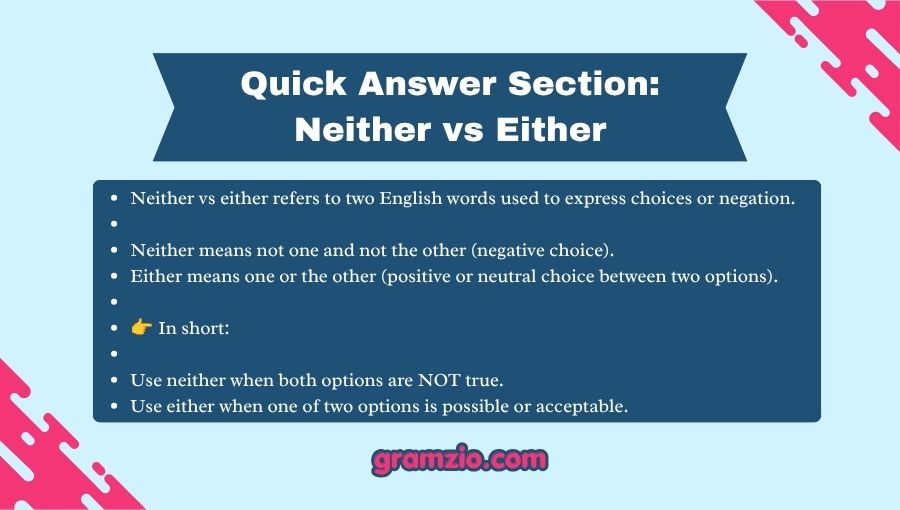
Neither vs either refers to two English words used to express choices or negation.
- Neither means not one and not the other (negative choice).
- Either means one or the other (positive or neutral choice between two options).
👉 In short:
- Use neither when both options are NOT true.
- Use either when one of two options is possible or acceptable.
Understanding the Basics of Neither vs Either
To fully understand neither vs either, you must first see how they behave in sentences.
Core Difference
- Neither = Negative form (none of the two options)
- Either = Positive/choice form (one of the two options)
Comparison Table: Neither vs Either
| Form | Type | Meaning | Example | Correct/Incorrect |
|---|---|---|---|---|
| Neither | Determiner / Pronoun | Not one and not the other | Neither answer is correct. | Correct |
| Either | Determiner / Pronoun | One of two options | Either answer is correct. | Correct |
| Neither | Conjunction | Not A and not B | Neither John nor Mary came. | Correct |
| Either | Conjunction | A or B | Either John or Mary will come. | Correct |
Correct Meanings & Uses of Neither vs Either
1. Using “Neither” in Sentences
“Neither” is used when you want to reject both options.
Example:
- Neither of the answers is correct.
Breakdown:
- “Neither” = not one, not the other
- “of the answers” = two choices
- “is correct” = verb agrees with singular structure
More Examples:
- Neither car is available today.
- Neither of the students passed the test.
- I like neither option.
💡 Test Tip:
If you can replace it with “not one and not the other,” then “neither” is correct.
2. Using “Either” in Sentences
“Either” is used when choosing between two options.
Example:
- You can take either road.
Breakdown:
- “Either” = one or the other
- “road” = two possible choices implied
More Examples:
- You can sit on either side.
- Either answer may be correct.
- I can eat either pizza or pasta.
💡 Test Tip:
If the sentence still makes sense with “one of the two,” use “either.”
3. Either…Or Structure
This is a very common grammar structure.
- Either you study hard or you will fail.
- You can either call me or text me.
This structure shows a choice between two possibilities.
4. Neither…Nor Structure
Used for negative pairing.
- Neither the manager nor the employees were present.
- She likes neither tea nor coffee.
This structure rejects both options.
Case Study Section (Real-Life Example)
Workplace Email Example
Incorrect:
- Either of the reports are wrong.
Correct:
- Neither of the reports is correct.
Explanation:
In a corporate email, using the wrong form can confuse meaning. If both reports are wrong, “neither” must be used. If one of them is correct, then “either” is appropriate.
Real Email:
Dear Team,
After review, neither of the submitted reports is accurate. Please revise and resubmit by Friday.
Regards,
Manager
This shows professional, precise communication using neither vs either correctly.
Grammar Rules Explanation
According to standard grammar references like Merriam-Webster and widely accepted English usage rules:
Key Rules:
- Neither takes a singular verb in formal grammar:
- Neither of the boys is ready.
- Either also takes singular verbs:
- Either option is fine.
Why confusion happens:
- Informal speech often ignores strict grammar rules.
- People treat plural nouns incorrectly after “of.”
- Fast communication leads to structural mistakes.
Common Mistakes
Why learners confuse neither vs either:
- Fast typing mistakes ⌨️
- Autocorrect interference 📱
- Lack of grammar understanding 📚
Common Grammar Confusions Table
| Confusion Pair | Incorrect Example | Correct Example |
|---|---|---|
| its / it’s | It’s tail is long | Its tail is long |
| your / you’re | Your amazing | You’re amazing |
| neither / either | Either of them is not correct | Neither of them is correct |
Usage in Different Contexts
1. Everyday Conversation
- Neither works for me.
- Either is fine.
2. Professional Writing
- Neither proposal meets requirements.
- Either option is acceptable.
3. Creative Writing
- Neither moon nor stars could brighten the sky.
- Either path leads to destiny.
4. Social Media / Texting
- I want neither 😅
- Either works lol 👍
Why It Matters (Important)
Understanding neither vs either is important because:
- It improves clarity in communication
- It prevents misunderstandings
- It enhances professional writing quality
- It strengthens grammar accuracy in digital communication
“Clear writing begins with precise word choice.”
Using the correct word can change the entire meaning of a sentence.
Special Exception
In some informal spoken English, especially in American casual speech, people may ignore strict singular/plural agreement rules. However, in formal writing, always follow standard grammar rules for neither vs either.
No major brand or exception alters the standard grammar rules.
Quick Recap Checklist
| Question | If Yes → Use |
|---|---|
| Are both options incorrect? | Neither |
| Is one of two options possible? | Either |
Practice Examples:
- ___ of the answers is correct. (Neither/Either)
- You can choose ___ option. (Neither/Either)
- ___ Tom nor Jerry was late. (Neither/Either)
FAQs on Neither vs Either
1. What is the main difference between neither and either?
Neither means “not one or the other,” while either means “one of two options.”
2. Can neither and either be used interchangeably?
No, they have opposite meanings and cannot be swapped.
3. Is it correct to say “either of them are”?
No, correct grammar is “either of them is.”
4. What is the opposite of neither?
The opposite of neither is either.
5. What is the difference between neither…nor and either…or?
- Neither…nor = negative choices
- Either…or = positive choices between options
6. Can either be used for more than two options?
Traditionally, either is used for two options only.
Conclusion
The difference between neither vs either is simple once you understand the logic behind them. “Neither” always means none of the two options, making it a negative choice, while “either” means one of two possible options, creating a sense of selection or possibility.
Both words are essential in everyday English, academic writing, and professional communication. Using them correctly improves clarity, reduces misunderstandings, and strengthens your grammar foundation.
Remember: use neither when rejecting both choices, and use either when selecting or offering a choice between two options. With regular practice and attention to sentence structure, you will quickly master these commonly confused words.
Grammar becomes much easier when you focus on meaning rather than memorization. Keep practicing, and soon neither vs either will never confuse you again. 😊
Also read: Mei Fun vs Chow Fun

Hi, I’m Axton Vane. I work at gramzio.com and bring over 11 years of experience in professional grammar. I specialize in refining complex syntax to help writers achieve perfect clarity in every sentence.