Swap vs Swop: What’s the Difference and Which One Is Correct?
Have you ever wondered about the difference between swap vs swop and which spelling is actually correct? 🤔 This common English spelling confusion catches many writers off guard because both words sound exactly the same when spoken. However, when it comes to professional, academic, or everyday writing, choosing the right form can make a big difference.
Many English learners and even native speakers occasionally question whether they should write “swap” or “swop.” The confusion grows because both spellings appear in some dictionaries and can occasionally be found in books, websites, and online discussions.
Understanding swap vs swop is important for clear and accurate communication. Although both words share the same meaning, they are not used equally in modern English. One spelling is the standard choice recognized in contemporary writing, while the other is largely historical or regional.
In this guide, you’ll learn exactly when to use each term, why the difference exists, common mistakes people make, and how to remember the correct choice every time. ✅
Quick Answer: Swap vs Swop
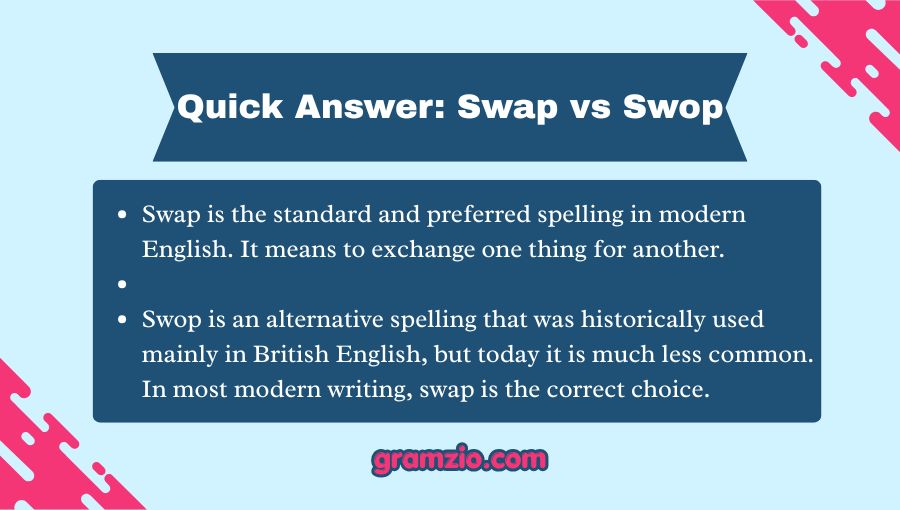
Swap is the standard and preferred spelling in modern English. It means to exchange one thing for another.
Swop is an alternative spelling that was historically used mainly in British English, but today it is much less common. In most modern writing, swap is the correct choice.
Understanding the Basics of Swap vs Swop
The main difference between swap and swop is not their meaning but their spelling and usage frequency.
Both words mean:
- To exchange one thing for another
- To trade items, positions, ideas, or responsibilities
- To substitute something with something else
However, modern English strongly favors swap.
Comparison Table
| Form | Type | Meaning | Example | Correct/Incorrect |
|---|---|---|---|---|
| Swap | Verb/Noun | Exchange something for another | Let’s swap seats. | ✅ Correct |
| Swop | Verb/Noun | Exchange something for another | Let’s swop seats. | ⚠ Rare/Nonstandard |
| Swap | Modern Standard English | Widely accepted worldwide | We swapped numbers. | ✅ Correct |
| Swop | Historical Alternative | Mostly outdated spelling | We swopped numbers. | ⚠ Rare Usage |
Key Takeaway
If you’re unsure, always choose swap. It is the spelling recognized and preferred in modern dictionaries, style guides, and professional writing.
Correct Meanings and Uses
What Does “Swap” Mean?
The word swap functions as both a verb and a noun.
As a Verb
It means to exchange something.
Examples:
- We swapped phone numbers.
- They swapped classrooms for the day.
- I want to swap my ticket for a later flight.
Sentence Breakdown:
We swapped phone numbers.
- Subject: We
- Verb: swapped
- Object: phone numbers
Meaning: Both people exchanged contact information.
As a Noun
It refers to the exchange itself.
Examples:
- The toy swap was successful.
- We organized a book swap at school.
Test Tip ✅
Replace the word with exchange.
If the sentence still makes sense, swap is likely correct.
Example:
- Let’s swap seats.
- Let’s exchange seats.
Both work perfectly.
What Does “Swop” Mean?
Swop has the same meaning as swap.
Examples:
- They swopped houses during the vacation.
- We decided to swop duties.
However, these examples sound unusual to most modern readers because swap is now the dominant spelling.
Test Tip ✅
Ask yourself:
“Am I writing for a modern audience?”
If yes, use swap.
Case Study Section
Workplace Email Example
Imagine an employee wants to exchange work shifts.
Correct Modern Usage
Hi Sarah,
Would you like to swap shifts with me on Friday? I have an appointment in the afternoon.
Thanks,
James
This sounds natural and professional.
Less Common Usage
Hi Sarah,
Would you like to swop shifts with me on Friday?
Thanks,
James
Although some readers may understand it, the spelling appears outdated or unusual.
Lesson Learned
In professional communication, swap creates clarity and avoids distracting readers.
Grammar Rules Explanation
Why Is “Swap” Considered Correct?
Modern dictionaries and grammar references recognize swap as the standard spelling.
The word evolved through common usage and became the dominant form in both American and British English.
Major language references generally list:
- Swap as the primary spelling
- Swop as a variant or historical alternative
According to standard dictionary usage, including references such as Merriam-Webster, swap is the accepted modern spelling.
Rule to Remember
✅ Modern English → Swap
⚠ Historical or rare regional usage → Swop
Why Is “Swop” Less Common?
Language changes over time.
Many English words once had multiple spellings. Eventually, one version became dominant.
For example:
- Show vs shew
- Music vs musick
- Public vs publick
Similarly, swap became the preferred spelling while swop gradually declined.
Common Mistakes
People often make mistakes because the words sound identical.
Why the Confusion Happens
Fast Typing
Writers may accidentally type the wrong version.
Autocorrect Issues
Some devices recognize older spellings.
Lack of Knowledge
Many people assume both spellings are equally common today.
Similar Grammar Confusions
| Confusing Pair | Difference |
|---|---|
| It’s / Its | Contraction vs Possessive |
| Your / You’re | Possessive vs “You are” |
| Then / Than | Time vs Comparison |
| Affect / Effect | Verb vs Noun |
| Swap / Swop | Standard vs Rare Alternative |
| To / Too | Direction vs Also |
| Their / There | Possession vs Location |
Test Tip ✅
When editing, check whether the spelling is the modern standard form.
Usage in Different Contexts
Everyday Conversation
People almost always use swap.
Examples:
- Let’s swap places.
- Can we swap tickets?
- I swapped my lunch with a friend.
Professional Writing
Professional documents should use swap.
Examples:
- Employees may swap shifts with approval.
- The company allows staff to swap schedules.
Using swap helps maintain professionalism.
Creative Writing
Authors may occasionally use swop to:
- Reflect historical periods
- Create regional dialects
- Mimic older British speech
Example:
“Let’s swop hats for the afternoon,” said the old gentleman.
This stylistic choice is rare.
Social Media and Texting
Most users naturally write:
- Swap pics?
- Let’s swap ideas.
- Anyone want to swap tickets?
The spelling swop appears very infrequently online.
Why It Matters
Using the correct spelling improves communication in several ways.
Clarity in Communication
Readers immediately recognize swap.
There is no confusion about meaning.
Professionalism
Correct spelling helps establish credibility.
Employers, clients, and colleagues notice polished writing.
Writing Accuracy in Digital Communication
Online communication moves quickly.
Using standard spellings helps readers understand messages without hesitation.
Quote
“Clear writing is clear thinking.”
Choosing the standard spelling contributes to clearer communication.
Special Exception
When Might “Swop” Still Appear?
Although uncommon, you may encounter swop in:
- Older British publications
- Historical documents
- Archived newspapers
- Literary works
- Regional dialect writing
These situations are exceptions rather than the norm.
Important Note
Finding swop in a book does not mean it is the preferred modern spelling.
Quick Recap Checklist
| Question | If Yes → Use |
|---|---|
| Are you writing modern English? | Swap |
| Are you writing professionally? | Swap |
| Are you posting online? | Swap |
| Are you communicating at work? | Swap |
| Are you using a historical style? | Possibly Swop |
| Are you unsure? | Swap |
Practice Examples
Example 1
We decided to ___ phone numbers.
✅ Swap
Example 2
Can you ___ seats with me?
✅ Swap
Example 3
The friends agreed to ___ books.
✅ Swap
FAQs About Swap vs Swop
Is swop a real word?
Yes. Swop is a real word and an alternative spelling of swap, but it is much less common in modern English.
Which is correct: swap or swop?
Swap is the standard and preferred spelling in modern English.
Is swop used in British English?
Historically, yes. However, modern British English overwhelmingly prefers swap.
Can I use swop in professional writing?
It is not recommended. Use swap to ensure clarity and professionalism.
Why do swap and swop mean the same thing?
They developed as spelling variants of the same word. Over time, swap became the dominant form.
Will readers understand swop?
Many readers will understand it, but some may view it as outdated or unusual. Using swap avoids confusion.
Conclusion
The debate over swap vs swop is much simpler than it first appears. Both words share the same meaning: to exchange one thing for another. However, modern English strongly favors swap, making it the standard spelling for everyday communication, professional writing, academic work, and online content.
While swop still exists as a historical or regional variant, it is rarely used today and may look unusual to many readers. For that reason, choosing swap is almost always the safest and most effective option.
Remember this simple rule: If you’re writing for a modern audience, use “swap.” It improves clarity, supports professionalism, and ensures your message is understood immediately.
When in doubt, make the swap—not the swop. ✨
Also read: Double Check or Double Confirm

Hi, I’m Axton Vane. I work at gramzio.com and bring over 11 years of experience in professional grammar. I specialize in refining complex syntax to help writers achieve perfect clarity in every sentence.