
Persue or Pursue: Which Spelling Is Correct?
Have you ever typed a word, looked at it twice, and still wondered whether it was correct? 🤔 One common spelling confusion in English is “persue or pursue.” Many people accidentally write persue when they actually mean pursue. Since the words look similar and are often pronounced quickly in conversation, the mistake is understandable.
However, only one spelling is accepted in standard English. Using the wrong version can make your writing appear less professional, especially in emails, job applications, academic papers, and business communication.
Understanding the difference between persue or pursue is important because the correct spelling appears frequently in everyday writing. Whether you are talking about pursuing a dream, pursuing a career, or pursuing a goal, knowing the correct form helps you communicate clearly and confidently.
In this guide, you’ll learn the correct spelling, meaning, grammar rules, practical examples, common mistakes, and helpful memory tricks. By the end, you’ll never wonder about persue or pursue again. 🚀
Quick Answer: Persue or Pursue?
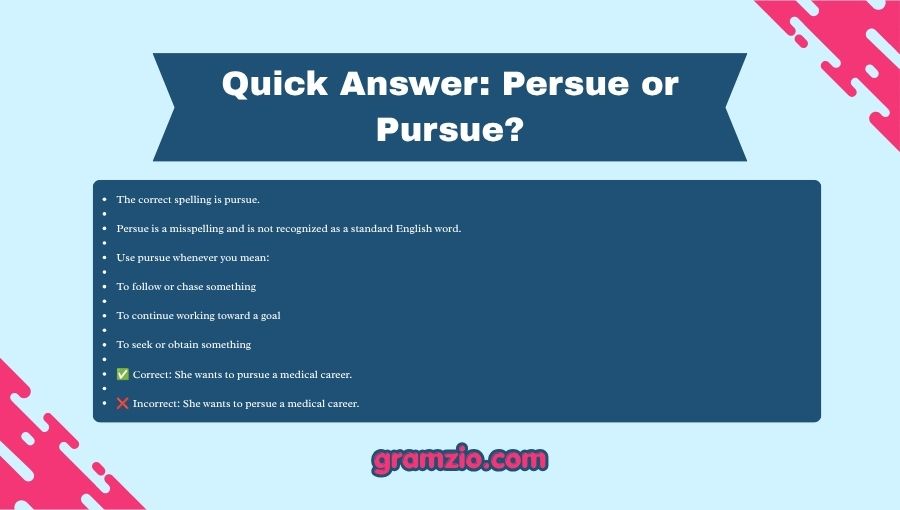
The correct spelling is pursue.
Persue is a misspelling and is not recognized as a standard English word.
Use pursue whenever you mean:
- To follow or chase something
- To continue working toward a goal
- To seek or obtain something
✅ Correct: She wants to pursue a medical career.
❌ Incorrect: She wants to persue a medical career.
Understanding the Basics: Persue or Pursue
The confusion comes from spelling. Many English learners and native speakers accidentally switch the positions of the letters r and s, resulting in persue.
The standard dictionary spelling is pursue.
Comparison Table
| Form | Type | Meaning | Example | Correct/Incorrect |
|---|---|---|---|---|
| Pursue | Verb | To follow, chase, seek, or continue toward a goal | I will pursue my dreams. | ✅ Correct |
| Persue | Misspelling | No recognized meaning in standard English | I will persue my dreams. | ❌ Incorrect |
Key Takeaway
Whenever you see persue, replace it with pursue.
Correct Meanings and Uses of Pursue
Pursue Meaning #1: To Follow or Chase
One meaning of pursue is to follow something or someone.
Examples
- The police pursued the suspect.
- The lion pursued its prey across the grassland.
- The dog pursued the ball.
Sentence Breakdown
The police pursued the suspect.
- Subject: The police
- Verb: pursued
- Object: the suspect
The verb indicates active chasing.
Test Tip ✅
If you can replace the word with chase, then pursue is probably correct.
Pursue Meaning #2: To Work Toward a Goal
This is one of the most common uses.
Examples
- She pursued a degree in engineering.
- He plans to pursue higher education.
- They are pursuing financial independence.
Sentence Breakdown
She pursued a degree in engineering.
The action is not physical chasing. Instead, it means actively working toward achieving something.
Test Tip ✅
If the meaning is to strive for or seek, use pursue.
Pursue Meaning #3: To Continue an Activity
Sometimes pursue means continuing a course of action.
Examples
- The company will pursue new opportunities.
- Researchers continue to pursue innovative solutions.
- The team pursued its strategy despite setbacks.
Test Tip ✅
If the sentence suggests ongoing effort, pursue is likely the correct choice.
Pursue Meaning #4: To Engage in a Profession or Interest
Examples
- She decided to pursue teaching.
- He wants to pursue acting.
- They pursued careers in technology.
Test Tip ✅
When discussing careers, hobbies, or interests, pursue is the correct spelling.
Case Study Section
Workplace Email Example
Imagine an employee writing to their manager.
Incorrect Version
I would like to persue additional training opportunities this year.
The misspelling may make the message appear less polished.
Correct Version
I would like to pursue additional training opportunities this year.
This version looks professional and grammatically correct.
Why It Matters
Small spelling mistakes can influence how readers perceive your attention to detail. Using pursue correctly strengthens credibility and professionalism.
Grammar Rules Explanation
Why Is Pursue Correct?
According to standard English dictionaries, including Merriam-Webster, pursue is the accepted spelling of the verb.
The word comes from historical forms derived through French and Latin influences. Over time, the standardized English spelling became pursue.
The spelling persue never became part of standard English grammar.
Grammar Rule
When writing the verb meaning:
- chase
- seek
- follow
- continue
- strive for
Always use:
✅ pursue
Never use:
❌ persue
Common Mistakes
Why Do People Write Persue?
Several factors contribute to the error.
1. Fast Typing ⌨️
People often type quickly and accidentally rearrange letters.
2. Pronunciation Similarities 🗣️
In rapid speech, the vowel sounds can make the spelling seem unclear.
3. Autocorrect Dependence 📱
Writers sometimes rely too heavily on spell-check tools.
4. Lack of Familiarity 📚
Some people simply haven’t encountered the correct spelling often enough.
Similar Grammar Confusions
| Incorrect Pair | Correct Usage |
|---|---|
| its / it’s | Its = possession, It’s = it is |
| your / you’re | Your = possession, You’re = you are |
| then / than | Then = time, Than = comparison |
| affect / effect | Affect = verb, Effect = noun |
| loose / lose | Loose = not tight, Lose = fail to keep |
| persue / pursue | Pursue is always correct |
Usage in Different Contexts
Everyday Conversation
People frequently use pursue when discussing goals and ambitions.
Examples
- I’m going to pursue my dream job.
- She wants to pursue music.
Professional Writing
Professional documents often contain this word.
Examples
- The organization will pursue strategic growth.
- We intend to pursue additional partnerships.
Business communication should always use the correct spelling.
Academic Writing
Examples
- Students may pursue advanced research opportunities.
- The study pursues a new analytical approach.
Accuracy is particularly important in academic work.
Creative Writing
Authors often use pursue to create action and motivation.
Examples
- The knight pursued the dragon through the mountains.
- She pursued answers hidden in the ancient manuscript.
Social Media and Texting
Even in casual communication, correct spelling improves clarity.
Examples
- Time to pursue my fitness goals! 💪
- Always pursue what makes you happy. 😊
Why It Matters
Using the correct spelling of pursue matters for several reasons.
1. Clarity in Communication
Correct spelling ensures readers understand your message immediately.
2. Professionalism
Employers, clients, teachers, and colleagues notice writing quality.
3. Credibility
Accurate spelling builds trust.
4. Digital Communication Accuracy
Emails, websites, blogs, and social media posts benefit from polished writing.
Quote
“Good communication begins with clear and accurate language.”
A single corrected spelling can improve the effectiveness of an entire message.
Special Exception
Are There Any Exceptions?
No.
In modern standard English:
- Pursue is always the correct spelling.
- Persue is always considered a spelling error.
There are no recognized grammar exceptions.
Some websites, usernames, brand names, or personal project names may intentionally use Persue, but that does not make it a correct dictionary word.
Quick Recap Checklist
Use this checklist whenever you’re unsure.
| Question | If Yes → Use |
|---|---|
| Are you talking about chasing someone or something? | Pursue |
| Are you talking about achieving a goal? | Pursue |
| Are you talking about a career or education? | Pursue |
| Are you continuing an effort or activity? | Pursue |
| Did you write “persue”? | Change it to Pursue |
Practice Examples
Example 1
I want to ______ a career in medicine.
✅ pursue
Example 2
The detective ______ the suspect.
✅ pursued
Example 3
They continue to ______ innovation.
✅ pursue
Frequently Asked Questions (FAQs)
Is persue a real word?
No. Persue is a misspelling and is not recognized as a standard English word.
Which is correct: persue or pursue?
Pursue is correct. Persue is incorrect.
What does pursue mean?
Pursue means to follow, seek, chase, continue, or work toward achieving something.
Why do people misspell pursue?
The mistake usually happens because of fast typing, letter transposition, pronunciation confusion, or lack of familiarity with the correct spelling.
Can I use persue in formal writing?
No. Formal writing should always use pursue.
How can I remember the correct spelling?
Remember that pursue contains the sequence “urs” after the letter p.
Think:
Pursue Your Goals
The phrase can help reinforce the correct spelling.
Is pursue a verb?
Yes. Pursue is a verb that describes following, seeking, chasing, or striving toward something.
Conclusion
The debate over persue or pursue has a very simple answer: pursue is the only correct spelling. Whether you’re talking about chasing a suspect, pursuing higher education, pursuing a career, or pursuing your dreams, the proper word is always pursue.
The misspelling persue commonly appears because of typing errors, pronunciation confusion, and unfamiliarity with the correct form. Fortunately, once you understand the rule, the mistake is easy to avoid.
Whenever you’re unsure, remember this simple guideline: if you mean to follow, seek, continue, or work toward something, use pursue. There are no standard grammar exceptions.
Mastering small spelling details like this improves communication, strengthens professionalism, and helps your writing appear polished and trustworthy. ✨
So from now on, confidently pursue excellence in your writing—and never write “persue” again.
Also read: Headed vs Heading

Hi, I’m Elara Quinn. Working at gramzio.com, I use my 8 years of experience in linguistics to simplify difficult English rules, making them accessible and easy to learn for our global community.