If He Was vs If He Were: Which One Is Correct? 🤔
Have you ever wondered about the difference between if he was vs if he were when writing or speaking English? You’re not alone. This common grammar question confuses native speakers, students, writers, and professionals because both phrases sound correct in certain situations.
At first glance, both expressions seem interchangeable. After all, people use them regularly in conversations, books, emails, and social media posts. However, the distinction between if he was vs if he were is more important than many people realize. Choosing the correct form depends on whether you’re talking about a real possibility or a hypothetical situation.
English grammar includes special rules for wishes, imaginary scenarios, and conditions that are contrary to fact. In these cases, grammar experts often recommend “if he were.” Meanwhile, “if he was” is typically used when referring to something that may actually have happened or could be true.
Understanding the rule behind if he was vs if he were can improve your writing, strengthen your communication skills, and help you avoid one of the most common grammar mistakes in English. In this guide, you’ll learn when to use each form, why the difference matters, and how to apply the rule confidently in everyday communication. ✨
Quick Answer: If He Was vs If He Were
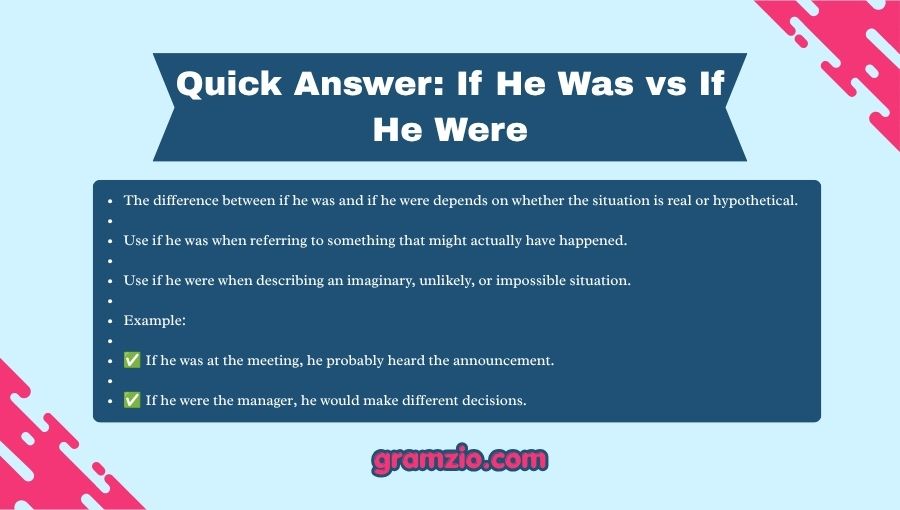
The difference between if he was and if he were depends on whether the situation is real or hypothetical.
- Use if he was when referring to something that might actually have happened.
- Use if he were when describing an imaginary, unlikely, or impossible situation.
Example:
✅ If he was at the meeting, he probably heard the announcement.
✅ If he were the manager, he would make different decisions.
Understanding the Basics of If He Was vs If He Were
The key difference lies in the grammatical mood being used.
| Form | Type | Meaning | Example | Correct/Incorrect |
|---|---|---|---|---|
| If he was | Indicative Mood | Refers to a possible fact or real event | If he was late, traffic may have caused it. | Correct |
| If he were | Subjunctive Mood | Refers to a hypothetical or unreal situation | If he were rich, he would travel the world. | Correct |
| If he was rich, he would travel the world. | Hypothetical Situation | Traditionally less formal | If he was rich, he would travel the world. | Often considered less correct |
| If he were at the meeting yesterday. | Real Past Event | Incorrect use of subjunctive | If he were at the meeting yesterday. | Incorrect |
Simple Rule
Ask yourself:
Is this situation real or possibly true?
➡️ Use if he was
Is this situation imaginary, hypothetical, or contrary to fact?
➡️ Use if he were
Correct Meanings and Uses
When to Use “If He Was” ✅
Use if he was when discussing a situation that may have occurred in reality.
Example 1
If he was at the office yesterday, he probably saw the report.
Breakdown:
- Being at the office is possible.
- The speaker is uncertain.
- The event could have happened.
Example 2
If he was responsible for the mistake, we’ll discuss it tomorrow.
Breakdown:
- The responsibility is not yet confirmed.
- It remains a real possibility.
Test Tip 💡
Replace the sentence with:
“If it turns out that he was…”
If the meaning still works, if he was is usually correct.
When to Use “If He Were” ✅
Use if he were when talking about imaginary, impossible, or unlikely situations.
Example 1
If he were taller, he could play professional basketball.
Breakdown:
- He is not taller.
- The statement imagines an alternative reality.
Example 2
If he were president, he would change the policy.
Breakdown:
- He is not president.
- The sentence is purely hypothetical.
Test Tip 💡
Try replacing the sentence with:
“Imagine that he was…”
If you’re imagining a different reality, if he were is usually the better choice.
Wishes and Desires
The subjunctive form often appears with wishes.
Examples
✅ I wish he were here.
✅ I wish he were more confident.
✅ I wish he were able to join us.
These statements express something that is not currently true.
Conditional Sentences
Conditional sentences frequently require if he were.
Examples
✅ If he were available, he would help.
✅ If he were my neighbor, I’d invite him over.
✅ If he were younger, he’d enjoy the trip more.
Case Study Section
Workplace Email Example 📧
Imagine a team leader discussing a project delay.
Incorrect Interpretation
“If he were responsible for the missing files, we’ll investigate further.”
Why?
The company is trying to determine a real fact. Responsibility is possible, not imaginary.
Correct Version
“If he was responsible for the missing files, we’ll investigate further.”
Now consider another situation:
“If he were the department head, he would approve this proposal.”
This is hypothetical because he is not the department head.
Practical Lesson
- Real possibility → if he was
- Imaginary scenario → if he were
Understanding the distinction makes workplace communication more precise and professional.
Grammar Rules Explanation
The Indicative Mood
The indicative mood describes facts, possibilities, and real situations.
Example:
If he was sick yesterday, that explains his absence.
The speaker believes sickness is a real possibility.
The Subjunctive Mood
The subjunctive mood expresses:
- Wishes
- Hypothetical situations
- Imaginary scenarios
- Conditions contrary to fact
Example:
If he were a doctor, he could answer that question.
The speaker knows he is not a doctor.
What Do Grammar Authorities Say?
According to grammar guidance found in dictionaries and style references such as Merriam-Webster, the traditional rule favors “were” in hypothetical statements regardless of whether the subject is I, he, she, or it.
Examples:
✅ If I were
✅ If he were
✅ If she were
✅ If it were
This usage preserves the subjunctive mood and remains standard in formal English.
Common Mistakes
People often mix up these forms because modern spoken English sometimes blurs the distinction.
Why These Mistakes Happen
Fast Typing ⌨️
Writers often choose the first phrase that sounds natural.
Autocorrect 📱
Some devices suggest common forms without considering grammar context.
Lack of Grammar Knowledge 📚
Many people are never formally taught the subjunctive mood.
Similar Grammar Confusions
| Confusing Pair | Correct Usage |
|---|---|
| It’s vs Its | It’s = it is; Its = possession |
| Your vs You’re | Your = possession; You’re = you are |
| Their vs There | Different meanings |
| Who’s vs Whose | Who’s = who is; Whose = possession |
| Then vs Than | Time vs comparison |
| If He Was vs If He Were | Real possibility vs hypothetical situation |
Usage in Different Contexts
Everyday Conversation 🗣️
Informal speech often uses both forms.
Example:
“If he was here earlier, I missed him.”
“If he were here, he’d know what to do.”
Professional Writing 💼
Formal writing generally follows traditional grammar rules.
Example:
“If he were appointed director, significant changes would occur.”
This sounds polished and professional.
Creative Writing ✍️
Authors frequently use subjunctive constructions to create imagined scenarios.
Example:
“If he were a king, every street would bear his name.”
Social Media and Texting 📱
People often ignore formal grammar online.
Example:
“If he was rich lol 😂”
While common online, many editors would still prefer:
“If he were rich.”
Why It Matters
Grammar is not just about rules. It is about communicating clearly.
Using the correct form helps readers instantly understand whether you’re discussing:
- Reality
- Possibility
- Imagination
- Hypothetical situations
Benefits
Better Clarity
Readers understand exactly what you mean.
Professionalism
Correct grammar creates a stronger impression.
Improved Writing Accuracy
Accurate language builds credibility.
Stronger Digital Communication
Emails, reports, and online content become easier to understand.
“Clear writing reflects clear thinking.”
A small grammar choice can make a big difference.
Special Exception
Modern English Flexibility
In casual American English, many speakers use if he was even in hypothetical situations.
Example:
“If he was here right now, he’d help us.”
While many people say this naturally, formal grammar still generally prefers:
“If he were here right now, he’d help us.”
Therefore:
- Informal speech may allow flexibility.
- Formal writing should usually use if he were for hypotheticals.
Quick Recap Checklist
Which Form Should You Use?
| Question | If Yes → Use |
|---|---|
| Is the event possibly true? | If he was |
| Did it actually happen or might it have happened? | If he was |
| Is the situation imaginary? | If he were |
| Is the situation contrary to fact? | If he were |
| Are you expressing a wish? | If he were |
| Are you creating a hypothetical scenario? | If he were |
Practice Examples
Example 1
_____ at the party last night, he probably met Sarah.
✅ If he was
Example 2
_____ the CEO, he would change the company policy.
✅ If he were
Example 3
I wish _____ more interested in reading.
✅ he were
FAQs About If He Was vs If He Were
1. Is “if he were” grammatically correct?
Yes. If he were is grammatically correct when discussing hypothetical, imaginary, or unreal situations.
2. Is “if he was” ever correct?
Absolutely. Use if he was when referring to a real possibility or an event that may actually have happened.
3. Why do people say “if he was” instead of “if he were”?
Many native speakers use informal grammar in everyday conversation. Spoken English often simplifies traditional subjunctive rules.
4. Which form should I use in professional writing?
Use if he were for hypothetical situations and if he was for real possibilities. This follows standard grammar conventions.
5. Is “I wish he was here” wrong?
Not necessarily in casual speech, but formal grammar traditionally prefers:
✅ I wish he were here.
6. Do grammar experts still recommend “were”?
Yes. Most grammar authorities and style guides continue to recommend were for hypothetical and contrary-to-fact situations.
Conclusion
Understanding if he was vs if he were becomes much easier once you recognize the difference between reality and imagination. Use if he was when discussing something that may actually have happened. Use if he were when describing hypothetical situations, wishes, or conditions that are contrary to fact.
The traditional grammar rule remains simple: real possibility equals was, while imaginary possibility equals were. Although modern conversation sometimes blurs the distinction, using the correct form can make your writing clearer, more professional, and more accurate.
Whenever you’re unsure, ask yourself one question: Is this real, or am I imagining it? The answer will usually tell you which form to choose.
Master this rule, and you’ll eliminate one of the most common English grammar mistakes with confidence. 🚀
Also read: Mine as Well or Might as Well

Hi, I’m Willa Sterling. I work at gramzio.com as a senior editor. With 15 years of experience in academic and formal grammar, I provide the expert insights you need to make your writing flawless.