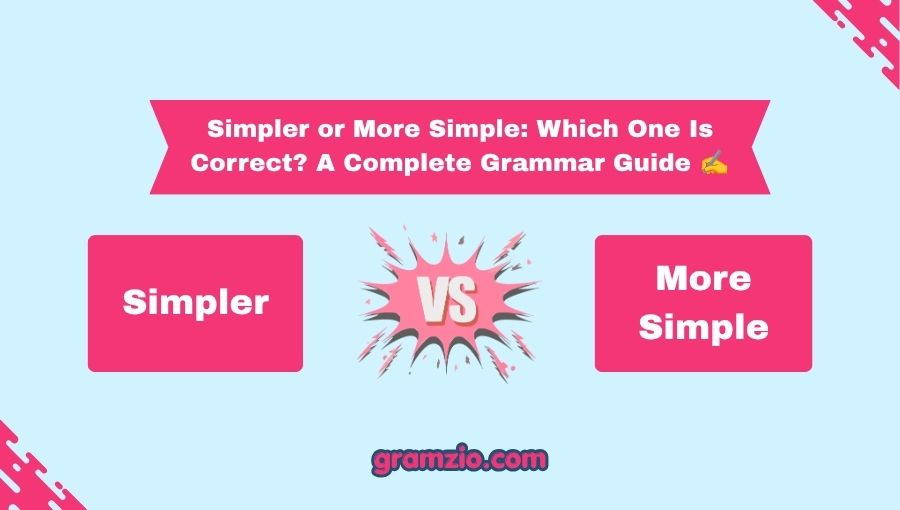
Simpler or More Simple: Which One Is Correct? A Complete Grammar Guide ✍️
Have you ever wondered whether simpler or more simple is the correct phrase to use in a sentence? 🤔 This common grammar question confuses many English learners and native speakers alike because both forms seem possible at first glance. Knowing the difference can help you write more naturally and confidently.
The confusion exists because English adjectives can form comparisons in different ways. Some adjectives add “-er” to become comparative, while others use “more” before the adjective. Since both “simpler” and “more simple” seem to follow common English patterns, many people assume they are interchangeable.
The good news is that both forms can be correct. However, one is usually preferred in modern English. Understanding when and why each form is used can make your writing clearer, more professional, and more natural.
In this guide, you’ll learn the difference between simpler or more simple, discover the grammar rules behind comparative adjectives, see practical examples, avoid common mistakes, and gain confidence in choosing the best option every time. 🚀
Quick Answer: Simpler or More Simple
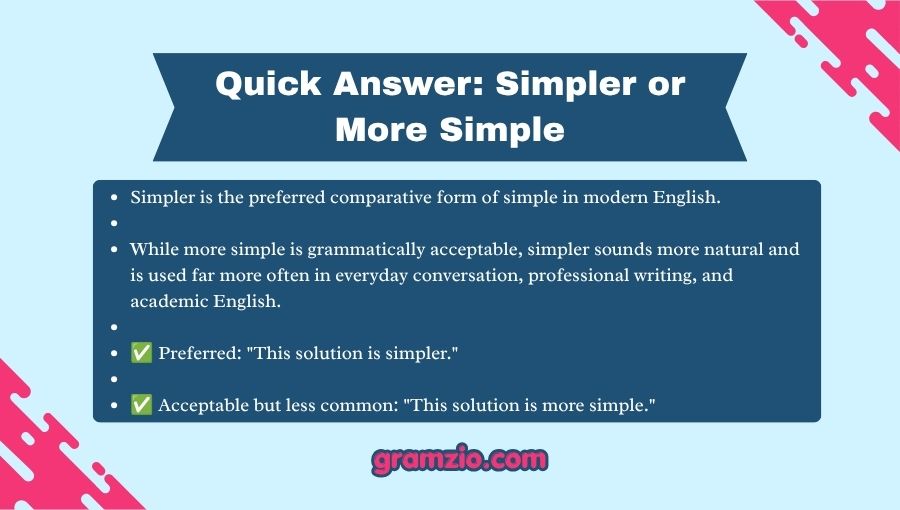
Simpler is the preferred comparative form of simple in modern English.
While more simple is grammatically acceptable, simpler sounds more natural and is used far more often in everyday conversation, professional writing, and academic English.
✅ Preferred: “This solution is simpler.”
✅ Acceptable but less common: “This solution is more simple.”
Understanding the Basics of Simpler or More Simple
To understand the difference, you first need to know how comparative adjectives work.
A comparative adjective compares two things.
Examples:
- Tall → Taller
- Fast → Faster
- Smart → Smarter
- Simple → Simpler
Some adjectives form comparisons by adding -er, while longer adjectives typically use more.
Comparison Table
| Form | Type | Meaning | Example | Correct/Incorrect |
|---|---|---|---|---|
| Simpler | Comparative adjective | Easier to understand | This method is simpler. | ✅ Correct |
| More Simple | Comparative adjective phrase | Easier to understand | This method is more simple. | ✅ Correct but less common |
| Simple | Base adjective | Easy to understand | The instructions are simple. | ✅ Correct |
| Most Simple | Superlative phrase | Simplest among many | Rarely used | ⚠️ Usually avoided |
| Simplest | Superlative adjective | Easiest among many | This is the simplest method. | ✅ Correct |
Key Takeaway
Although both forms are grammatically valid, simpler is generally preferred because it is shorter, smoother, and more natural.
Correct Meanings and Uses
Using “Simpler”
The word simpler is the standard comparative form of simple.
It compares one thing with another and suggests that one option is easier, clearer, or less complicated.
Examples
- This explanation is simpler than the first one.
- The new software has a simpler interface.
- Her approach is simpler and more effective.
Sentence Breakdown
Sentence:
“The new design is simpler.”
Breakdown:
- New design = subject
- Is = linking verb
- Simpler = comparative adjective
Meaning:
The new design is easier to understand than another design.
Test Tip ✅
If the adjective is short and naturally accepts -er, use the comparative form ending in -er.
Using “More Simple”
The phrase more simple is not technically wrong.
However, it is less common because English speakers usually prefer the shorter comparative form.
Examples
- We need a more simple explanation.
- The updated instructions are more simple than before.
Although these sentences are correct, many editors would revise them:
✔ Better:
- We need a simpler explanation.
- The updated instructions are simpler than before.
Test Tip ✅
If replacing more simple with simpler sounds natural, choose simpler.
Why Is “Simpler” More Common?
English naturally favors efficiency. ✨
When an adjective comfortably accepts -er, speakers typically choose that form instead of using more.
Consider these examples:
| Preferred | Less Preferred |
|---|---|
| Smaller | More small |
| Faster | More fast |
| Simpler | More simple |
| Cleaner | More clean |
The shorter version generally sounds smoother and more natural.
Case Study Section
Workplace Email Example
Imagine two employees writing instructions for a new software tool.
Version A
“The new process is more simple than the previous system.”
Version B
“The new process is simpler than the previous system.”
Most readers immediately find Version B more natural and professional.
Why?
Because simpler follows the standard comparative pattern for short adjectives.
Real-World Impact
Using common grammar patterns:
- Improves readability
- Increases professionalism
- Makes communication clearer
- Reduces confusion
In workplace communication, small grammar choices often create a stronger impression.
Grammar Rules Explanation
Rule 1: Comparative Adjectives
Comparative adjectives compare two people, places, things, or ideas.
Examples:
- Tall → Taller
- Small → Smaller
- Simple → Simpler
According to standard English grammar references and dictionaries such as Merriam-Webster, simple commonly forms its comparative as simpler.
Rule 2: Short Adjectives Usually Take “-er”
Most one-syllable adjectives use -er.
Examples:
- Fast → Faster
- Smart → Smarter
- Long → Longer
Although simple has two syllables, it behaves like many adjectives that comfortably take -er.
Therefore:
✅ Simpler
is preferred.
Rule 3: Longer Adjectives Usually Use “More”
Examples:
- More beautiful
- More important
- More comfortable
These adjectives do not naturally take -er.
For this reason:
❌ Beautifuller
❌ Importanter
❌ Comfortabler
are incorrect.
Rule 4: Don’t Use Double Comparatives
Never combine both forms.
Incorrect:
❌ More simpler
Correct:
✅ Simpler
✅ More simple
Only one comparative marker should be used.
Common Mistakes
Many writers make mistakes because English contains multiple comparison patterns.
Why Mistakes Happen
Fast Typing ⌨️
Writers often choose whichever version comes to mind first.
Autocorrect
Some grammar tools fail to flag uncommon but technically correct forms.
Lack of Knowledge
Many people do not know when to use -er versus more.
Similar Grammar Confusions
| Confusion | Correct Usage |
|---|---|
| It’s vs Its | It’s = it is; Its = possession |
| Your vs You’re | Your = possession; You’re = you are |
| Than vs Then | Than = comparison; Then = time |
| Affect vs Effect | Affect = verb; Effect = noun |
| Simpler vs More Simple | Simpler is usually preferred |
Usage in Different Contexts
Everyday Conversation
People naturally choose simpler.
Examples:
- This recipe is simpler.
- The new route is simpler.
- Your explanation is simpler.
Professional Writing
Business communication favors concise language.
Examples:
- The revised process is simpler.
- We developed a simpler solution.
- The report presents a simpler framework.
Academic Writing
Academic writers occasionally use more simple, especially when emphasizing a specific contrast.
Example:
- The second model is more simple in structure.
However, simpler remains more common.
Creative Writing
Authors often choose whichever version fits the rhythm of the sentence.
Example:
- He searched for a simpler life.
- She wished for a more simple existence.
Both may appear depending on style.
Social Media and Texting
On social media, brevity matters.
Examples:
- Keep it simpler.
- Here’s a simpler way.
- Life feels simpler now.
The shorter form dominates online communication.
Why It Matters
Many people assume grammar choices are insignificant.
In reality, choosing the correct comparative form affects clarity and professionalism.
Clarity
Readers understand familiar structures more quickly.
Professionalism
Proper grammar creates credibility.
Writing Accuracy
Consistent grammar improves overall quality.
Digital Communication
Emails, blogs, and social media posts are easier to read when language feels natural.
A Helpful Quote
“Clear writing is clear thinking.”
Using the most natural comparative form helps your message reach readers more effectively.
Special Exception
Although simpler is preferred, more simple is not automatically wrong.
Sometimes writers intentionally use more simple for:
- Emphasis
- Stylistic preference
- Formal comparisons
- Literary rhythm
Example:
“The new version is more simple in appearance but more powerful in function.”
Such cases are uncommon but acceptable.
Quick Recap Checklist
Which Form Should You Use?
| Question | If Yes → Use |
|---|---|
| Are you comparing two things? | Simpler |
| Does the adjective naturally take -er? | Simpler |
| Are you writing everyday English? | Simpler |
| Do you need a highly natural expression? | Simpler |
| Is there a special stylistic reason? | More Simple (sometimes) |
Practice Examples
Example 1
“This explanation is _____ than the first one.”
✅ Simpler
Example 2
“The updated design is _____ to use.”
✅ Simpler
Example 3
“We need a _____ approach.”
✅ Simpler
FAQs About Simpler or More Simple
Is “more simple” grammatically correct?
Yes. It is grammatically correct, but it is less common than simpler.
Which is more natural: simpler or more simple?
Simpler sounds more natural to most native English speakers.
Why do people say “more simple”?
Some writers prefer it for emphasis, style, or specific sentence flow.
Can I use “more simpler”?
No. This is a double comparative and is grammatically incorrect.
Correct:
- Simpler
- More simple
Incorrect:
- More simpler
What is the superlative form of simple?
The superlative form is simplest.
Example:
“This is the simplest solution.”
Should I use simpler in formal writing?
Yes. Most professional editors and style guides prefer simpler because it is concise and natural.
Final Comparison Table
| Feature | Simpler | More Simple |
|---|---|---|
| Grammatically Correct | Yes | Yes |
| Common in Everyday English | Yes | Less Common |
| Preferred by Editors | Yes | Usually No |
| Professional Writing | Preferred | Rare |
| Natural Sound | Very Natural | Slightly Formal or Unusual |
Conclusion
The debate over simpler or more simple is easier to resolve than many grammar questions. Both forms are grammatically correct, but simpler is the standard and preferred comparative form of simple. It sounds more natural, reads more smoothly, and appears more frequently in modern English.
In everyday conversation, professional communication, academic writing, and digital content, simpler is usually the best choice. While more simple can occasionally appear for stylistic or rhetorical reasons, it is generally less common and often replaced by the shorter comparative form.
Whenever you’re unsure, remember this simple rule: if simple can comfortably take -er, choose simpler. Doing so will make your writing clearer, more concise, and more natural for your audience.
📚 Good grammar does not have to be complicated—the simplest choice is often the best one.
Also read: Has Run vs Has Ran

Hi, I’m Elara Quinn. Working at gramzio.com, I use my 8 years of experience in linguistics to simplify difficult English rules, making them accessible and easy to learn for our global community.