Has Run vs Has Ran: Which One Is Correct? A Complete Grammar Guide ✅🏃
If you’ve ever been confused about has run vs has ran, you’re not alone. 🤔 Many people struggle with this common grammar question because both words come from the verb run, yet only one form is correct in certain situations. You might have written a sentence like “He has ran five miles today” and wondered whether it sounded right.
Many English learners and even native speakers get confused because both run and ran are forms of the same verb. Since they are closely related, it can be difficult to remember which one belongs in certain sentence structures.
The confusion becomes even greater when using helping verbs such as has, have, and had. While one phrase is grammatically correct, the other is considered an error in standard English.
Understanding the difference between has run vs has ran can instantly improve your writing, speaking, and professional communication. Whether you’re writing emails, social media posts, academic papers, or workplace reports, using the correct verb form helps you sound more confident and credible.
In this guide, you’ll learn exactly when to use has run, why has ran is incorrect, and how to avoid this mistake forever. 🚀
Quick Answer: Has Run vs Has Ran
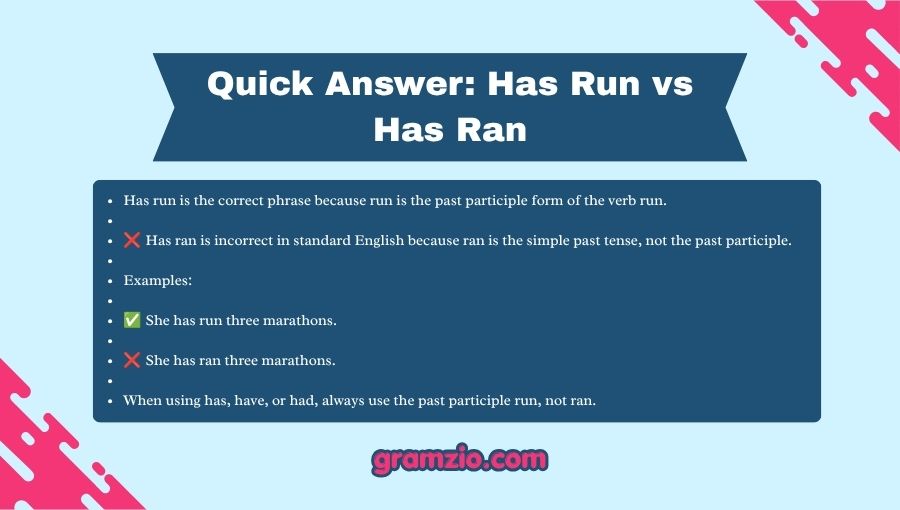
Has run is the correct phrase because run is the past participle form of the verb run.
❌ Has ran is incorrect in standard English because ran is the simple past tense, not the past participle.
Examples:
✅ She has run three marathons.
❌ She has ran three marathons.
When using has, have, or had, always use the past participle run, not ran.
Understanding the Basics of Has Run vs Has Ran
To understand the difference, you first need to know the three principal forms of the verb run.
| Form | Type | Meaning | Example | Correct/Incorrect |
|---|---|---|---|---|
| Run | Base Form | Present action | I run daily. | ✅ Correct |
| Ran | Simple Past | Action completed in the past | I ran yesterday. | ✅ Correct |
| Run | Past Participle | Used with has, have, had | I have run before. | ✅ Correct |
| Ran with has/have/had | Incorrect combination | Grammatical error | I have ran before. | ❌ Incorrect |
Simple Rule
- Use ran alone for simple past tense.
- Use run after has, have, or had.
Think of it this way:
✅ Yesterday, I ran.
✅ I have run every day this week.
Correct Meanings and Uses
Using “Has Run” Correctly
The phrase has run is part of the present perfect tense.
The present perfect connects a past action to the present.
Examples
✅ He has run five miles today.
Breakdown:
- Has = helping verb
- Run = past participle
Meaning: He completed the run sometime today.
✅ The company has run several successful campaigns.
Breakdown:
- Has = helping verb
- Run = past participle
Meaning: The campaigns happened in the past and are relevant now.
Test Tip 💡
Replace the subject with they.
If have run sounds correct, then has run is also correct.
Example:
- They have run a marathon.
- She has run a marathon.
Both are correct.
Why “Has Ran” Is Incorrect
Many people mistakenly think that because ran is already in the past tense, it should follow has.
However, English grammar does not work that way.
Helping verbs such as:
- Has
- Have
- Had
must be followed by a past participle, not a simple past tense verb.
Therefore:
❌ He has ran.
is incorrect.
The correct version is:
✅ He has run.
Test Tip 💡
If the sentence contains has, have, or had, check whether the next verb is a past participle.
If not, revise it.
Case Study Section
Workplace Email Example
Imagine an employee sends this email:
❌ “The marketing team has ran several promotions this quarter.”
While readers will probably understand the message, the sentence contains a grammar error.
Correct version:
✅ “The marketing team has run several promotions this quarter.”
Why It Matters
Using the correct form:
- Creates a professional impression
- Demonstrates attention to detail
- Improves credibility
In workplace communication, even small grammar mistakes can affect how your writing is perceived.
Grammar Rules Explanation
According to standard English grammar and respected language references such as the dictionary and usage guidance found in Merriam-Webster, the verb run is an irregular verb.
Its forms are:
| Verb Form | Word |
|---|---|
| Base Form | Run |
| Simple Past | Ran |
| Past Participle | Run |
Unlike regular verbs that add -ed, irregular verbs change forms unpredictably.
Examples:
| Base Verb | Past Tense | Past Participle |
|---|---|---|
| Go | Went | Gone |
| Write | Wrote | Written |
| Speak | Spoke | Spoken |
| Run | Ran | Run |
Because run is the past participle, it must be used after:
- Has
- Have
- Had
Examples:
✅ Has run
✅ Have run
✅ Had run
Never:
❌ Has ran
❌ Have ran
❌ Had ran
Common Mistakes
Why Do People Make This Mistake?
Several factors contribute to the confusion.
1. Fast Typing ⌨️
People often type quickly and accidentally choose the wrong verb form.
2. Autocorrect Issues 📱
Autocorrect does not always catch grammar mistakes.
3. Lack of Grammar Knowledge 📚
Many speakers know that ran is a past form but do not realize that run becomes the past participle.
4. Regional Speech Habits 🗣️
Some dialects use nonstandard constructions such as has ran, which can influence writing.
Similar Grammar Confusions
| Incorrect Pair | Correct Usage |
|---|---|
| Has ran / Has run | Has run |
| It’s / Its | It’s = it is, Its = possession |
| Your / You’re | Your = possession, You’re = you are |
| Their / There | Different meanings |
| Who’s / Whose | Who’s = who is, Whose = possession |
| Lay / Lie | Different verb meanings |
Usage in Different Contexts
Everyday Conversation
People often use these phrases in casual speech.
Correct:
✅ She has run to the store.
Incorrect:
❌ She has ran to the store.
Professional Writing
Business communication requires proper grammar.
Correct:
✅ The department has run multiple audits this year.
Incorrect:
❌ The department has ran multiple audits this year.
Creative Writing
Authors use accurate verb forms to maintain credibility.
Correct:
✅ The horse has run across these fields many times.
Social Media and Texting
Grammar mistakes spread quickly online.
Correct:
✅ I have run every morning this week! 💪
Incorrect:
❌ I have ran every morning this week.
Even on social media, correct grammar improves clarity.
Why It Matters ⭐
The distinction between has run vs has ran may seem small, but it has a significant impact.
Clarity in Communication
Correct grammar prevents misunderstandings.
Professionalism
Employers, clients, and colleagues often judge writing quality.
Writing Accuracy
Accurate grammar strengthens your message.
Better First Impressions
Well-written communication appears more trustworthy.
Quote
“Good grammar is the foundation of clear communication.”
When grammar is correct, readers focus on your ideas rather than your mistakes.
Special Exception
Are There Any Exceptions?
In standard English grammar, there are no accepted exceptions where has ran is correct.
However, you may occasionally hear has ran in:
- Regional dialects
- Informal speech
- Certain local language varieties
These uses are considered nonstandard and should generally be avoided in formal writing.
For standard English:
✅ Has run
❌ Has ran
Always.
Quick Recap Checklist
Which One Should You Use?
| Question | If Yes → Use |
|---|---|
| Does the sentence contain has? | Run |
| Does the sentence contain have? | Run |
| Does the sentence contain had? | Run |
| Is the sentence simple past tense? | Ran |
| Did the action happen yesterday without a helping verb? | Ran |
Practice Examples
Example 1
Sentence:
She _____ a marathon this year.
Answer:
✅ She has run a marathon this year.
Example 2
Sentence:
Yesterday she _____ five miles.
Answer:
✅ She ran five miles yesterday.
Example 3
Sentence:
The team has _____ several tests.
Answer:
✅ The team has run several tests.
FAQs About Has Run vs Has Ran
Is “has ran” ever grammatically correct?
No. In standard English, has ran is incorrect. The correct phrase is has run.
Why is “has run” correct?
Because run is the past participle form required after the helping verb has.
What tense is “has run”?
Has run is present perfect tense.
Example:
✅ She has run every morning this month.
What is the difference between “ran” and “run”?
Ran is the simple past tense.
Run is the base form and the past participle.
Examples:
✅ I ran yesterday.
✅ I have run before.
Is “have ran” correct?
No.
Use:
✅ Have run
Incorrect:
❌ Have ran
How can I remember the rule?
Remember this simple pattern:
- Yesterday → Ran
- Has/Have/Had → Run
Example:
✅ I ran yesterday.
✅ I have run today.
Conclusion
Understanding the difference between has run vs has ran is easier than it first appears. The key rule is simple: run is the past participle, while ran is the simple past tense. Whenever you use helping verbs such as has, have, or had, you must choose run.
Remember these examples:
✅ He has run five miles.
❌ He has ran five miles.
✅ They have run a successful business.
❌ They have ran a successful business.
Mastering this rule improves grammar accuracy, strengthens professional writing, and helps you communicate with confidence. The next time you see has run vs has ran, you’ll know exactly which form belongs in the sentence.
One easy rule to remember: After has, have, or had, always use “run,” never “ran.” 🎯
Also read: Setup vs Set Up

Hi, I’m Grayson Finch. I’m part of the gramzio.com team with 9 years of experience in grammar education. I am dedicated to teaching professional communication and helping you master the art of writing.