Due To or Do To: What’s the Difference and Which One Is Correct? 🤔
Have you ever wondered whether to write “due to” or “do to” in a sentence? 🤔 The confusion between “due to or do to” is extremely common because both phrases sound identical when spoken aloud. Many people accidentally use the wrong version in emails, text messages, social media posts, and even professional documents.
Although these two phrases may sound the same, they have very different meanings and grammar rules. Using “do to” when you actually mean “due to” can make your writing appear unclear or unprofessional. 😅
The good news is that understanding the difference is much easier than most people think. Once you learn the basic grammar behind each phrase, choosing the correct one becomes simple and natural.
In this guide, you will learn:
- The meaning of “due to”
- The meaning of “do to”
- When each phrase is correct
- Easy grammar rules
- Real-life examples
- Common mistakes to avoid
By the end of this article, you will confidently know when to use “due to” and when “do to” is actually correct.
Quick Answer: Due To or Do To ✅
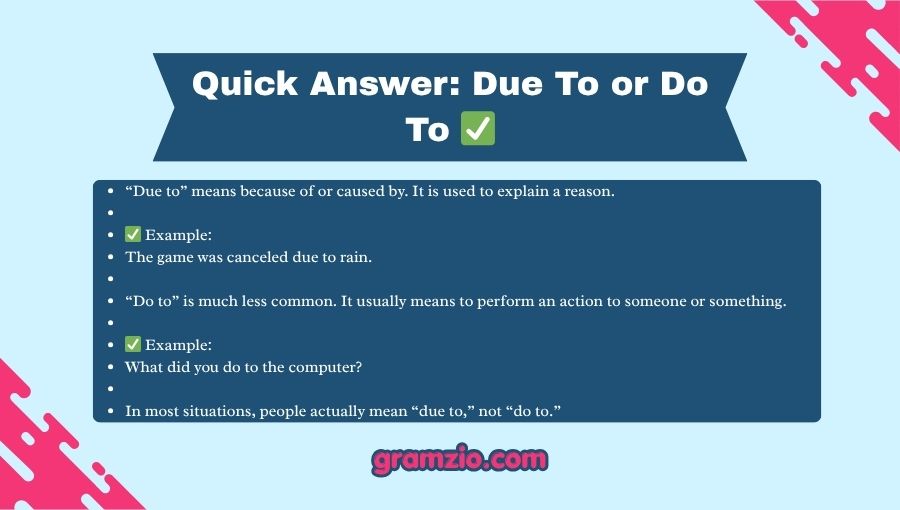
“Due to” means because of or caused by. It is used to explain a reason.
✅ Example:
The game was canceled due to rain.
“Do to” is much less common. It usually means to perform an action to someone or something.
✅ Example:
What did you do to the computer?
In most situations, people actually mean “due to,” not “do to.”
Understanding the Basics of Due To or Do To
The main difference between these two phrases is their meaning and grammatical function.
| Form | Type | Meaning | Example | Correct/Incorrect |
|---|---|---|---|---|
| Due to | Prepositional phrase | Because of | The delay happened due to traffic. | ✅ Correct |
| Do to | Verb + preposition | Perform an action toward something | What did you do to my phone? | ✅ Correct |
| Do to | Used instead of “due to” | Incorrect replacement | The flight was late do to weather. | ❌ Incorrect |
The easiest way to remember this is:
👉 “Due to” = because of
👉 “Do to” = perform an action
Correct Meanings & Uses
What Does “Due To” Mean? 📘
“Due to” means:
- Because of
- Caused by
- Resulting from
It is used to explain the reason something happened.
Examples of “Due To”
✅ The meeting was canceled due to bad weather.
✅ She missed school due to illness.
✅ The road was closed due to construction.
Sentence Breakdown
Example:
The concert was postponed due to heavy rain.
- “The concert was postponed” = main event
- “due to heavy rain” = explains why it happened
Test Tip ✅
Replace “due to” with “because of.”
If the sentence still makes sense, it is correct.
✅ The concert was postponed because of heavy rain.
✔ Works perfectly.
What Does “Do To” Mean? 📘
“Do to” is a combination of:
- Do = action verb
- To = preposition
It means performing an action toward someone or something.
Examples of “Do To”
✅ What did you do to the printer?
✅ Please do no harm to others.
✅ I would never do that to my friend.
Sentence Breakdown
Example:
What did you do to the car?
- “did” = action
- “to the car” = receiver of the action
Test Tip ✅
Ask yourself:
👉 “Is this sentence talking about an action?”
If yes, “do to” may be correct.
Why People Confuse Due To and Do To 🤯
The confusion happens because:
- Both phrases sound identical
- English contains many homophones
- Autocorrect often misses the error
- Fast typing leads to spelling mistakes
For example:
❌ The event was canceled do to rain.
This mistake happens because the writer typed the phrase based on sound rather than meaning.
Grammar Rules Explanation 📚
Rule for “Due To”
“Due to” functions as an adjective phrase that explains a cause or reason.
According to grammar authorities like Merriam-Webster, “due to” is properly used to show causation.
Correct Examples
✅ The cancellation was due to weather.
✅ His absence was due to illness.
In modern English, “due to” is widely accepted in everyday and professional writing.
Rule for “Do To”
“Do to” is not a fixed phrase like “due to.” It only appears when:
- “Do” acts as a verb
- “To” introduces the object receiving the action
Correct Examples
✅ What did you do to the files?
✅ Don’t do that to your brother.
Case Study Section 🧠
Workplace Email Example
Incorrect Email
❌ The meeting was delayed do to technical issues.
This sentence contains a spelling mistake because the writer meant “because of.”
Correct Email
✅ The meeting was delayed due to technical issues.
Now the sentence clearly explains the reason for the delay.
Real-Life Conversation Example
Conversation
👩 Sarah: Why is the laptop broken?
👨 Mike: I don’t know what Jake did to it.
Here, “did to” is correct because Mike is talking about an action performed on the laptop.
Deep Dive Into “Due To” 🔍
Common Sentence Structures
Structure 1
Subject + verb + due to + noun
✅ The flight was canceled due to fog.
Structure 2
Subject + due to + noun + verb
✅ The delays due to snow caused frustration.
Common Words Used With “Due To”
You will often see “due to” with:
- Weather
- Traffic
- Illness
- Problems
- Technical issues
- Delays
Examples
✅ Due to traffic
✅ Due to illness
✅ Due to heavy rain
✅ Due to technical problems
Deep Dive Into “Do To” 🔍
“Do to” appears less often because it depends on the sentence structure.
Common Patterns
Pattern 1
What did you do to + object?
✅ What did you do to my keyboard?
Pattern 2
Do something to someone
✅ Don’t do that to your sister.
Common Mistakes 🚫
Mistake #1: Using “Do To” Instead of “Due To”
❌ The match ended early do to rain.
✅ The match ended early due to rain.
Reason:
The sentence explains a cause, not an action.
Mistake #2: Writing Based on Sound
Because the phrases sound the same, people often type the wrong version quickly.
Mistake #3: Trusting Autocorrect
Autocorrect may not catch the mistake because “do” and “due” are both real words.
Similar Grammar Confusions Table 📋
| Incorrect Pair | Correct Difference |
|---|---|
| It’s vs Its | “It’s” = it is, “its” = possession |
| Your vs You’re | “You’re” = you are |
| Their vs There | Different meanings and functions |
| Than vs Then | Comparison vs time |
| Due to vs Do to | Cause vs action |
Why These Mistakes Happen 🤔
Fast Typing ⌨️
People often type quickly without checking spelling carefully.
Autocorrect Problems 📱
Devices may not identify contextual grammar mistakes.
Lack of Grammar Knowledge 📚
Many learners never receive a clear explanation of the difference.
Homophone Confusion 🔊
Words that sound alike frequently create writing errors.
Usage in Different Contexts
Everyday Conversation 🗣️
People commonly use “due to” when explaining reasons.
✅ We stayed home due to the storm.
“Do to” appears when discussing actions.
✅ What did you do to your hair?
Professional Writing 💼
Correct grammar matters in:
- Emails
- Reports
- Applications
- Business communication
Using “do to” incorrectly may appear unprofessional.
Professional Example
✅ Sales dropped due to market conditions.
Creative Writing ✍️
Authors use both phrases depending on context.
Example
✅ The kingdom fell due to corruption.
✅ What have you done to this city?
Social Media & Texting 📱
Mistakes happen frequently online because people type fast.
❌ Party canceled do to weather.
✅ Party canceled due to weather.
Even casual writing benefits from correct grammar.
Why It Matters ⭐
Using the correct phrase improves:
- Clarity
- Professionalism
- Writing quality
- Reader understanding
Small grammar mistakes can change how readers view your intelligence and attention to detail.
Quote 💬
“Good grammar is the foundation of clear communication.”
In professional settings, proper grammar creates trust and credibility.
Special Exception ⚠️
There are very few exceptions.
“Do to” is correct only when:
- “Do” functions as a verb
- Someone performs an action toward something
Otherwise, “due to” is almost always the intended phrase.
Quick Recap Checklist ✅
| Question | If Yes → Use |
|---|---|
| Does the sentence mean “because of”? | Due to |
| Is someone performing an action? | Do to |
| Can “because of” replace the phrase? | Due to |
| Is the sentence asking “what happened to something”? | Do to |
Practice Examples 📝
Example 1
The picnic was canceled ___ rain.
✅ Answer: due to
Example 2
What did you ___ my laptop?
✅ Answer: do to
Example 3
The delay happened ___ technical issues.
✅ Answer: due to
Memory Tricks to Remember the Difference 🧠
Trick #1: “Due” Means Cause
Think:
👉 “Due” = reason
Example:
✅ Due to traffic = because of traffic
Trick #2: “Do” Means Action
Think:
👉 “Do” = perform
Example:
✅ What did you do to the files?
Sentence Comparison Examples 🔄
| Sentence | Correct? | Why |
|---|---|---|
| The game ended due to rain. | ✅ | Explains cause |
| The game ended do to rain. | ❌ | Wrong word |
| What did you do to the computer? | ✅ | Action performed |
| What did you due to the computer? | ❌ | Wrong word |
Academic Perspective on Due To 📖
Traditional grammar experts once argued that “due to” should only follow linking verbs like:
- is
- was
- are
- were
Example:
✅ The cancellation was due to rain.
However, modern English usage accepts broader constructions.
Today, these are also considered correct:
✅ Due to rain, the event was canceled.
✅ We stayed inside due to the storm.
SEO and Digital Communication Relevance 🌐
Correct grammar matters online because:
- Search engines value readable content
- Professional brands need credibility
- Readers trust polished writing
- Grammar errors reduce engagement
Using “due to” correctly improves clarity in:
- Blog posts
- Website copy
- Emails
- Social media captions
FAQs About Due To or Do To ❓
1. Is “do to” ever correct?
Yes. It is correct when referring to an action performed toward something.
✅ What did you do to the TV?
2. Is “due to” the same as “because of”?
Almost always, yes.
✅ The game ended due to rain.
✅ The game ended because of rain.
Both mean the same thing.
3. Why do people confuse “due to” and “do to”?
Because they sound identical when spoken aloud.
4. Which phrase is more common?
“Due to” is far more common in everyday and professional English.
5. Can I start a sentence with “due to”?
Yes.
✅ Due to bad weather, school was canceled.
This structure is widely accepted today.
6. Is using “do to” instead of “due to” a grammar mistake?
Yes, if the sentence is explaining a reason rather than an action.
❌ The event ended do to rain.
✅ The event ended due to rain.
Conclusion 🎯
The difference between “due to” and “do to” is simple once you understand the meaning behind each phrase.
✅ Due to means because of and explains a cause.
✅ Do to refers to performing an action toward someone or something.
Most writing situations require “due to,” especially in professional communication, academic writing, and everyday English. The mistake usually happens because both phrases sound the same, but their grammar functions are completely different.
Whenever you feel unsure, use this quick test:
👉 Can you replace it with “because of”?
If yes, use due to.
Mastering small grammar details like this can dramatically improve your writing clarity, confidence, and professionalism. ✨
Remember: clear grammar creates clear communication.
Also read: Here Is or Here Are

Hi, I’m Elara Quinn. Working at gramzio.com, I use my 8 years of experience in linguistics to simplify difficult English rules, making them accessible and easy to learn for our global community.