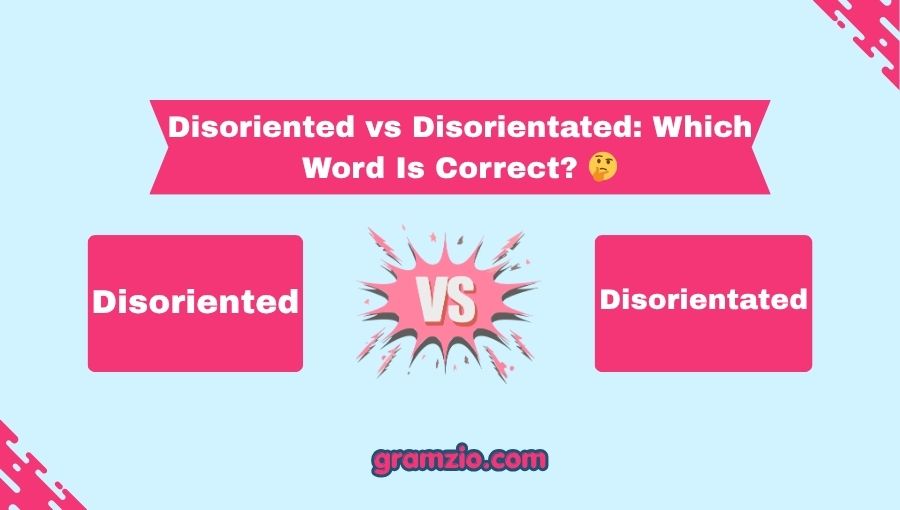
Disoriented vs Disorientated: Which Word Is Correct? 🤔
Have you ever felt confused while reading or writing the phrase Disoriented vs Disorientated? These two words often create uncertainty because they look almost identical and are used in similar contexts. One article says disoriented, another says disorientated, and suddenly you’re left wondering which one is actually correct. 😵
The confusion around Disoriented vs Disorientated is very common in English writing. Both terms describe a feeling of confusion, loss of direction, or inability to understand surroundings. However, writers often struggle to decide which form is correct, especially when switching between American and British English styles. This small difference can impact clarity, tone, and even professionalism in writing.
The good news is that the difference is not as complicated as it seems. Once you understand usage patterns and regional preferences, choosing between Disoriented vs Disorientated becomes simple and effortless.
Let’s break it down clearly and remove all confusion step by step. ✍️
Quick Answer: Disoriented vs Disorientated
Disoriented and disorientated have the same meaning: confused, lost, or unable to understand your surroundings clearly.
The main difference is usage. Disoriented is more common in American English 🇺🇸, while disorientated appears more often in British English 🇬🇧. Both are grammatically correct.
Understanding the Basics: Disoriented vs Disorientated
At their core, these words describe a state of confusion or loss of direction.
The variation exists because the verb forms also differ:
- orient → oriented → disoriented
- orientate → orientated → disorientated
American English tends to prefer shorter forms. British English often accepts longer forms.
Comparison Table
| Form | Type | Meaning | Example | Correct/Incorrect |
|---|---|---|---|---|
| Disoriented | Adjective | Confused or unable to understand surroundings | I felt disoriented after waking up. | Correct |
| Disorientated | Adjective | Confused or unable to understand surroundings | She felt disorientated after the long flight. | Correct |
| Disorientated (US formal writing) | Less common | Same meaning | Rare in US style guides | Less preferred |
| Disoriented (US English) | Preferred | Standard US usage | He became disoriented in the fog. | Correct |
Correct Meanings & Uses
Disoriented: Meaning and Use
Disoriented is the preferred form in US English. It appears in journalism, healthcare writing, academic content, and everyday speech.
Examples:
✅ After the accident, the driver looked disoriented.
✅ I felt disoriented after spinning around too fast.
✅ The patient appeared disoriented and confused.
Sentence breakdown:
- Subject: The patient
- Verb: appeared
- Adjective: disoriented
The adjective describes the condition of the patient.
Test Tip 🎯
If your audience is primarily American, use disoriented.
Disorientated: Meaning and Use
Disorientated carries exactly the same meaning.
Examples:
✅ The traveler felt disorientated after changing time zones.
✅ She seemed disorientated in the unfamiliar city.
✅ He became disorientated during the storm.
Sentence breakdown:
- Subject: He
- Verb: became
- Adjective: disorientated
Test Tip 🎯
If writing for British readers, disorientated may sound more natural.
Case Study Section
Imagine this workplace email:
Email Version A:
“After the emergency evacuation drill, several employees appeared disoriented.”
Email Version B:
“After the emergency evacuation drill, several employees appeared disorientated.”
Both are grammatically correct.
However:
- In an American office, Version A feels more natural.
- In a British workplace, Version B may sound familiar.
This demonstrates how audience expectations affect word choice.
Grammar Rules Explanation
The difference begins with two verb forms:
- orient
- orientate
Both mean “to position or adjust according to surroundings.”
From those verbs:
- orient → disorient → disoriented
- orientate → disorientate → disorientated
According to standard dictionary authorities such as Merriam-Webster, disoriented and disorientated are accepted variants with identical meanings.
American English usually favors shorter constructions.
Examples:
- toward instead of towards
- backward instead of backwards
- orient instead of orientate
As a result, disoriented became more common in the US.
This is not a matter of right versus wrong. It is a matter of convention.
Common Mistakes
People often think one version is a spelling error.
That assumption happens for several reasons:
Fast typing ⌨️
People type quickly and may assume the longer version is accidental.
Autocorrect 📱
Some devices automatically switch words based on language settings.
Lack of knowledge 📚
Many writers do not realize regional differences exist.
Similar Grammar Confusions
| Confusing Pair | Correct Difference |
|---|---|
| It’s / Its | Contraction vs possession |
| Your / You’re | Possessive vs “you are” |
| Affect / Effect | Verb vs noun |
| Than / Then | Comparison vs time |
| Disoriented / Disorientated | US preference vs UK preference |
Usage in Different Contexts
Everyday Conversation 🗣️
People usually use whichever form they hear most often.
Example:
“I felt disoriented after getting off the roller coaster.”
Professional Writing 💼
Business communication should follow audience expectations.
US audience:
✅ disoriented
UK audience:
✅ disorientated
Consistency matters more than the specific choice.
Creative Writing ✍️
Authors can select whichever version matches character voice or setting.
Example:
“The explorer felt disorientated as the mist swallowed the trail.”
Social Media and Texting 📱
People rarely think deeply about regional standards online.
Example:
“That spinning ride left me totally disoriented 😂”
Shorter forms often appear more frequently in texting.
Why It Matters (Important)
Small grammar choices can create a big impact.
Choosing correctly improves:
Clarity in communication
Readers understand your message faster.
Professionalism
Consistent language builds credibility.
Accuracy in digital writing
Content online reaches global audiences.
When you write for an international audience, language consistency becomes important.
“Clear writing creates clear thinking.”
Simple choices improve trust and readability.
Special Exception
There are very few exceptions.
Some organizations or publications create internal style guides. A company with a British audience might require disorientated, while an American publication may insist on disoriented.
Academic institutions sometimes follow national style standards.
The key rule:
Always match the style guide being used.
Quick Recap Checklist
| Question | If Yes → Use |
|---|---|
| Writing for American readers? | Disoriented |
| Writing for British readers? | Disorientated |
| Need shorter wording? | Disoriented |
| Following a UK style guide? | Disorientated |
| Need consistency? | Keep one version throughout |
Practice Examples 📝
Choose the better option:
- The patient seemed _____ after surgery.
Answer: disoriented (US style)
- The tourist became _____ after leaving the train station.
Answer: disorientated (UK style)
- The child felt _____ after waking from a deep sleep.
Answer: Either works depending on audience
Frequently Asked Questions (FAQs)
Is disorientated incorrect?
No. It is grammatically correct and widely used, especially in British English.
Which is more common: disoriented or disorientated?
Disoriented is generally more common in American English.
Do they have different meanings?
No. Both words mean confused or unable to understand surroundings.
Which should I use in academic writing?
Follow your required style guide or regional preference.
Why does American English prefer disoriented?
American English often favors shorter word forms and simplified structures.
Can I use both in the same article?
It is better not to. Consistency improves readability and professionalism.
Conclusion
The debate over Disoriented vs Disorientated sounds more complicated than it really is. Both words are correct, both share the same meaning, and neither is a spelling mistake. The biggest difference is regional preference.
If you write for an American audience, disoriented is usually the safer choice. If your readers are British, disorientated may sound more familiar. Beyond that, consistency matters most.
Language evolves, and English often offers multiple acceptable forms. Instead of worrying about choosing a “wrong” word, focus on choosing the version that best fits your audience and style.
Remember this simple rule: same meaning, different preference. Know your audience, stay consistent, and your writing will always stay on the right path. 🚀
Also read: Wasn’t vs Weren’t

Hi, I’m Willa Sterling. I work at gramzio.com as a senior editor. With 15 years of experience in academic and formal grammar, I provide the expert insights you need to make your writing flawless.