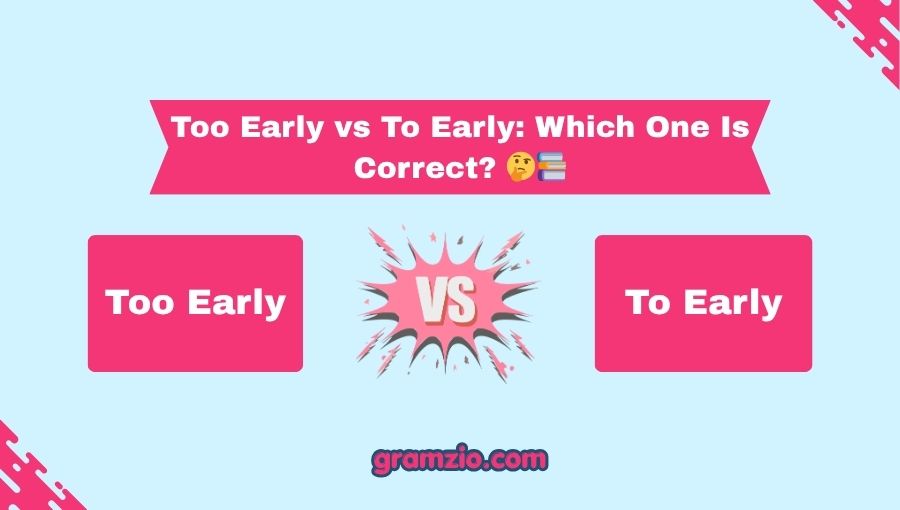
Too Early vs To Early: Which One Is Correct? 🤔📚
Have you ever typed a message like, “I woke up to early today” and paused for a second because something felt off? You are not alone. Many English learners and even native speakers sometimes confuse Too Early vs To Early because the words to and too look almost identical and sound exactly the same. 👀
This small spelling difference creates a surprisingly common grammar mistake. One extra “o” changes the meaning completely. Since both words appear frequently in everyday writing, emails, texts, and social media posts, it is easy to type the wrong one without noticing.
The confusion becomes even stronger during fast typing or when autocorrect fails to catch the issue. However, understanding the distinction is actually very simple once you know the grammar rule behind it.
In this guide, we will break down Too Early vs To Early in clear, simple English. You will learn the meanings, grammar rules, examples, real-life usage, common mistakes, and expert tips so you never make this error again. ✨
Quick Answer: Too Early vs To Early ⚡
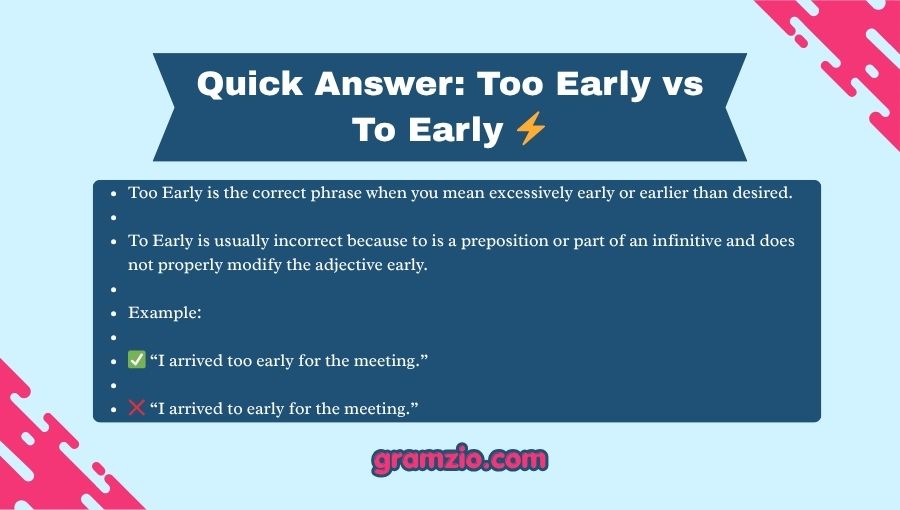
Too Early is the correct phrase when you mean excessively early or earlier than desired.
To Early is usually incorrect because to is a preposition or part of an infinitive and does not properly modify the adjective early.
Example:
✅ “I arrived too early for the meeting.”
❌ “I arrived to early for the meeting.”
Understanding the Basics: Too Early vs To Early
The difference comes down to understanding to and too.
- Too = excessively, more than needed, or also
- To = shows direction, relationship, or forms infinitive verbs
When describing something as more early than desired, you need too, not to.
Comparison Table
| Form | Type | Meaning | Example | Correct/Incorrect |
|---|---|---|---|---|
| Too Early | Adverb + adjective | Earlier than desired | “We got there too early.” | ✅ Correct |
| To Early | Preposition + adjective | Grammatically incomplete | “We got there to early.” | ❌ Incorrect |
The extra o matters more than people think. 😊
Correct Meanings & Uses
Understanding “Too Early”
The word too means more than necessary or excessively.
When combined with early, it means something happened before the desired or appropriate time.
Examples:
✅ “You arrived too early for the interview.”
Breakdown:
- too = excessively
- early = before expected time
Meaning:
The person arrived earlier than necessary.
✅ “It is too early to make a decision.”
Breakdown:
- The timing is not appropriate yet.
Meaning:
The action should happen later.
✅ “I woke up too early this morning.” 😴
Meaning:
The wake-up time felt earlier than preferred.
Test Tip 📝
Replace too with excessively.
Example:
“It is excessively early.”
If it still makes sense, too is correct.
Why “To Early” Usually Fails
The word to serves different purposes:
Examples:
- Go to school
- Walk to the store
- Want to sleep
Notice something?
To usually connects actions, directions, or relationships.
Now look at:
❌ “I woke up to early.”
The phrase breaks grammar rules because to cannot modify early in this way.
Sentence Breakdown Examples
Correct:
✅ “She came too early.”
Meaning:
She arrived earlier than expected.
Incorrect:
❌ “She came to early.”
Problem:
The sentence lacks proper grammatical structure.
Case Study Section 🏢
Imagine an employee sending an email:
Incorrect Email:
“I reached the office to early today.”
The manager reads it and immediately notices the mistake.
Now look at the corrected version:
Correct Email:
“I reached the office too early today, so I waited in the lobby.”
The sentence now communicates the intended meaning clearly and professionally.
This example shows how a tiny spelling difference affects credibility in workplace communication.
Grammar Rules Explanation 📘
Grammar authorities such as dictionaries and style references including Merriam-Webster explain that too functions as an adverb meaning also or to an excessive degree.
Examples:
- too fast
- too loud
- too expensive
- too early
The structure follows a common pattern:
too + adjective
Examples:
- too hot
- too cold
- too slow
- too early
This pattern does not work with to.
Incorrect structure:
❌ to + adjective
unless part of a larger infinitive construction:
✅ “To arrive early is important.”
Notice the difference:
“To arrive” is an infinitive phrase.
“Too early” expresses excess.
Common Mistakes 🚫
People make this mistake for several reasons.
Fast typing ⌨️
People type quickly and accidentally miss an extra “o.”
Example:
Typing:
to early
Instead of:
too early
Autocorrect issues 📱
Autocorrect sometimes ignores the mistake because to is still a real word.
Lack of grammar knowledge 📖
Many people know both words exist but are unsure when to use each one.
Similar Grammar Confusions
| Incorrect Pair | Correct Distinction |
|---|---|
| It’s / Its | It’s = it is; Its = possession |
| Your / You’re | Your = ownership; You’re = you are |
| Their / There | Ownership vs location |
| Than / Then | Comparison vs time |
| To / Too | Direction vs excess |
| Affect / Effect | Verb vs noun |
These pairs confuse writers because pronunciation often sounds similar.
Usage in Different Contexts 🌎
Everyday Conversation
People frequently use too early while discussing schedules and timing.
Examples:
✅ “You called me too early.”
✅ “The store opened too early.”
Professional Writing
Business communication values precision.
Example:
✅ “The presentation draft was submitted too early.”
Professional writing requires grammar accuracy because mistakes can affect credibility.
Creative Writing ✍️
Authors use too early to create mood and emotion.
Example:
“The sun appeared too early, interrupting the peaceful darkness.”
Social Media and Texting 📱
People often shorten messages.
Example:
“Why are you awake? It’s too early 😂”
Even in casual writing, correct grammar improves clarity.
Why It Matters ⭐
You may wonder:
“Does one extra letter really matter?”
Yes.
Small grammar choices affect communication in important ways.
Clarity
Readers instantly understand your meaning.
Professionalism
Correct writing creates a stronger impression.
Accuracy
Digital communication depends on precise wording.
A famous writing principle says:
“Good writing is clear thinking made visible.”
Tiny grammar details contribute to that clarity.
Special Exception 🔍
There are almost no standard situations where to early works by itself.
However, to can appear before phrases involving early when part of a larger structure:
✅ “To arrive early is helpful.”
Here:
- To arrive = infinitive
- Early = adverb describing arrive
This differs completely from:
✅ “We arrived too early.”
The meanings and structures are different.
Quick Recap Checklist ✅
| Question | If Yes → Use |
|---|---|
| Do you mean excessively or earlier than desired? | Too Early |
| Can you replace the word with “excessively”? | Too Early |
| Are you using a direction or infinitive? | To |
| Is timing happening earlier than needed? | Too Early |
Practice Examples
- We reached the airport ___ early.
Answer: too
- It is ___ early to decide.
Answer: too
- I want ___ arrive early.
Answer: to
FAQs: Too Early vs To Early
1. Is “to early” ever correct?
Usually no. The phrase by itself is generally incorrect because to cannot replace too when indicating excess.
2. Why do people confuse too and to?
They sound identical in speech, making them easy to mix up during writing.
3. What does “too early” mean?
It means earlier than desired, expected, or appropriate.
Example:
“It is too early to leave.”
4. Can “too” mean something besides excess?
Yes. It can also mean also.
Example:
“I want pizza too.” 🍕
5. Is “too early” grammatically correct?
Yes. It follows the standard pattern:
too + adjective
6. How can I quickly remember the rule?
Remember this trick:
Too has an extra O because it means extra. 🎯
Conclusion
The debate around Too Early vs To Early becomes simple once you understand the role of one tiny letter. Too early is the correct phrase when you mean earlier than desired or excessively early. Meanwhile, to early is usually incorrect because to does not function as an adverb modifying early.
A quick memory trick can help: Too has an extra “o,” and that extra letter represents something extra. Whenever timing feels excessive, use too.
Whether you are writing emails, text messages, essays, social media captions, or professional documents, choosing the correct form improves clarity and professionalism. ✨
Grammar does not always require complicated rules. Sometimes one extra letter makes all the difference. Remember it once, apply it often, and you will never write to early by mistake again.
Also read: On the Plane or n the Plane

Hi, I’m Grayson Finch. I’m part of the gramzio.com team with 9 years of experience in grammar education. I am dedicated to teaching professional communication and helping you master the art of writing.