Quieter vs More Quiet: Which One Is Correct? 🤔🔇
The confusion between Quieter vs More Quiet is one of the most common grammar doubts in English writing and speaking. Many learners are unsure which form is correct when comparing levels of noise or calmness. Should we say “quieter room” or “more quiet room”? This small difference often creates big uncertainty.
The truth is that both forms exist in English, but they are not equally preferred. One follows standard comparative adjective rules, while the other sounds less natural in modern usage. Because English allows flexibility in structure, learners often mix the two forms without knowing which one is grammatically accepted.
In this guide, we will clearly break down Quieter vs More Quiet, explain the correct usage, provide real-life examples, and show you when each form works. By the end, you will confidently know which version to use in writing and conversation.
Quick Answer: Quieter vs More Quiet ⚡
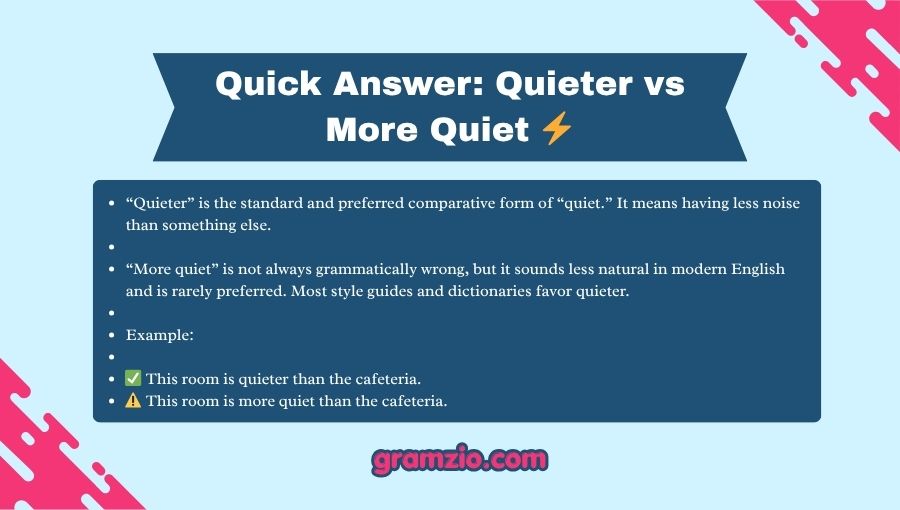
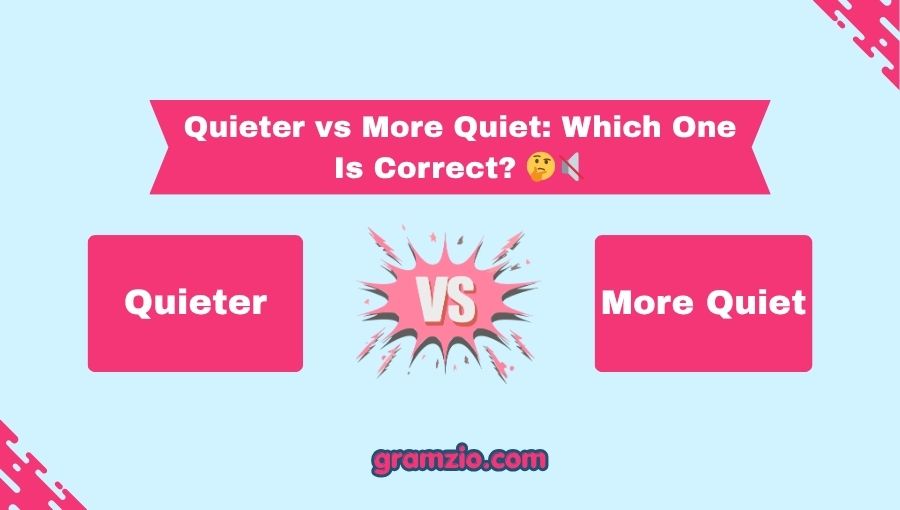
“Quieter” is the standard and preferred comparative form of “quiet.” It means having less noise than something else.
“More quiet” is not always grammatically wrong, but it sounds less natural in modern English and is rarely preferred. Most style guides and dictionaries favor quieter.
Example:
✅ This room is quieter than the cafeteria.
⚠️ This room is more quiet than the cafeteria.
Understanding the Basics of Quieter vs More Quiet
Comparative adjectives help compare two things. English generally creates comparatives in two ways:
- Add –er to short adjectives
- Use more before longer adjectives
Because quiet is a short adjective with two syllables, English normally forms its comparative by adding –er, creating quieter.
Comparison Table
| Form | Type | Meaning | Example | Correct/Incorrect |
|---|---|---|---|---|
| Quieter | Comparative adjective | Less noisy | The library is quieter than the hall. | ✅ Correct |
| More Quiet | Comparative phrase | Less noisy | The library is more quiet than the hall. | ⚠️ Less preferred |
| Quiet | Base adjective | Not noisy | The room is quiet. | ✅ Correct |
The key idea is simple: quieter follows the usual grammar pattern.
Correct Meanings & Uses
Using “Quieter” Correctly 🔇
“Quieter” compares one thing with another and shows reduced noise or calmness.
Examples:
- The evening became quieter after the guests left.
- My new office is quieter than the old one.
- Please speak quieter during the meeting.
Sentence breakdown:
My new office is quieter than the old one.
Subject: My new office
Verb: is
Comparative adjective: quieter
Comparison: than the old one
The sentence compares two offices.
Test Tip ✅
Ask yourself:
“Am I comparing two things?”
If yes, and quiet is the adjective, quieter is usually your answer.
Can “More Quiet” Ever Be Used? 🤔
Although uncommon, “more quiet” can appear in certain situations.
Examples:
- We need a more quiet and peaceful environment.
- The second option felt more quiet in mood than energetic.
Writers occasionally choose it for rhythm, emphasis, or style.
However, in everyday English:
quieter sounds more natural.
Why Native Speakers Prefer “Quieter”
English favors efficiency. Short adjectives usually take –er.
Examples:
- Small → smaller
- Fast → faster
- Bright → brighter
- Quiet → quieter
Because of this pattern, quieter feels smoother and easier to say.
Case Study Section 📧
Imagine this workplace email:
Original version:
“Can we move to a more quiet room for the meeting?”
While understandable, it sounds slightly awkward.
Improved version:
“Can we move to a quieter room for the meeting?”
The revised version sounds more professional and natural.
This matters in business communication because small grammar choices affect readability and confidence.
Grammar Rules Explanation 📚
According to standard grammar principles and major dictionary authorities, comparative adjectives with one syllable and many two-syllable adjectives typically use –er endings.
Examples:
- Quiet → quieter
- Happy → happier
- Narrow → narrower
Grammar references and dictionaries commonly recognize quieter as the standard comparative form.
The structure is:
Base adjective + er
So:
Quiet + er = quieter
Not:
More + quiet
English sometimes permits flexibility, but standard usage strongly favors quieter.
Common Mistakes ❌
People make mistakes with Quieter vs More Quiet for several reasons:
Fast typing ⌨️
People write quickly and choose what first sounds right.
Autocorrect 📱
Devices sometimes fail to recognize style preferences.
Lack of knowledge 📖
Many learners memorize vocabulary but not comparative rules.
Similar Grammar Confusions
| Confusing Pair | Correct Use | Why Errors Happen |
|---|---|---|
| Its / It’s | Its = possession; It’s = it is | Apostrophe confusion |
| Your / You’re | You’re = you are | Fast typing |
| Affect / Effect | Verb vs noun confusion | Similar sounds |
| Fewer / Less | Countable vs uncountable nouns | Grammar uncertainty |
| Quieter / More Quiet | Comparative adjective rules | Lack of comparative knowledge |
Usage in Different Contexts
Everyday Conversation 🏠
People naturally say:
- Can we go somewhere quieter?
- The street feels quieter today.
This sounds smooth and natural.
Professional Writing 💼
Professional writing values clarity.
Examples:
- We selected a quieter location for the conference.
- Employees requested a quieter workspace.
Creative Writing ✍️
Writers may occasionally choose “more quiet” for stylistic rhythm.
Example:
“The village grew more quiet as darkness spread.”
This is acceptable when tone matters.
Social Media and Texting 📱
Most users naturally write:
- It’s much quieter here 😂
- Wish this place was quieter.
Shorter forms dominate online communication.
Why It Matters ⭐
Using Quieter vs More Quiet correctly improves communication in several ways.
Clarity
Readers understand your meaning instantly.
Professionalism
Strong grammar creates a better impression.
Writing accuracy
Digital communication depends on concise language.
Better readability
Natural phrasing helps readers move smoothly through text.
Consider this quote:
“Clear language creates clear thinking.”
Even a small grammar choice can affect how polished your writing sounds.
Special Exception 🚨
There are rare situations where writers intentionally choose more quiet.
Possible reasons:
- Literary style
- Rhythm
- Formal emphasis
- Poetic effect
Example:
“The forest became more quiet with each passing hour.”
Although acceptable in creative writing, everyday grammar still favors quieter.
Think of this as a stylistic exception rather than a grammar rule.
Quick Recap Checklist ✅
| Question | If Yes → Use |
|---|---|
| Are you comparing two things? | Quieter |
| Is “quiet” acting as an adjective? | Quieter |
| Are you writing everyday English? | Quieter |
| Are you aiming for natural speech? | Quieter |
| Are you creating poetic emphasis? | Possibly more quiet |
Practice Examples
Choose the correct answer:
- The second classroom is ______ than the first.
Answer: quieter
- The neighborhood became ______ after midnight.
Answer: quieter
- We searched for a ______ place to study.
Answer: quieter
Frequently Asked Questions (FAQs)
Is “more quiet” grammatically wrong?
No. It is not entirely wrong, but quieter is preferred and sounds more natural.
Why do people say “more quiet”?
Some people use it for emphasis, writing style, or because they are unsure of comparative adjective rules.
Which is more common in American English?
Quieter is far more common in modern American English.
Is “quieter” an adjective or adverb?
“Quieter” is a comparative adjective.
Example:
“The office is quieter.”
Can I use “more quiet” in formal writing?
You can, but most editors and style guides would recommend quieter.
Is “quieter” correct?
No. The correct spelling is quieter, not quieter.
Conclusion
Understanding Quieter vs More Quiet becomes easy once you know how comparative adjectives work. English usually adds –er to shorter adjectives, and that rule gives us quieter as the standard form.
While more quiet occasionally appears in creative or stylistic writing, it is not the preferred choice in everyday communication. Whether you are writing emails, speaking with friends, preparing school assignments, or posting online, quieter will almost always sound more natural and polished. 🔇
Small grammar choices often create a big difference. Choosing the right comparative form strengthens clarity, improves professionalism, and helps your writing flow naturally.
Remember this simple rule:
When comparing noise levels, choose “quieter” and write with confidence. ✨
Also read: Master’s Student vs Masters Student vs MS Student

Hi, I’m Axton Vane. I work at gramzio.com and bring over 11 years of experience in professional grammar. I specialize in refining complex syntax to help writers achieve perfect clarity in every sentence.