Mother Tongue vs Native Language: What’s the Real Difference? 🌍🗣️
The difference between Mother Tongue vs Native Language often confuses learners, writers, and professionals around the world. 🤔 Many people assume these two terms mean exactly the same thing, but in reality, they can carry slightly different meanings depending on culture, upbringing, and context.
Have you ever filled out a form, created an online profile, or attended an interview and noticed two different options: “Mother Tongue” and “Native Language”? Many people pause at this point because both seem to describe the first language a person learns. So why do two separate expressions exist?
The confusion around Mother Tongue vs Native Language is surprisingly common. Some people use the terms interchangeably, while others believe they carry distinct meanings. In everyday conversation, the distinction often goes unnoticed. However, in education, linguistics, immigration forms, and cultural discussions, the difference can become important.
Language is deeply tied to identity, culture, family, and communication. Understanding these terms helps avoid misunderstandings and improves writing accuracy. Whether you are a student, professional, writer, or language learner, knowing the difference between Mother Tongue vs Native Language can help you communicate more clearly and confidently.
Let’s break it down in simple English and settle the confusion once and for all. 😊
Quick Answer: Mother Tongue vs Native Language
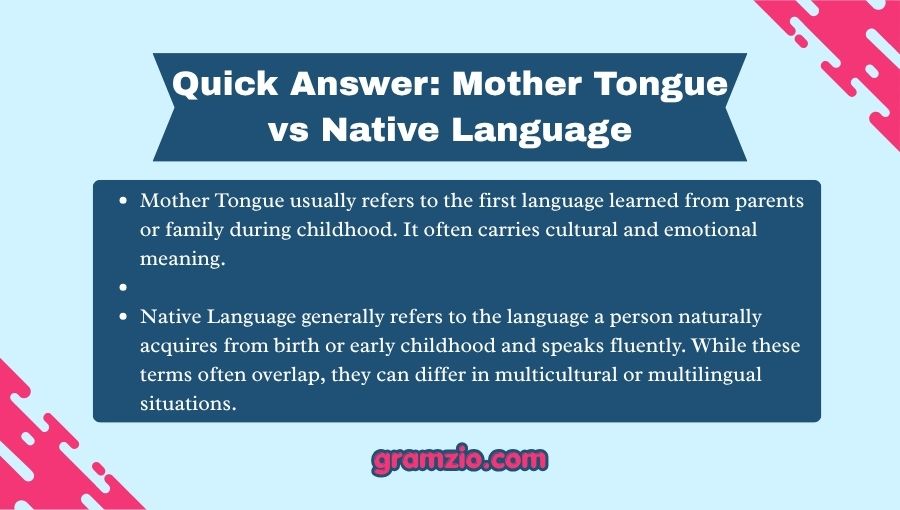
Mother Tongue usually refers to the first language learned from parents or family during childhood. It often carries cultural and emotional meaning.
Native Language generally refers to the language a person naturally acquires from birth or early childhood and speaks fluently. While these terms often overlap, they can differ in multicultural or multilingual situations.
Understanding the Basics: Mother Tongue vs Native Language
The main difference between Mother Tongue vs Native Language lies in emphasis.
- Mother Tongue focuses more on family, heritage, and cultural roots 👨👩👧
- Native Language focuses more on natural language acquisition and fluency 🗣️
For many people, both are the same language. However, life experiences can create exceptions.
For example:
A child born in Japan to Spanish-speaking parents may hear Spanish at home but grow up speaking Japanese daily.
- Mother Tongue: Spanish
- Native Language: Japanese (depending on usage and environment)
Comparison Table
| Form | Type | Meaning | Example | Correct/Incorrect |
|---|---|---|---|---|
| Mother Tongue | Cultural term | Language learned from family heritage | “Hindi is my mother tongue.” | Correct |
| Native Language | Linguistic term | Language naturally acquired in early life | “English is her native language.” | Correct |
| Mother Tongue = Native Language | Sometimes interchangeable | Used when both refer to the first language | “French is my mother tongue and native language.” | Correct |
| Assuming they always mean the same thing | Oversimplification | Not true in every case | “Everyone’s mother tongue equals native language.” | Incorrect |
Correct Meanings & Uses
What Does “Mother Tongue” Mean? 👩👦
The phrase mother tongue traditionally refers to the language passed down by parents and family.
It reflects:
- Heritage
- Ethnic background
- Cultural identity
- Early childhood exposure
Example:
“My mother tongue is Arabic because my family speaks Arabic at home.”
Sentence breakdown:
- My mother tongue → identifies family language
- is Arabic → specifies inherited language
- because my family speaks Arabic at home → explains cultural source
Test Tip ✅
Ask:
“What language did my family raise me with?”
If the answer is clear, “mother tongue” may fit.
What Does “Native Language” Mean? 🌎
A native language usually refers to a language acquired naturally during early childhood.
It often emphasizes:
- Fluency
- Natural acquisition
- Language environment
- Everyday use
Example:
“English became her native language because she grew up speaking it daily.”
Sentence breakdown:
- English became → acquired over time
- her native language → language of natural fluency
- grew up speaking it daily → explains exposure
Test Tip ✅
Ask:
“Which language do I naturally think and communicate in?”
That often points toward your native language.
When They Are the Same
For many people:
- Born in Mexico
- Raised by Spanish-speaking parents
- Speak Spanish from birth
Then:
- Mother Tongue = Spanish
- Native Language = Spanish
No difference exists.
Case Study Section 📖
Imagine a workplace onboarding form.
A new employee named Sarah fills out:
Mother Tongue: Korean
Native Language: English
HR becomes curious.
Sarah explains:
“My parents spoke Korean at home, so Korean is my mother tongue. But I grew up in the United States and learned English naturally from school and daily life.”
This real-life example shows why understanding Mother Tongue vs Native Language matters.
The distinction can affect:
- Education records
- Language assessments
- Immigration documents
- Cultural identity discussions
Grammar Rules Explanation
From a grammar perspective, neither term is grammatically incorrect.
The difference is semantic rather than grammatical.
Standard dictionaries and language references such as Merriam-Webster define:
Mother tongue: one’s first language or native language.
Native language: language naturally acquired from birth or early childhood.
Modern linguistic discussions recognize that identity and upbringing can create subtle differences.
Why confusion happens:
Historically, dictionaries treated them as direct synonyms. Today, globalization and multilingual families create situations where meanings can diverge.
Thus:
❌ “Mother tongue and native language are always identical.”
✅ “Mother tongue and native language often overlap but can differ.”
Common Mistakes ❌
People confuse these terms because:
Fast typing ⌨️
Writers choose whichever term comes to mind.
Autocorrect 🤖
Software rarely explains contextual differences.
Lack of knowledge 📚
Many textbooks treat the terms as exact synonyms.
Similar Grammar Confusions Table
| Confusing Pair | Correct Difference |
|---|---|
| It’s / Its | Contraction vs possession |
| Your / You’re | Possessive vs “you are” |
| Affect / Effect | Verb vs noun |
| Than / Then | Comparison vs time |
| Mother Tongue / Native Language | Cultural identity vs language acquisition |
Usage in Different Contexts
Everyday Conversation 🏠
People often use both terms interchangeably.
Example:
“Spanish is my mother tongue.”
“Spanish is my native language.”
Most listeners understand both.
Professional Writing 💼
Professional forms sometimes distinguish between them.
Example:
“Please list your native language and any additional languages.”
Precision matters.
Creative Writing ✍️
Writers may choose mother tongue because it sounds emotional and cultural.
Example:
“He missed hearing his mother’s tongue after moving abroad.”
Social Media and Texting 📱
People often shorten discussions.
Example:
“English isn’t my native language 😂”
This phrase appears frequently online.
Why It Matters (Important)
Understanding Mother Tongue vs Native Language improves communication clarity.
Benefits include:
Clarity in communication
People understand your linguistic background accurately.
Professionalism
Forms and applications become more precise.
Writing accuracy in digital communication
Correct word choices reduce misunderstandings.
Consider this quote:
“Language carries culture, memory, and identity.”
A small word choice can communicate a larger personal story.
Special Exception ⭐
Rare situations can blur definitions.
Consider adopted children.
A child adopted internationally may:
- Be born in China
- Move to America at age one
- Grow up speaking English only
Questions arise:
Is Chinese the mother tongue?
Is English the native language?
Experts may disagree depending on context.
Another exception involves multilingual households where children learn several languages simultaneously.
Quick Recap Checklist
| Question | If Yes → Use |
|---|---|
| Did you learn this language from family heritage? | Mother Tongue |
| Is this the language you naturally speak fluently? | Native Language |
| Are both true? | Either term |
| Does context involve culture? | Mother Tongue |
| Does context involve acquisition and fluency? | Native Language |
Practice Examples
- My family raised me speaking Punjabi at home.
→ Mother Tongue - I naturally grew up speaking English every day.
→ Native Language - My parents spoke Italian and I learned Italian first.
→ Both
FAQs: Mother Tongue vs Native Language
1. Are mother tongue and native language the same?
Usually yes, but not always. Multilingual backgrounds can create differences.
2. Which term is more formal?
Native language often appears in academic and professional settings.
3. Can someone have two native languages?
Yes. Children raised bilingually from birth may have two native languages. 🌍
4. Can a person forget their mother tongue?
Yes. If a language is not used regularly, fluency can decline over time.
5. Which term should I use on forms?
Read the context carefully. If it asks for cultural origin, choose mother tongue. If it asks about fluency or first acquired language, native language may fit better.
6. Is mother tongue outdated?
Not entirely. It remains widely used worldwide, though some people prefer more neutral terms like first language.
Conclusion
The debate around Mother Tongue vs Native Language may seem small, but the distinction can reveal meaningful differences in language, culture, and identity. In many situations, both terms describe the same thing: the language learned first in childhood. However, in multilingual families, migration experiences, and global communities, they can carry different meanings.
Remember this simple rule: mother tongue often connects to family and cultural roots, while native language focuses on natural language acquisition and fluency.
Choosing the right term improves communication, strengthens writing accuracy, and helps express personal identity more clearly. 🌟
Language is more than words—it tells the story of who we are and where we come from.
Also read: Goodbye vs Good Bye vs Good-bye

Hi, I’m Willa Sterling. I work at gramzio.com as a senior editor. With 15 years of experience in academic and formal grammar, I provide the expert insights you need to make your writing flawless.