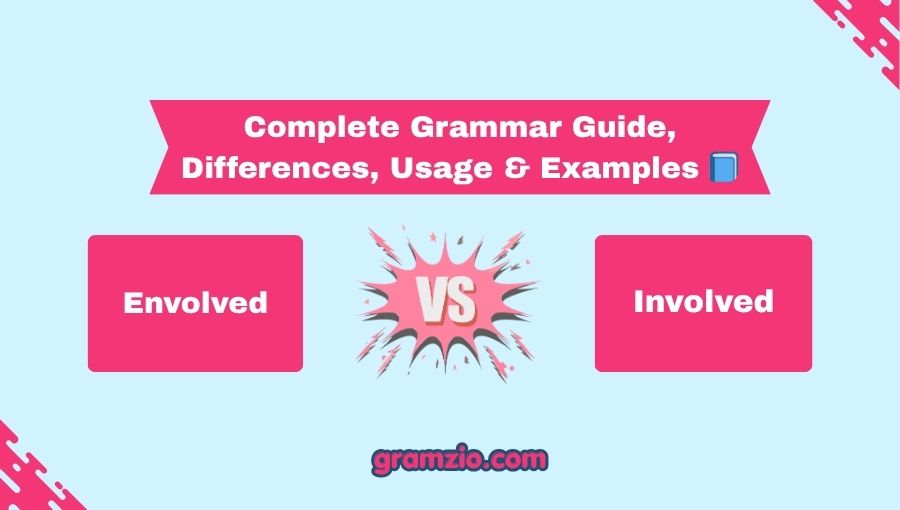
Envolved or Involved: Which One Is Correct? 🤔
Have you ever typed “envolved” and wondered if it was actually correct? You’re not alone. Many writers, students, and even professionals occasionally confuse “envolved or involved”—especially when typing quickly or relying on autocorrect. This small spelling difference can create a big impact on your writing clarity and credibility.
In everyday communication, whether you’re sending emails, writing essays, or posting on social media, using the correct word matters. “Involved” is a commonly used word in English, but “envolved” often sneaks in as a misspelling. The confusion usually arises due to pronunciation similarities or typing errors.
In this guide, we’ll break down everything you need to know about “envolved or involved” in a simple, easy-to-understand way. By the end, you’ll feel confident using the correct form every time—and avoiding one of the most common spelling mistakes in English. ✍️
✅ Quick Answer: Envolved or Involved
The correct word is “involved.” ✔️
“Envolved” is not a real English word and is always incorrect.
👉 Use “involved” when you mean being part of something, included in an activity, or emotionally engaged.
📘 Understanding the Basics: Envolved or Involved
Let’s simplify the difference:
| Form | Type | Meaning | Example Sentence | Correct/Incorrect |
|---|---|---|---|---|
| Involved | Adjective/Verb | Participating or included in something | She is involved in the project. | ✅ Correct |
| Envolved | — | No meaning (misspelling of “involved”) | He is envolved in the meeting. | ❌ Incorrect |
💡 Key Insight:
If you ever see “envolved,” it’s a mistake. The correct spelling is always involved.
📖 Correct Meanings & Uses of “Involved”
1. Being Part of Something 🤝
Meaning: To participate or be included in an activity.
Example:
- She is involved in community service.
Breakdown:
- “She” → subject
- “is involved” → participation
- “community service” → activity
👉 Test Tip: Replace “involved” with “participating.” If it fits, your usage is correct.
2. Emotional Engagement ❤️
Meaning: Showing deep interest or emotional connection.
Example:
- He became emotionally involved in the story.
👉 Test Tip: If it relates to feelings, “involved” is the right word.
3. Complicated or Detailed Situation 🧩
Meaning: Something complex or not simple.
Example:
- The process is quite involved.
👉 Test Tip: If you mean “complicated,” you can use “involved.”
🧠 Case Study: Real-Life Usage
Workplace Email Example 📧
Incorrect Version:
I would like to be more envolved in this project.
Correct Version:
I would like to be more involved in this project.
💡 Why it matters:
Using “envolved” in a professional email can make you appear careless or less credible. A simple spelling error may affect how others perceive your attention to detail.
📚 Grammar Rules Explanation
According to standard English dictionaries like Merriam-Webster, “involved” is the correct spelling derived from the verb “involve.”
Why “Involved” Is Correct:
- It follows standard English spelling rules.
- It comes from the root word “involve.”
- It is recognized in all formal and informal contexts.
Why “Envolved” Is Incorrect:
- It is not listed in any English dictionary.
- It is a spelling mistake caused by:
- Mishearing pronunciation
- Typing errors
- Language interference
⚠️ Common Mistakes Section
Why Do People Write “Envolved”?
- ⌨️ Fast typing mistakes
- 📱 Autocorrect errors
- 📚 Lack of spelling awareness
- 🔊 Confusion due to pronunciation
🔁 Similar Grammar Confusions
| Confusing Pair | Correct Form | Common Mistake | Reason |
|---|---|---|---|
| Its vs It’s | It’s | Its | Apostrophe confusion |
| Your vs You’re | You’re | Your | Grammar misunderstanding |
| Affect vs Effect | Effect | Affect | Meaning confusion |
| Then vs Than | Than | Then | Context confusion |
| Lose vs Loose | Lose | Loose | Spelling similarity |
🌍 Usage in Different Contexts
1. Everyday Conversation 🗣️
- I want to be more involved in family activities.
2. Professional Writing 💼
- Employees should stay involved in decision-making.
3. Creative Writing ✍️
- The character becomes deeply involved in the mystery.
4. Social Media/Texting 📱
- Stay involved and keep growing! 🚀
⭐ Why It Matters
Using the correct word—“involved” instead of “envolved”—is essential for:
- ✅ Clear communication
- ✅ Professional credibility
- ✅ Strong writing skills
- ✅ Better understanding
💬 “Good writing is clear thinking made visible.”
A small spelling mistake can change how your message is perceived. Accuracy builds trust.
🚫 Special Exception Section
There are no exceptions where “envolved” is correct.
Even in brand names, slang, or creative writing, this spelling is not accepted.
📋 Quick Recap Checklist
| Question | If Yes → Use |
|---|---|
| Are you describing participation? | Involved |
| Are you talking about emotional connection? | Involved |
| Are you describing something complex? | Involved |
| Are you about to type “envolved”? | ❌ Don’t! |
🧪 Practice Examples
- She is deeply ___ in the project.
✔️ Answer: involved - He wants to stay ___ in decision-making.
✔️ Answer: involved - This is an ___ process.
✔️ Answer: involved
❓ FAQs: Envolved or Involved
1. Is “envolved” ever correct?
No, “envolved” is always incorrect. It is not a real English word.
2. What does “involved” mean?
“Involved” means being part of something, emotionally engaged, or dealing with complexity.
3. Why do people confuse “envolved” and “involved”?
The confusion comes from pronunciation, fast typing, and lack of spelling awareness.
4. Can “involved” be used in formal writing?
Yes, “involved” is perfectly acceptable in both formal and informal writing.
5. How can I remember the correct spelling?
Think of the root word “involve.” Always start with “in-,” not “en-.”
6. Is “involved” a verb or adjective?
It can be both:
- Verb (past tense): She involved herself in the project.
- Adjective: He is involved in the process.
🏁 Conclusion
To sum it up, the debate between “envolved or involved” is simple: only “involved” is correct. “Envolved” is a common spelling mistake that should always be avoided. Whether you’re writing an email, an essay, or a social media post, using the correct word ensures clarity and professionalism.
Remember, good writing is built on small details. Mastering simple distinctions like this can significantly improve your communication skills.
✨ Final Tip: When in doubt, stick with “involved”—because that’s the only correct choice.
Also read: Requester vs Requestor

Hi, I’m Elara Quinn. Working at gramzio.com, I use my 8 years of experience in linguistics to simplify difficult English rules, making them accessible and easy to learn for our global community.