Assist With vs Assist In: The Complete Grammar Guide ✍️
Assist With vs Assist In is a common grammar confusion that many English learners and even native speakers struggle with. 🤔 At first glance, both phrases seem interchangeable because they share the same core meaning—helping someone. However, their use depends on subtle yet important grammatical rules that can affect the clarity and professionalism of your writing.
Have you ever paused mid-sentence, unsure whether to write “assist with a task” or “assist in completing a task”? You’re not alone. This confusion happens because both expressions are correct—but only in the right context. Using the wrong one may not always sound completely wrong, but it can make your sentence feel awkward or less polished.
In this complete guide, you will learn the exact difference between assist with vs assist in, when to use each correctly, and how to avoid common mistakes. By the end, you’ll be able to choose the right phrase confidently in any situation. ✅
Quick Answer: Assist With vs Assist In
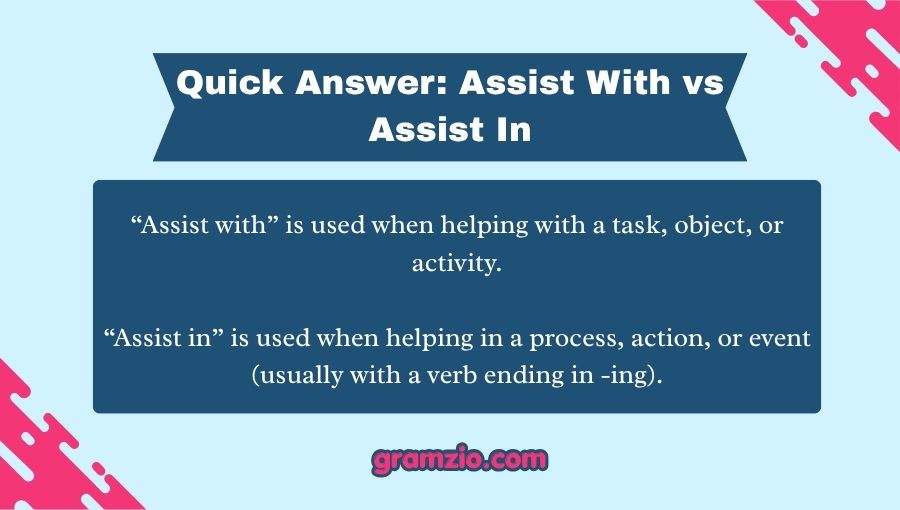
- “Assist with” is used when helping with a task, object, or activity.
- “Assist in” is used when helping in a process, action, or event (usually with a verb ending in -ing).
👉 Simple rule:
- Use assist with + noun
- Use assist in + verb (-ing)
Understanding the Basics: Assist With vs Assist In
To truly understand assist with vs assist in, you need to look at how each phrase connects to what comes after it.
- Assist with focuses on what you are helping.
- Assist in focuses on the action or process you are helping to carry out.
Comparison Table 📊
| Form | Type | Meaning | Example Sentence | Correct/Incorrect |
|---|---|---|---|---|
| Assist with | Preposition + noun | Help with a thing or task | She assisted with the project. | ✅ Correct |
| Assist in | Preposition + verb | Help in doing an action | She assisted in completing the project. | ✅ Correct |
| Assist with | + verb (-ing) | Grammatically awkward | She assisted with completing the task. | ❌ Incorrect |
| Assist in | + noun (sometimes) | Less common but possible in formal use | He assisted in the project. | ⚠️ Acceptable |
Correct Meanings & Uses
🔹 Assist With
Use assist with when referring to things, tasks, or objects.
Examples:
- She assisted with the report. 📄
- He assisted with customer service. 👥
- They assisted with event planning. 🎉
Sentence Breakdown:
- “Assist” = help
- “with” = connects to a noun (report, service, planning)
👉 The focus is on the task itself, not the action.
Test Tip 🧠:
If you can replace the phrase with “help with something,” then assist with is correct.
🔹 Assist In
Use assist in when referring to actions or processes, usually followed by a verb ending in -ing.
Examples:
- She assisted in writing the report. ✍️
- He assisted in managing the team. 👔
- They assisted in organizing the event. 📅
Sentence Breakdown:
- “Assist” = help
- “in” = connects to an action (writing, managing, organizing)
👉 The focus is on doing something, not just the task.
Test Tip 🧠:
If the next word is a verb ending in -ing, use assist in.
Case Study 📌
Workplace Email Example
Incorrect Email:
I assisted with completing the project.
Correct Email:
I assisted in completing the project. ✅
Why?
- “Completing” is a verb (action), so assist in is required.
Real Conversation Example
Person A: Can you help with the presentation?
Person B: Sure, I can assist with the slides and assist in preparing the content. 👍
👉 Notice:
- “Slides” = noun → assist with
- “Preparing” = action → assist in
Grammar Rules Explanation 📘
According to standard grammar references like Merriam-Webster, prepositions such as “with” and “in” determine how a verb connects to its object.
Key Rule:
- With → connects to nouns (things)
- In → connects to actions (verbs ending in -ing)
This pattern follows traditional English prepositional usage:
- “Help with homework” ✔️
- “Help in doing homework” ✔️
But:
- “Help with doing homework” ❌ (awkward structure)
👉 That’s why assist with vs assist in follows the same logic.
Common Mistakes ⚠️
Why Do Mistakes Happen?
Many learners mix these forms because:
- Both mean “help”
- They sound similar
- Autocorrect doesn’t catch them
- Fast typing leads to errors ⌨️
Common Mistake Examples
| Incorrect Sentence | Correct Sentence | Reason |
|---|---|---|
| She assisted with completing the task. | She assisted in completing the task. | Action requires “in” |
| He assisted in the report. | He assisted with the report. | Noun requires “with” |
| They assisted with organizing the event. | They assisted in organizing the event. | Verb needs “in” |
Similar Grammar Confusions Table
| Confusion | Correct Usage Example |
|---|---|
| Its vs It’s | It’s raining. / The dog wagged its tail |
| Your vs You’re | You’re welcome. / Your book is here |
| Affect vs Effect | This will affect results. |
| Then vs Than | She is taller than him. |
Usage in Different Contexts 🌍
🗣️ Everyday Conversation
- “Can you assist with this bag?”
- “He assisted in fixing my car.”
💼 Professional Writing
- “The team assisted with the project deliverables.”
- “She assisted in developing the strategy.”
✍️ Creative Writing
- “He assisted in building a new future.” 🌟
- “She assisted with the tools and materials.”
📱 Social Media / Texting
- “Thanks for assisting with my work 🙌”
- “He assisted in making this happen 🔥”
Why It Matters (Important Section) ⭐
Using assist with vs assist in correctly improves:
- ✅ Clarity in communication
- ✅ Professionalism in writing
- ✅ Accuracy in emails and reports
- ✅ Confidence in English usage
📢 “Clear language leads to clear thinking—and better results.”
Even small grammar choices can shape how others perceive your writing.
Special Exception ⚠️
There are rare cases where “assist in + noun” is acceptable, especially in formal or legal contexts:
- “He assisted in the investigation.” ✔️
However, in modern everyday English:
👉 “Assist with the investigation” is more common and natural.
Quick Recap Checklist ✅
| Question | If Yes → Use |
|---|---|
| Is it a noun (thing/task)? | Assist with |
| Is it a verb ending in -ing (action)? | Assist in |
| Are you describing a process? | Assist in |
| Are you referring to an object or task? | Assist with |
Practice Examples 📝
- She assisted ___ writing the report.
👉 Answer: in - He assisted ___ the presentation slides.
👉 Answer: with - They assisted ___ organizing the event.
👉 Answer: in
FAQs: Assist With vs Assist In❓
1. Can “assist with” and “assist in” be used interchangeably?
Not always. While both mean “help,” assist with is used for nouns, and assist in is used for actions. Using them incorrectly can sound unnatural.
2. Is “assist with doing something” correct?
No. It is grammatically awkward.
👉 Use: “assist in doing something” instead.
3. Which is more formal: assist with or assist in?
Both are formal, but assist in is slightly more common in academic and professional writing when describing actions.
4. Can I use “assist in” with a noun?
Yes, but it is less common. For example:
- “assist in the process” ✔️
Still, assist with is usually more natural.
5. What is the easiest way to remember the difference?
👉 Simple trick:
- With = thing
- In = action (-ing)
6. Is “help with” and “help in” the same as assist with vs assist in?
Yes, they follow similar grammar patterns, but assist is more formal than help.
Conclusion
Understanding assist with vs assist in doesn’t have to be complicated. The key is to remember one simple rule:
👉 Use assist with for tasks or things (nouns).
👉 Use assist in for actions or processes (verbs ending in -ing).
By applying this rule, you can avoid common mistakes and improve both your spoken and written English. Whether you are writing an email, preparing a report, or chatting casually, choosing the correct phrase will make your communication clearer and more professional.
Mastering small grammar details like this builds strong language skills over time. 💡
Write clearly, speak confidently, and let your words work for you. 🚀
Also read: Newfound or New Found

Hi, I’m Axton Vane. I work at gramzio.com and bring over 11 years of experience in professional grammar. I specialize in refining complex syntax to help writers achieve perfect clarity in every sentence.