Hola or Ola: What’s the Difference and Which One Should You Use? (2026) 👋
Have you ever typed a quick greeting like “ola” in a message and wondered if it was actually correct? 🤔 You’re not alone. The confusion between “Hola or Ola” is surprisingly common, especially in today’s fast-paced world of texting, social media, and multilingual communication. At first glance, both words seem similar. They sound alike, look almost identical, and are often used in casual greetings. But here’s the catch—only one of them is correct in Spanish.
Understanding the difference between “Hola or Ola” is not just about spelling. It’s about meaning, context, and accuracy. Using the wrong word can completely change your message—or even make it confusing or incorrect.
In this guide, you’ll learn exactly what each term means, when to use it, and how to avoid common mistakes. Whether you’re a student, writer, or just someone who loves languages, this article will give you complete clarity in simple, easy-to-understand US English.
Quick Answer: Hola or Ola
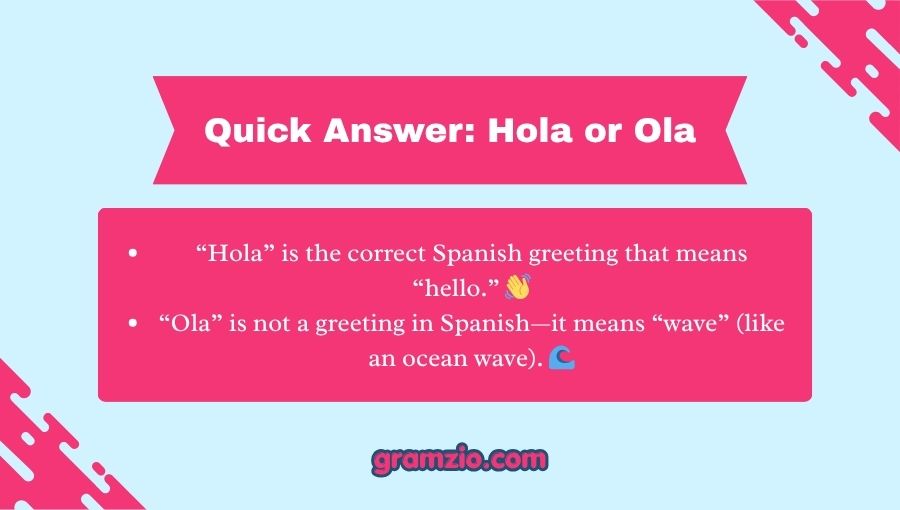
“Hola” is the correct Spanish greeting that means “hello.” 👋
“Ola” is not a greeting in Spanish—it means “wave” (like an ocean wave). 🌊
So, if you’re trying to say hello in Spanish, always use “hola.”
Understanding the Basics: Hola or Ola
Let’s break down the difference clearly:
| Form | Type | Meaning | Example | Correct/Incorrect |
|---|---|---|---|---|
| Hola | Interjection (Greeting) | Hello / Hi 👋 | Hola, ¿cómo estás? | ✅ Correct |
| Ola | Noun | Wave (water or motion) 🌊 | La ola es grande | ❌ Incorrect (as greeting) |
Key Insight:
- Hola = Greeting (correct for hello)
- Ola = Object (a wave, not a greeting)
Correct Meanings & Uses
What Does “Hola” Mean? 👋
“Hola” is a Spanish word used to greet someone. It works just like “hello” or “hi” in English.
Example:
- Hola, amigo.
- Hola = Hello
- amigo = friend
👉 “Hello, friend.”
Sentence Breakdown:
- “Hola” is used at the beginning.
- It sets a friendly tone.
- It can be used formally or casually.
More Examples:
- Hola, ¿qué tal? (Hello, how are you?)
- Hola, buenos días. (Hello, good morning.)
💡 Test Tip:
If you’re greeting someone, always use “hola”—never “ola.”
What Does “Ola” Mean? 🌊
“Ola” is a Spanish noun that means “wave,” like a wave in the ocean.
Example:
- La ola es fuerte.
- La = the
- ola = wave
👉 “The wave is strong.”
Sentence Breakdown:
- “Ola” refers to something physical.
- It cannot be used as a greeting.
More Examples:
- Una ola gigante (A giant wave)
- La ola del mar (The ocean wave)
💡 Test Tip:
If you’re talking about water or motion, “ola” is correct. Otherwise, it’s likely wrong.
Case Study Section 📘
Scenario: Workplace Email
Incorrect Message:
Ola Maria, I hope you are doing well.
❌ Problem:
- “Ola” is used instead of “Hola.”
- It changes the meaning and appears incorrect.
Correct Message:
Hola Maria, I hope you are doing well.
✅ Why it works:
- “Hola” is the proper greeting.
- It shows professionalism and accuracy.
Takeaway:
Even small spelling mistakes can impact your credibility—especially in professional communication.
Grammar Rules Explanation
The difference between “Hola or Ola” comes down to vocabulary and meaning, not just grammar.
According to standard Spanish dictionaries (such as those aligned with Merriam-Webster language references):
- “Hola” is classified as an interjection, used to express greeting.
- “Ola” is a noun, referring to a physical object (wave).
Why “Hola” Is Correct:
- It functions as a greeting word.
- It has a social and conversational role.
Why “Ola” Is Incorrect (as greeting):
- It has a completely different meaning.
- It does not function as a greeting in any context.
Common Mistakes Section ⚠️
Why Do People Confuse Hola or Ola?
Here are the main reasons:
- Fast typing ⌨️
- Autocorrect errors 📱
- Lack of language knowledge 📚
- Phonetic similarity 🔊
Similar Grammar Confusions
| Confusion | Correct Form | Incorrect Form | Reason |
|---|---|---|---|
| It’s / Its | It’s = it is | Its = possession | Apostrophe confusion |
| Your / You’re | You’re = you are | Your = possession | Sound similarity |
| Their / There | Their = possession | There = place | Homophones |
| Hola / Ola | Hola = greeting | Ola = wave | Language misunderstanding |
Usage in Different Contexts
1. Everyday Conversation 🗣️
- Correct: Hola, ¿cómo estás?
- Incorrect: Ola, ¿cómo estás?
2. Professional Writing 💼
- Always use “hola” if writing in Spanish.
- Avoid “ola” unless referring to waves.
3. Creative Writing ✍️
- Use “hola” in dialogue.
- Use “ola” only in descriptive scenes (e.g., ocean).
4. Social Media/Texting 📱
- People often mistype “ola.”
- Always double-check before sending.
Why It Matters ⭐
Using the correct word between Hola or Ola matters more than you think:
- ✅ Clarity in communication
- ✅ Professionalism
- ✅ Accuracy in writing
- ✅ Better language learning
“Clear language builds clear understanding.”
Even one letter can change your message completely.
Special Exception Section
There are no real exceptions where “ola” can replace “hola” as a greeting in Spanish.
However:
- “Ola” may appear in brand names or non-Spanish contexts.
- In Portuguese, “olá” (with an accent) means hello—but that’s a different language.
👉 Important: Stick to “hola” for Spanish greetings.
Quick Recap Checklist ✅
| Question | If Yes → Use |
|---|---|
| Are you greeting someone? | Hola 👋 |
| Are you talking about the ocean? | Ola 🌊 |
| Is it a conversation starter? | Hola |
| Is it describing water motion? | Ola |
Practice Examples:
- ___, amigo. → Hola
- La ___ es grande. → Ola
- ___, buenos días. → Hola
FAQs Section ❓
1. Is “ola” ever correct as a greeting?
No. In Spanish, “ola” is never used as a greeting. It means “wave.”
2. Why do people type “ola” instead of “hola”?
Mostly due to fast typing, autocorrect, or not knowing Spanish spelling rules.
3. Can “hola” be used in formal situations?
Yes. “Hola” is suitable for both formal and informal greetings.
4. What does “ola” mean in English?
“Ola” translates to “wave,” like an ocean wave.
5. Is “hola” used worldwide?
Yes. It is widely recognized as the Spanish word for “hello.”
6. What is the Portuguese version of “hola”?
In Portuguese, it’s “olá” (with an accent), which also means hello.
Conclusion
The confusion between Hola or Ola is simple but important. “Hola” is the correct word for saying hello in Spanish, while “ola” refers to a wave and should never be used as a greeting. This small difference can have a big impact on how your message is understood.
By remembering that “hola = hello” and “ola = wave,” you can avoid common mistakes and communicate more clearly and confidently. Whether you’re writing an email, sending a text, or learning a new language, accuracy matters.
So next time you greet someone in Spanish, make it count—say “hola,” not “ola.” 👋
Also read: Indigo vs Violet

Hi, I’m Elara Quinn. Working at gramzio.com, I use my 8 years of experience in linguistics to simplify difficult English rules, making them accessible and easy to learn for our global community.