Did You Have or Did You Had: The Complete Grammar Guide (US English)
Have you ever wondered whether you should say “Did you have or did you had” when forming questions in English? 🤔 This is one of the most common grammar mistakes learners make, and it often causes confusion in both writing and speaking. The difference may look small, but the rule behind it is very important for correct English usage.
The confusion around “Did you have or did you had” comes from mixing past tense structures incorrectly. English grammar can feel tricky because we often combine helping verbs like did with main verbs, and each part follows a strict rule.
In this article, we will break down this grammar question in the simplest way possible. You will learn why one form is correct, why the other is incorrect, and how to confidently use them in everyday communication. 📘
By the end, you’ll never hesitate again when forming questions in the past tense. Let’s clear up this confusion once and for all.
Quick Answer: Did You Have or Did You Had
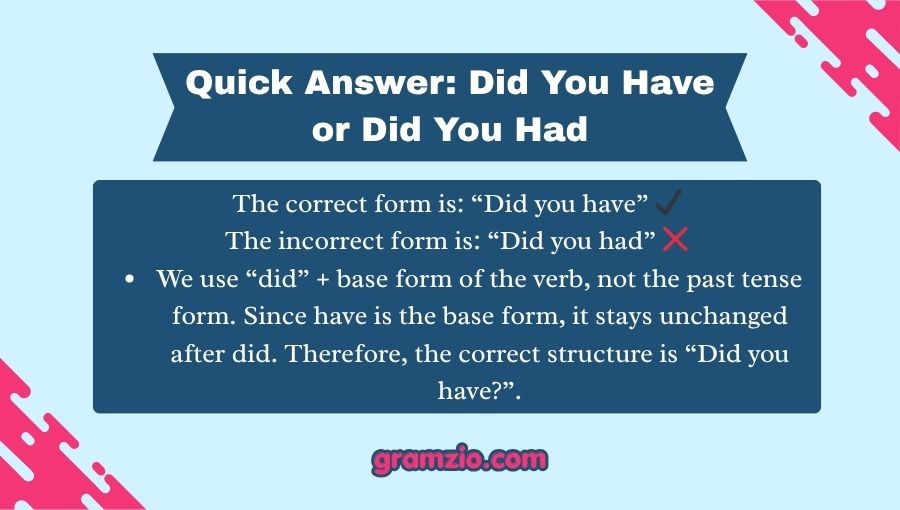
The correct form is: “Did you have” ✔️
The incorrect form is: “Did you had” ❌
We use “did” + base form of the verb, not the past tense form. Since have is the base form, it stays unchanged after did. Therefore, the correct structure is “Did you have?”.
Understanding the Basics: Did You Have or Did You Had
To fully understand this grammar rule, we need to look at how past tense questions are formed in English.
When we use the auxiliary verb “did”, the main verb always returns to its base form (present form without -ed or past modification).
❌ Incorrect:
- Did you had breakfast?
- Did she went to school?
✔️ Correct:
- Did you have breakfast?
- Did she go to school?
📊 Comparison Table
| Form | Type | Meaning | Example | Correct/Incorrect |
|---|---|---|---|---|
| Did you have | Correct question form | Asking about past possession or experience | Did you have dinner? | ✔️ Correct |
| Did you had | Incorrect form | Mixing past auxiliary with past verb | Did you had dinner? | ❌ Incorrect |
Why “Did You Have” Is Correct
The reason is simple: “did” already shows past tense.
So we do NOT need to change the main verb into past form again.
Structure Rule:
Did + subject + base verb
Examples:
- Did you have time yesterday?
- Did you have a meeting with him?
- Did you have fun at the party? 🎉
👉 Notice that “have” never changes, even though we are talking about the past.
Why “Did You Had” Is Incorrect
The form “did you had” is grammatically wrong because it creates a double past tense.
❌ Problem:
- “Did” already indicates past tense
- “Had” is also past tense
- Combining both creates redundancy
Correct Logic:
- Did you have ❌ (wrong)
- Did you had ❌ (double past error)
- Did you have ✔️ (correct structure)
Test Tip 🧠
If you can replace “did” with “do/does” in your mind, the verb should always remain in base form:
- Do you have?
- Did you have?
If the verb changes after “did,” it is incorrect.
Case Study: Real-Life Usage
💼 Workplace Email Example
Incorrect:
Did you had the report ready by Monday?
Correct:
Did you have the report ready by Monday?
🧑🤝🧑 Conversation Example
A: Did you have lunch today?
B: Yes, I had pasta. 🍝
👉 Notice how “did you have” is used in the question, and “had” appears only in the answer, not after “did.”
Grammar Rules Explanation
According to standard English grammar rules supported by references like Merriam-Webster, auxiliary verbs such as did always require the base form of the verb.
Key Rule:
When “did” is used, the main verb does NOT take past tense form.
This rule applies to all verbs:
- go → did you go (not did you went)
- eat → did you eat (not did you ate)
- have → did you have (not did you had)
Why this rule exists:
English avoids repeating tense markers in one sentence. The helper verb (did) already carries the time reference.
Common Mistakes
Many learners accidentally say “did you had” due to habit or confusion.
Why these mistakes happen:
- ⌨️ Fast typing without thinking grammar rules
- 🤖 Autocorrect suggestions from devices
- 📚 Lack of understanding of auxiliary verb rules
- 🗣️ Influence from spoken language mistakes
📊 Similar Grammar Confusions Table
| Incorrect | Correct |
|---|---|
| Did you had lunch? | Did you have lunch? |
| Did she went home? | Did she go home? |
| Did they saw it? | Did they see it? |
| Did he cooked food? | Did he cook food? |
| Did I wrote it? | Did I write it? |
Usage in Different Contexts
🗣️ Everyday Conversation
- Did you have breakfast today?
- Did you have a good sleep?
💼 Professional Writing
- Did you have time to review the document?
- Did you have access to the system?
✍️ Creative Writing
- Did you have the courage to speak up?
- Did you have the chance to run away?
📱 Social Media / Texting
- Did you have fun today? 😄
- Did you have a good weekend? 🌴
Why It Matters
Using correct grammar is not just about rules—it affects how people understand and trust your communication.
Key benefits:
- ✔️ Clear communication
- ✔️ Professional impression
- ✔️ Better writing accuracy
- ✔️ Improved confidence in English
📢 As communication expert William Zinsser once emphasized:
“Clarity is the most important element of good writing.”
Special Exception Section
There are no major exceptions to this rule in standard English grammar.
However, in very informal speech or dialects, people may incorrectly say “did you had”, but this is not accepted in formal or academic English.
Quick Recap Checklist
| Question | If Yes → Use |
|---|---|
| Are you using “did” in the sentence? | Use base verb |
| Is the verb past tense after “did”? | Change it to base form |
Practice Examples:
- ❌ Did you had breakfast?
✔️ Did you have breakfast? - ❌ Did she went to school?
✔️ Did she go to school? - ❌ Did they saw the movie?
✔️ Did they see the movie?
FAQs: Did You Have or Did You Had
1. Why is “Did you had” wrong?
Because “did” already shows past tense, so the verb must stay in base form.
2. Is “Did you have” correct English?
Yes, it is the correct and standard form used in both spoken and written English.
3. Can we ever say “Did you had”?
No, it is grammatically incorrect in standard English.
4. What is the rule after “did”?
Always use the base form of the verb (present form).
5. Why do people get confused?
Because they mistakenly apply past tense twice in one sentence.
6. What is the easiest way to remember it?
Think: “Did = already past, so verb stays simple.”
Conclusion (150 words)
The confusion between “Did you have or did you had” is very common, but the rule is actually simple. The correct form is always “Did you have”, because the auxiliary verb did already carries the past tense meaning, and the main verb must remain in its base form.
Using “did you had” is incorrect because it unnecessarily doubles the past tense, which breaks English grammar rules. Once you understand this structure, you can apply it to all verbs—not just have.
Mastering this rule improves your confidence in speaking, writing, and professional communication. Whether you’re texting a friend or writing an email, using correct grammar helps you sound clear and natural.
So next time you hesitate, just remember:
👉 “Did + base verb = always correct.” ✔️
Keep practicing, and this rule will become second nature in no time.
Also read: Feel vs Felt

Hi, I’m Dexter Rhodes. At gramzio.com, I apply my 10 years of experience in copy-editing to ensure every guide we publish is accurate, professional, and follows the highest editorial standards.