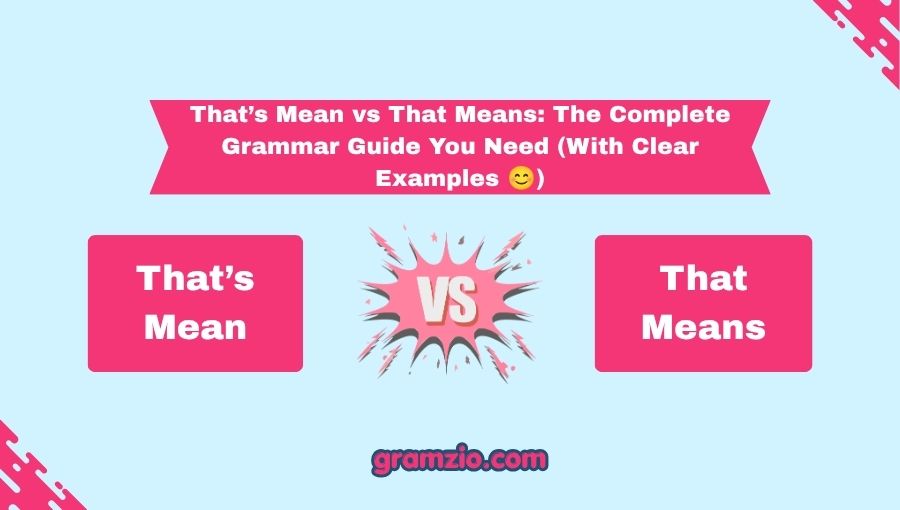
That’s Mean vs That Means: The Complete Grammar Guide You Need (With Clear Examples 😊)
That’s Mean Vs That Means is one of the most commonly confused grammar pairs in English, especially for learners and everyday writers. At first glance, these two phrases look similar, but they have completely different meanings and uses in communication.
Many people mix up That’s Mean Vs That Means in texting, social media posts, and casual conversation because both phrases start in a similar way. However, one is used to express rudeness or unkind behavior, while the other is used to explain or describe a result.
Understanding That’s Mean Vs That Means is important if you want to speak and write clearly without misunderstandings. In this guide, we will break everything down in a simple, practical way so you never confuse them again 😊.
Quick Answer: That’s Mean vs That Means
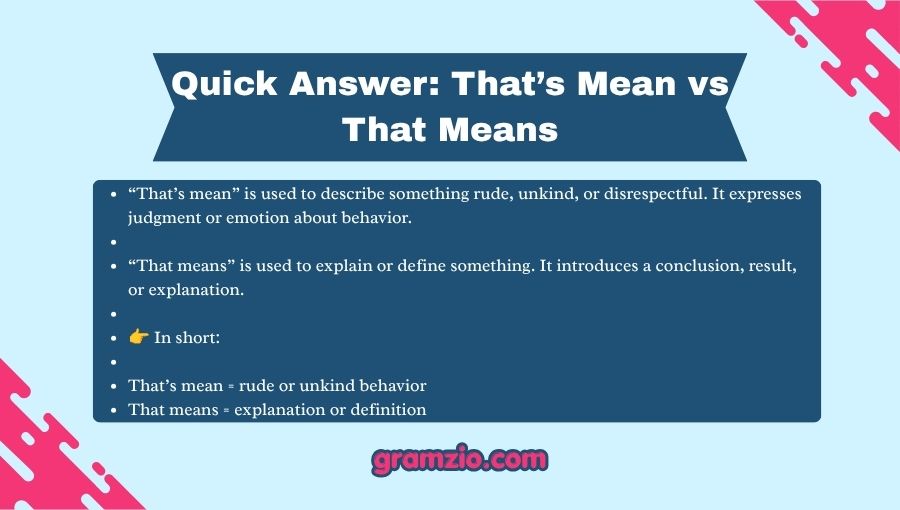
“That’s mean” is used to describe something rude, unkind, or disrespectful. It expresses judgment or emotion about behavior.
“That means” is used to explain or define something. It introduces a conclusion, result, or explanation.
👉 In short:
- That’s mean = rude or unkind behavior
- That means = explanation or definition
Understanding the Basics: That’s Mean vs That Means
To fully understand that’s mean vs that means, we need to break down the grammar behind each phrase.
🔹 “That’s Mean”
- “That’s” = That is
- “Mean” = unkind or rude behavior
So, “that’s mean” means:
👉 Something is rude or not nice.
Example:
- “You didn’t share your food? That’s mean!”
🔹 “That Means”
- “That” = referring to something
- “Means” = indicates, explains, or shows a result
So, “that means” is used for explanation.
Example:
- “It is raining heavily, that means the match will be canceled.”
Comparison Table: That’s Mean vs That Means
| Feature | That’s Mean 😠 | That Means 💡 |
|---|---|---|
| Form | Contraction + adjective | Pronoun + verb |
| Type | Opinion/Emotion | Explanation |
| Meaning | Rude or unkind behavior | Explanation or result |
| Usage | Expressing feelings | Giving clarification |
| Example | That’s mean of you | That means we are late |
| Correct Usage | When judging behavior | When explaining something |
Correct Meanings & Uses
🔹 1. “That’s Mean” – Expressing Rudeness
We use “that’s mean” when someone behaves in a way that is unkind, unfair, or hurtful.
Example Breakdown:
- “You laughed at him.”
- “That’s mean.”
👉 Here, the speaker is showing disapproval.
More Examples:
- “You didn’t invite her? That’s mean.”
- “Taking his lunch without asking is mean.”
💡 Test Tip:
If you can replace it with “That’s not nice,” then “that’s mean” is correct.
🔹 2. “That Means” – Giving Explanation
We use “that means” when we want to explain a result or meaning.
Example Breakdown:
- “The store is closed today, that means we will shop tomorrow.”
👉 Here, one situation explains another.
More Examples:
- “He didn’t reply, that means he is busy.”
- “The light is red, that means stop.”
💡 Test Tip:
If you can replace it with “this shows” or “this explains,” use that means.
Case Study: Real-Life Usage Example
Situation: Workplace Email
❌ Incorrect:
- “The client canceled the meeting, that’s mean we are free now.”
✔ Correct:
- “The client canceled the meeting, that means we are free now.”
Explanation:
The speaker is not judging behavior. They are explaining a result. Therefore, “that means” is correct.
Grammar Rules Explanation
Understanding grammar rules helps eliminate confusion.
🔹 “That’s Mean”
- “That’s” = contraction of “that is”
- “Mean” = adjective describing behavior
- Used for opinions or emotional reactions
🔹 “That Means”
- “Means” = verb (third-person singular of “mean”)
- Used to express explanation or result
According to standard grammar references like Merriam-Webster Dictionary, “mean” can function as both an adjective (unkind) and a verb (to signify). This dual function is what causes confusion.
👉 Key Rule:
- If you are describing behavior → That’s mean
- If you are explaining something → That means
Common Mistakes
Many learners confuse these phrases due to similar spelling and sound.
🔹 Why Mistakes Happen
- Fast typing ⌨️
- Autocorrect errors 📱
- Lack of grammar knowledge 📚
- Speaking-style writing in texts 💬
🔹 Common Confusion Table
| Confused Pair | Correct Form | Why It Happens |
|---|---|---|
| it’s / its | it’s (it is) | apostrophe confusion |
| your / you’re | you’re (you are) | sound similarity |
| that’s mean / that means | that means | grammar misunderstanding |
| their / there / they’re | depends | spelling similarity |
Usage in Different Contexts
🔹 Everyday Conversation
- “You didn’t call me? That’s mean!”
- “He is late, that means traffic is bad.”
🔹 Professional Writing
- “Sales dropped, that means strategy needs adjustment.”
- “Ignoring deadlines is mean behavior in teams.”
🔹 Creative Writing
- “She walked away without a word, that means something was wrong.”
- “His joke felt mean, even if he didn’t intend it.”
🔹 Social Media/Texting
- “You saw my message and ignored it? That’s mean 😤”
- “No replies all day, that means you’re busy 😂”
Why It Matters (Important)
Using correct grammar is not just about rules—it’s about clarity.
Why it matters:
- Improves communication clarity
- Builds professionalism
- Avoids misunderstandings
- Enhances writing quality in digital spaces
“Good grammar is the foundation of clear communication.”
A small mistake like mixing that’s mean vs that means can completely change the message tone—from explanation to offense.
Special Exception
There are no special exceptions for these phrases in standard English grammar. However, in informal texting, people sometimes intentionally misuse grammar for humor or tone.
Example:
- “Oh you didn’t save me food? That’s mean 😂”
This is still correct usage, just informal and emotional.
Quick Recap Checklist
| Question | If Yes → Use |
|---|---|
| Are you describing rude behavior? | That’s mean |
| Are you explaining something? | That means |
Practice Examples:
- “He didn’t show up, ____ we are starting without him.”
✔ Answer: that means - “You didn’t share your toy, ____.”
✔ Answer: that’s mean - “It is dark outside, ____ night has come early.”
✔ Answer: that means
FAQs: That’s Mean vs That Means
1. What is the difference between “that’s mean” and “that means”?
“That’s mean” describes rude behavior, while “that means” explains a result or situation.
2. Is “that’s mean” grammatically correct?
Yes, it is correct when you are describing unkind or rude behavior.
3. Can I use “that means” in formal writing?
Yes, it is commonly used in both formal and informal English.
4. Why do people confuse these two phrases?
Because both start similarly and sound alike, but they serve completely different grammatical purposes.
5. Is “that’s mean” used in professional English?
Rarely. In professional writing, it is better to say “That is unkind” or “That is inappropriate.”
6. What is an easy trick to remember the difference?
- Mean = rude behavior 😠
- Means = explanation 💡
Conclusion
Understanding the difference between that’s mean vs that means is essential for clear and correct English communication. While they may look similar, their meanings are completely different. “That’s mean” expresses emotion or judgment about rude behavior, while “that means” provides explanation or clarification.
By remembering a simple rule—mean = rude, means = explain—you can avoid one of the most common grammar mistakes in English.
Whether you are texting, writing emails, or speaking in daily conversation, using the correct phrase will make your communication clearer and more professional.
Mastering small grammar differences like this builds strong language confidence over time. Keep practicing, and soon you will never mix them up again 😊.
Also read: Than vs Then

Hi, I’m Grayson Finch. I’m part of the gramzio.com team with 9 years of experience in grammar education. I am dedicated to teaching professional communication and helping you master the art of writing.