Disloyal vs Unloyal: Which Word Is Correct and When Should You Use It? 🤔
Have you ever typed a sentence like, “He was unloyal to his friends” and suddenly wondered if something felt off? You’re not alone. Many English learners and even native speakers get confused by Disloyal vs Unloyal because both words appear to mean the opposite of loyal. After all, prefixes like dis- and un- often create negative forms of words.
But English grammar is full of surprises. Some words follow patterns, while others develop through actual usage and language history. That means two words may look similar yet have very different levels of acceptance.
Understanding Disloyal vs Unloyal matters because using the wrong word can make writing sound awkward or unnatural. Whether you are writing emails, essays, social media posts, or professional documents, choosing the correct term improves your communication.
Let’s break down the confusion in simple terms and settle the debate once and for all. 🚀
Quick Answer: Disloyal vs Unloyal
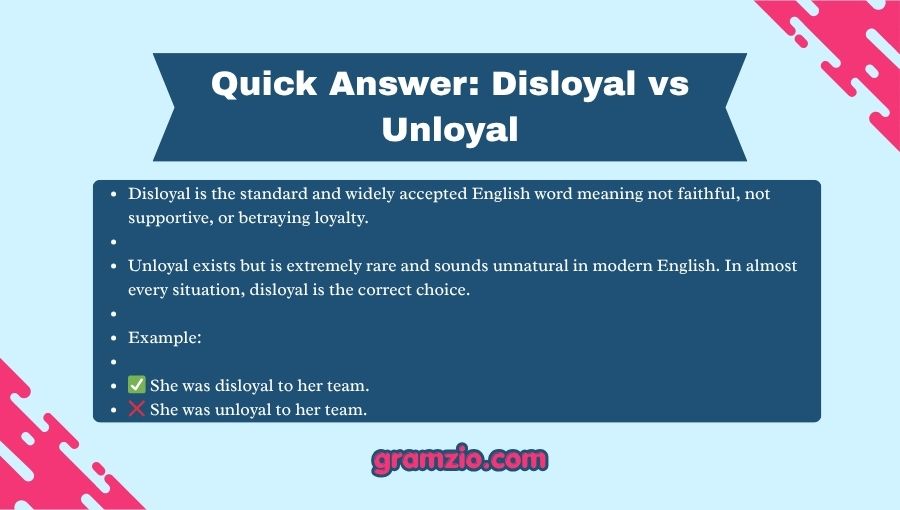
Disloyal is the standard and widely accepted English word meaning not faithful, not supportive, or betraying loyalty.
Unloyal exists but is extremely rare and sounds unnatural in modern English. In almost every situation, disloyal is the correct choice.
Example:
✅ She was disloyal to her team.
❌ She was unloyal to her team.
Understanding the Basics: Disloyal vs Unloyal
At first glance, both words seem logical:
- Loyal = faithful
- Disloyal = not faithful
- Unloyal = not faithful
However, English does not always treat prefixes equally. Language usage over time determines what becomes standard.
Here is a clear comparison:
| Form | Type | Meaning | Example | Correct/Incorrect |
|---|---|---|---|---|
| Loyal | Adjective | Faithful and supportive | She remained loyal. | ✅ Correct |
| Disloyal | Adjective | Not loyal; betraying trust | He was disloyal. | ✅ Correct |
| Unloyal | Adjective | Intended to mean not loyal | He was unloyal. | ❌ Usually incorrect or uncommon |
The key takeaway:
Disloyal is accepted standard English. Unloyal is technically a word but rarely used.
Correct Meanings and Uses
What Does “Disloyal” Mean? 📘
Disloyal describes someone who betrays trust, support, duty, or faithfulness.
Examples:
✅ He was disloyal to his company.
✅ She felt betrayed by her disloyal friend.
✅ The soldier was accused of being disloyal.
Sentence breakdown:
- Subject: He
- Verb: was
- Adjective: disloyal
- Object: to his company
The adjective describes a failure of loyalty.
Why “Unloyal” Sounds Strange
Although dictionaries may acknowledge unloyal, it is not commonly used in modern English.
Examples:
❌ He became unloyal after the disagreement.
❌ My unloyal teammate ruined the game.
Readers often pause because the wording sounds unnatural.
Native speakers overwhelmingly prefer disloyal.
Test Tip 📝
Try replacing the word with:
“betraying trust” or “faithless.”
If it fits, use disloyal.
Example:
“He betrayed his friends.”
“He was disloyal to his friends.”
Works perfectly. ✅
Case Study Section
Imagine this workplace email:
Incorrect version:
“John has been unloyal to the company and shared private information.”
This sentence feels awkward.
Improved version:
“John has been disloyal to the company and shared private information.”
Why?
In professional writing, standard usage matters. Readers expect familiar vocabulary.
Using uncommon forms may distract readers or reduce credibility.
Real-world communication depends on natural language choices.
Grammar Rules Explanation
English frequently creates opposites using prefixes:
Examples:
- happy → unhappy
- fair → unfair
- known → unknown
Because of this pattern, many learners assume:
loyal → unloyal
That seems logical.
However, English also uses dis-:
- honest → dishonest
- obey → disobey
- loyal → disloyal
Language history and common usage determine which version survives.
According to standard dictionary conventions and grammar authorities such as Merriam-Webster, disloyal is the established term in common English usage.
English evolves through actual usage rather than pure logic.
That is why disloyal became dominant.
Common Mistakes
Why do people confuse Disloyal vs Unloyal?
Several reasons explain it:
Fast typing ⌨️
People automatically add un- because many negatives begin that way.
Autocorrect 📱
Typing software sometimes accepts unusual forms.
Lack of knowledge 📚
Many learners assume all adjectives follow identical rules.
Similar Grammar Confusions
| Confusing Pair | Correct Difference |
|---|---|
| it’s / its | contraction vs possession |
| your / you’re | possession vs you are |
| affect / effect | verb vs noun |
| farther / further | distance vs extension |
| disloyal / unloyal | standard vs uncommon |
These mistakes happen because English often ignores patterns.
Usage in Different Contexts
Everyday Conversation 🗣️
People naturally say:
✅ “He was disloyal.”
Rarely:
❌ “He was unloyal.”
Professional Writing 💼
Business communication values standard wording.
Example:
“Employees should avoid disloyal behavior.”
Professional documents rarely use unloyal.
Creative Writing ✍️
Authors sometimes experiment with language.
A writer could intentionally use unloyal to create a unique voice or character style.
Example:
“Mama called him an unloyal boy.”
Still, this is uncommon.
Social Media and Texting 📱
Short posts often contain grammar shortcuts.
You may occasionally see:
“Fake and unloyal people everywhere 😒”
Even online, disloyal remains more natural.
Why It Matters ⭐
Word choice affects communication quality.
Using the right form improves:
Clarity
Readers understand your message instantly.
Professionalism
Correct grammar builds trust.
Writing Accuracy
Accurate wording prevents confusion in digital communication.
Consider this quote:
“Clear language creates clear understanding.”
Simple word choices often create stronger writing.
Special Exception
There are rare situations where unloyal may appear.
Examples include:
- historical texts
- regional usage
- artistic writing
- intentional stylistic choices
Some authors may purposely choose unusual wording for effect.
Still, these are exceptions—not the rule.
For normal writing:
Use disloyal. ✅
Quick Recap Checklist
| Question | If Yes → Use |
|---|---|
| Are you describing betrayal? | Disloyal |
| Are you writing professionally? | Disloyal |
| Does unloyal sound strange? | Disloyal |
| Are you following standard English? | Disloyal |
Practice examples:
- She was ______ to her friends.
Answer: disloyal
- The employee acted ______ toward the company.
Answer: disloyal
- His actions seemed ______ and dishonest.
Answer: disloyal
Frequently Asked Questions (FAQs)
Is unloyal a real word?
Yes. Unloyal exists in dictionaries, but it is extremely uncommon and rarely used in modern English.
Which is correct: disloyal or unloyal?
Disloyal is the correct and preferred word in almost every context.
Why does unloyal sound awkward?
English usage developed around disloyal, making it the standard form. Native speakers rarely use unloyal.
Can I use unloyal in creative writing?
Yes. Writers sometimes use uncommon wording intentionally for style or character voice.
Is disloyal negative?
Yes. It describes betrayal, lack of faithfulness, or broken trust.
Is disloyal used in business writing?
Absolutely. Professional communication strongly favors disloyal.
Conclusion
The confusion around Disloyal vs Unloyal comes from English prefix patterns. Since many words use un- for opposites, unloyal appears logical. However, language does not always follow strict rules.
Modern English strongly prefers disloyal because it is standard, natural, and widely accepted. While unloyal technically exists, it sounds unusual and rarely appears in everyday writing.
Remember this simple rule:
✅ Betrayal or lack of faithfulness = disloyal
❌ Avoid unloyal in normal usage
Small grammar choices create a big impact. Mastering them helps your writing sound smoother, smarter, and more professional. The right word does not just convey meaning—it builds confidence. 🚀
Also read: Sale vs Sail

Hi, I’m Grayson Finch. I’m part of the gramzio.com team with 9 years of experience in grammar education. I am dedicated to teaching professional communication and helping you master the art of writing.