Agreed vs Agree: What’s the Difference and Which One Should You Use? 🤝
Have you ever typed a message like “I agreed with your idea” and then paused for a second? Or maybe you wrote “I agree with your suggestion” and wondered whether agreed or agree was the right choice. You’re not alone. Many English learners and even native speakers get confused by Agreed vs Agree, especially because both words come from the same verb and seem nearly identical.
The confusion usually happens because one word refers to a present action while the other often points to a completed action or past event. A tiny change in form creates a different grammatical role and meaning. That small difference can affect your writing in emails, conversations, essays, and professional communication.
Understanding Agreed vs Agree matters because choosing the wrong form can make a sentence sound awkward or grammatically incorrect. The good news? The distinction is easier than it appears. 😊
In this guide, you’ll learn the meanings, rules, examples, grammar explanations, common mistakes, real-life uses, and practical tips to master these two words with confidence.
Quick Answer: Agreed vs Agree
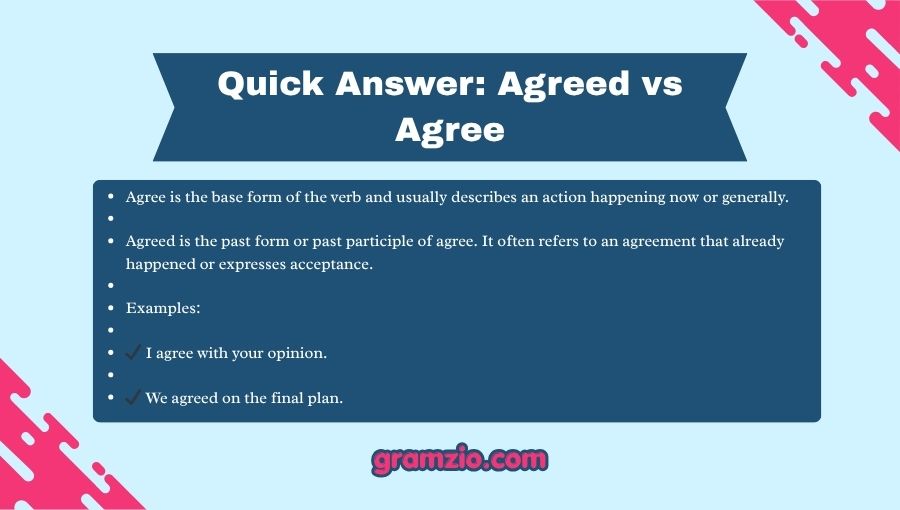
Agree is the base form of the verb and usually describes an action happening now or generally.
Agreed is the past form or past participle of agree. It often refers to an agreement that already happened or expresses acceptance.
Examples:
✔ I agree with your opinion.
✔ We agreed on the final plan.
Understanding the Basics: Agreed vs Agree
The core difference is simple:
- Agree = present/base verb
- Agreed = past tense or adjective-like use
Here is a quick comparison table:
| Form | Type | Meaning | Example | Correct/Incorrect |
|---|---|---|---|---|
| Agree | Verb (base form) | To share the same opinion | I agree with you. | ✔ Correct |
| Agreed | Past tense/Past participle | Accepted or shared opinion in the past | They agreed yesterday. | ✔ Correct |
| Agree | Wrong past use | Incorrect past form usage | Yesterday I agree. | ❌ Incorrect |
| Agreed | Wrong present use | Incorrect for present statement | I agreed with you now. | ❌ Incorrect |
The key idea: ask yourself When did the agreement happen?
- Happening now → agree
- Happened before → agreed
Correct Meanings & Uses
Using “Agree”
Agree is used when discussing present situations, habits, or future intentions.
Examples:
✔ I agree with your point.
Sentence breakdown:
- Subject: I
- Verb: agree
- Object phrase: with your point
Meaning: You share the same opinion now.
Another example:
✔ Most teachers agree that practice improves writing.
This expresses a general truth.
Test Tip 📝
If you can replace the sentence with currently believe, agree is often correct.
Using “Agreed”
Agreed usually refers to something completed in the past.
Examples:
✔ We agreed to meet at noon.
Breakdown:
- Subject: We
- Verb: agreed
- Infinitive phrase: to meet at noon
Meaning: The decision was already made.
Another example:
✔ She agreed with the proposal yesterday.
The action happened in the past.
Test Tip 📝
Look for time clues:
- yesterday
- last week
- earlier
- previously
These often signal agreed.
“Agreed” as a Standalone Expression
English speakers also use Agreed! by itself.
Example:
Person A: This project needs more editing.
Person B: Agreed.
Meaning: I completely agree.
This usage is especially common in meetings and text conversations.
Case Study Section 📧
Imagine a workplace email conversation:
Manager:
“Should we move the meeting to Friday?”
Employee Response 1:
“I agree with moving the meeting.”
This means the employee supports the idea now.
Employee Response 2:
“We agreed to move the meeting last week.”
This means the decision already happened.
Notice the difference:
The first sentence shows current agreement.
The second refers to a completed decision.
A small verb change creates a different timeline.
Grammar Rules Explanation
According to standard grammar references and traditional dictionary usage principles such as those found in major language authorities like Merriam-Webster, agree is a regular verb.
Its forms follow this pattern:
- Agree
- Agrees
- Agreed
- Agreeing
Rule:
Base verbs describe present actions:
✔ I agree.
Past tense verbs describe completed actions:
✔ I agreed.
The issue arises when people use present and past forms interchangeably.
Incorrect:
❌ Yesterday I agree.
Correct:
✔ Yesterday I agreed.
Why?
Because yesterday indicates past time.
Grammar and time markers must match.
Common Mistakes ❌
People confuse Agreed vs Agree for several reasons:
Fast typing
People often type quickly and forget tense changes.
Example:
❌ We agree yesterday.
Autocorrect issues
Devices sometimes miss contextual grammar mistakes.
Lack of grammar knowledge
Some writers know the words but not their grammatical roles.
Similar Grammar Confusions Table
| Confusing Pair | Correct Difference |
|---|---|
| It’s / Its | Contraction vs possession |
| Your / You’re | Possession vs “you are” |
| Then / Than | Time vs comparison |
| Affect / Effect | Verb vs noun |
| Agree / Agreed | Present vs past |
Usage in Different Contexts
Everyday Conversation 🗣️
People use both forms constantly.
Examples:
“I agree with your choice.”
“We agreed to order pizza.”
Professional Writing 💼
Work emails often require precise wording.
Example:
✔ I agree with the proposed strategy.
✔ Our team agreed on the final budget.
Wrong verb tense can create confusion.
Creative Writing ✍️
Stories use both forms depending on timing.
“James agreed reluctantly.”
“Emma did not agree with him.”
Social Media and Texting 📱
Short forms appear often:
“Agreed!”
“Totally agree.”
“I agree 100%.”
Social media sometimes removes full sentence structure, but grammar still matters.
Why It Matters ⭐
The difference between Agreed vs Agree is more important than many people realize.
Clarity in communication
Correct grammar prevents misunderstandings.
Professionalism
Employers notice language quality.
Writing accuracy in digital communication
Emails, reports, and messages depend on precision.
Consider this quote:
“Clear language creates clear thinking.”
Using the correct word helps readers instantly understand your meaning.
Tiny grammar choices build credibility.
Special Exception
There is one interesting usage worth noting.
Agreed sometimes functions almost like an adjective.
Example:
“The agreed amount was paid.”
Here agreed describes the noun amount.
Meaning:
The amount had already been accepted by all parties.
Similarly:
“The agreed schedule begins Monday.”
These are less common but perfectly correct.
Quick Recap Checklist ✅
Use this guide when deciding.
| Question | If Yes → Use |
|---|---|
| Is it happening now? | Agree |
| Is it a general opinion? | Agree |
| Did it happen in the past? | Agreed |
| Was a decision already made? | Agreed |
| Is it a completed action? | Agreed |
Practice examples:
- We _____ to leave early yesterday.
Answer: agreed
- I _____ with your opinion.
Answer: agree
- They _____ on a new plan last week.
Answer: agreed
FAQs About Agreed vs Agree
1. Is “I agreed with you” grammatically correct?
Yes. It means you shared the same opinion in the past.
Example:
“I agreed with you during yesterday’s discussion.”
2. Is “I agree with you” correct?
Yes. It expresses a present opinion or belief.
Example:
“I agree with your idea.”
3. Can “Agreed” be a complete sentence?
Yes. Informally, Agreed! can stand alone.
Example:
Person A: We need more time.
Person B: Agreed!
4. Why do people confuse Agreed vs Agree?
Because both words come from the same root verb and differ only by tense.
Writers often overlook time context.
5. Which form appears more in business writing?
Both are common.
- Agree for current opinions
- Agreed for finalized decisions
6. Can agreed act like an adjective?
Yes.
Example:
“The agreed rules were followed.”
In this sentence, it describes rules.
Conclusion
Understanding Agreed vs Agree becomes easy once you focus on time. Agree is the base verb used for current opinions, ongoing thoughts, and general statements. Agreed refers to completed actions, past decisions, or accepted arrangements.
The rule is simple:
✔ Present or general → Agree
✔ Past or completed → Agreed
Although the difference seems small, using the right form improves clarity, professionalism, and writing accuracy. Whether you’re sending work emails, posting on social media, writing stories, or having everyday conversations, choosing the correct word helps your message sound polished and natural. 😊
Remember this simple line:
If the agreement already happened, it probably “agreed.” If it’s happening now, “agree” is the way to go.
Also read: Sweetie vs Sweety vs Sweatie

Hi, I’m Dexter Rhodes. At gramzio.com, I apply my 10 years of experience in copy-editing to ensure every guide we publish is accurate, professional, and follows the highest editorial standards.