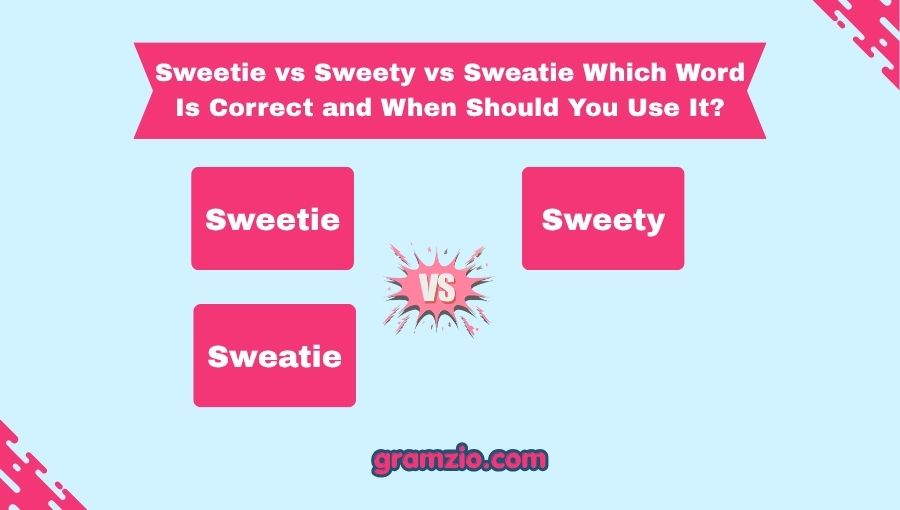
Sweetie vs Sweety vs Sweatie 🍬💬💦Which Word Is Correct and When Should You Use It?
Have you ever been confused about Sweetie vs Sweety vs Sweatie when typing a message like, “Good morning, sweety!”? 🤔 This small spelling difference often creates big confusion in everyday texting and online communication. Many people are unsure which version is correct, especially when trying to sound affectionate or friendly.
The confusion around Sweetie vs Sweety vs Sweatie happens because all three words look and sound similar, but they do not carry the same level of correctness in English. One is the standard term of endearment, another is an informal variation, and the third is usually a mistake that can completely change the meaning of your sentence.
In this guide, we will clearly break down each form, explain their meanings, show correct usage with examples, and help you confidently choose the right word every time.
Quick Answer: Sweetie vs Sweety vs Sweatie
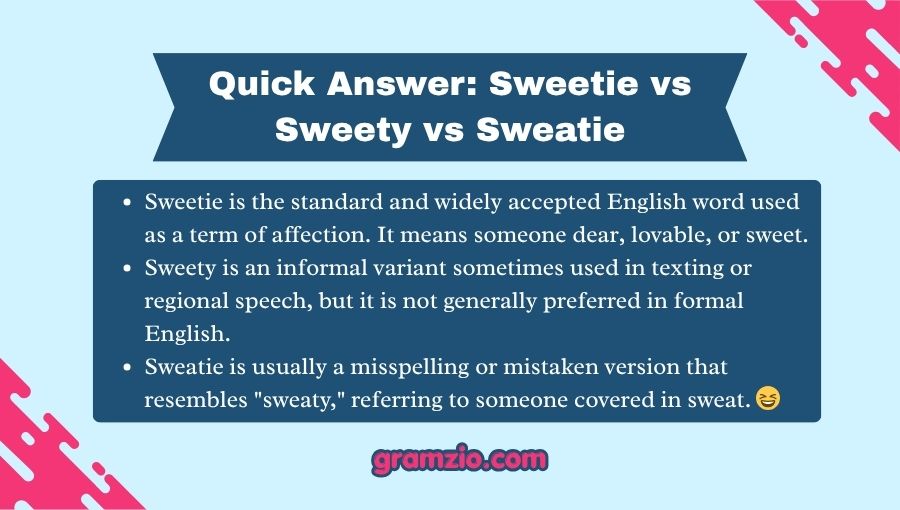
Sweetie is the standard and widely accepted English word used as a term of affection. It means someone dear, lovable, or sweet.
Sweety is an informal variant sometimes used in texting or regional speech, but it is not generally preferred in formal English.
Sweatie is usually a misspelling or mistaken version that resembles “sweaty,” referring to someone covered in sweat. 😆
Understanding the Basics: Sweetie vs Sweety vs Sweatie
The biggest difference is simple: only one version is considered standard English in most situations.
| Form | Type | Meaning | Example | Correct/Incorrect |
|---|---|---|---|---|
| Sweetie | Noun/term of affection | A loved person; someone sweet | “Goodnight, sweetie.” | ✅ Correct |
| Sweety | Informal variation | Casual nickname; nonstandard in many contexts | “Hi sweety!” | ⚠️ Informal |
| Sweatie | Misspelling | Often mistaken for “sweaty” | “Hello sweatie” | ❌ Usually incorrect |
The key takeaway: Sweetie is the safest and most accurate choice.
Correct Meanings & Uses
Sweetie ❤️
Sweetie is a common affectionate nickname used toward:
- Romantic partners
- Children
- Friends
- Family members
Examples:
Sentence: Come here, sweetie.
Breakdown:
- Come here = invitation
- sweetie = affectionate address
Sentence: Don’t worry, sweetie. Everything will be okay.
Breakdown:
- Emotional reassurance
- Loving tone
- Natural usage
Test Tip 📝
If you can replace the word with honey, dear, or darling, then sweetie is likely correct.
Example:
“Thanks, sweetie.”
“Thanks, honey.”
Works perfectly.
Sweety 😊
Sweety appears often in:
- Text messages
- Informal online chats
- Regional usage
- Non-native English communication
Examples:
“Good morning, sweety!”
“You are so kind, sweety.”
Although people use it, many dictionaries do not treat Sweety as the preferred standard spelling.
Test Tip 📝
If you are writing:
- school assignments
- professional communication
- blogs
- published content
Choose Sweetie instead.
Sweatie 💦
This is where things become unintentionally funny.
People often type Sweatie when they mean Sweetie.
However, readers may interpret it as:
“someone who is sweaty” 😅
Example:
“Thanks, sweatie!”
Readers might imagine a person covered in sweat after exercising.
Test Tip 📝
Read your sentence aloud. If the image becomes unintentionally awkward, double-check the spelling.
Case Study Section
Text Message Disaster 📱
Imagine Sarah texting her boyfriend after a long day:
Intended message:
“Miss you, sweetie ❤️”
But autocorrect changes it to:
“Miss you, sweatie ❤️”
Her boyfriend replies:
“I just got back from the gym. Accurate.”
Everyone laughs, but the example shows how one letter changes the meaning entirely.
Practical lesson:
Small spelling differences can create major communication confusion.
Grammar Rules Explanation
Why is Sweetie considered correct?
Standard grammar and dictionary conventions support Sweetie as the recognized noun form.
The word comes from:
sweet + ie
The suffix -ie often creates affectionate or familiar words:
- dog → doggie
- aunt → auntie
- sweet → sweetie
According to dictionary standards such as Merriam-Webster, affectionate terms often use suffixes that create softer and more personal forms.
Meanwhile:
- Sweety developed through informal use
- Sweatie usually results from typing mistakes
That is why Sweetie remains the accepted standard.
Common Mistakes
People make mistakes for several reasons.
Fast Typing ⌨️
People type quickly and accidentally swap letters.
Autocorrect 📲
Phones sometimes replace intended words.
Lack of Knowledge 📚
Some users simply assume all versions are interchangeable.
Here are similar English confusions:
| Confusing Words | Correct Difference |
|---|---|
| It’s / Its | Contraction vs possession |
| Your / You’re | Possessive vs “you are” |
| Then / Than | Time vs comparison |
| Affect / Effect | Verb vs noun |
| Sweetie / Sweatie | Affection vs sweaty person |
Usage in Different Contexts
Everyday Conversation 🏠
Correct:
“How was your day, sweetie?”
Natural and friendly.
Professional Writing 💼
Avoid terms like Sweetie in workplace communication unless culturally appropriate.
Incorrect:
“Please send the report, sweetie.”
Professional version:
“Please send the report when available.”
Creative Writing ✍️
Writers often use affectionate nicknames for emotional depth.
Example:
“Sleep well, sweetie,” she whispered.
Works naturally in stories.
Social Media and Texting 📱
Social media often bends grammar rules.
Examples:
“Morning sweety!”
“Love you sweety!”
Although common, standard English still favors Sweetie.
Why It Matters (Important)
Correct spelling improves communication in many ways.
Clarity
People instantly understand your message.
Professionalism
Accurate spelling creates credibility.
Digital Writing Accuracy
Texting mistakes spread quickly online.
Remember this quote:
“Words shape first impressions.”
One small typo can change meaning completely.
Compare:
“Thanks sweetie ❤️”
versus
“Thanks sweatie 💦”
Very different mental images.
Special Exception
There are a few exceptions.
Some businesses, usernames, products, or social media accounts intentionally use Sweety as branding.
Examples:
- Sweety Boutique
- Sweety Cakes
- Sweety123 usernames
These are stylistic choices rather than grammar rules.
Outside branding, Sweetie remains preferable.
Quick Recap Checklist
| Question | If Yes → Use |
|---|---|
| Are you expressing affection? | Sweetie |
| Is this formal or published writing? | Sweetie |
| Is it a casual nickname online? | Sweety (informal only) |
| Did autocorrect change your word? | Recheck |
| Does it accidentally sound like sweaty? | Fix spelling |
Practice examples:
- Thanks for helping me, _____.
Answer: Sweetie - Goodnight, _____ ❤️
Answer: Sweetie - Oops, I accidentally typed _____ after gym class.
Answer: Sweatie
FAQs
Is Sweetie or Sweety correct?
Sweetie is the standard and grammatically preferred form. Sweety exists informally but is less accepted.
Is Sweatie a real word?
Usually no. It is generally a typo or accidental variation of Sweetie and can resemble sweaty.
Why do people write Sweety?
People use it because of texting habits, regional preferences, or assumptions about spelling.
Can I use Sweety in social media captions?
Yes. Informal social media writing often ignores strict grammar rules. However, Sweetie remains more standard.
Is Sweetie romantic only?
No. Parents, friends, grandparents, and partners all use Sweetie.
Can Sweetie be used professionally?
Generally avoid affectionate nicknames in professional writing unless your workplace culture allows it.
Conclusion
The Sweetie vs Sweety vs Sweatie confusion is easy to understand because all three spellings look similar. However, only one is the standard choice in modern English.
Use Sweetie when showing affection, writing naturally, or communicating clearly. Sweety may appear in casual texting, but it is considered informal. Sweatie is usually a typo that can accidentally create a hilarious misunderstanding. 😄
The next time you type a loving message, pause for one second and check your spelling. One tiny letter can completely change your meaning.
Remember this simple rule:
If you mean love, kindness, or affection—choose Sweetie. ❤️
Also read: Lunchtime vs Lunch Time

Hi, I’m Elara Quinn. Working at gramzio.com, I use my 8 years of experience in linguistics to simplify difficult English rules, making them accessible and easy to learn for our global community.