Resignate or Resonate: Which Word Is Correct? 🎯
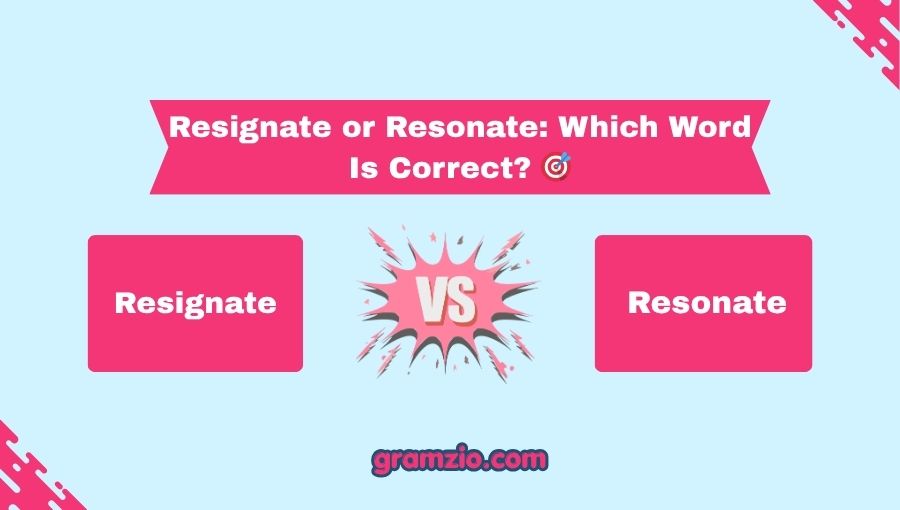
Resignate or Resonate” is a common grammar confusion that many English writers face today. Because these two words look and sound similar, people often use “resignate” when they actually mean “resonate.” 😅 This mistake appears frequently in emails, blog posts, social media captions, and even professional writing.
The confusion usually happens because of fast typing, autocorrect issues, or simple misunderstanding of the correct spelling. However, only one of these words is considered correct in standard English grammar.
Understanding the difference between “resignate” and “resonate” can improve your writing clarity, professionalism, and communication skills. Using the correct word helps your message sound polished and credible, especially in digital communication where grammar matters more than ever.
In this article, you will learn the correct meaning of “resonate,” why “resignate” is usually incorrect, grammar rules, real-world examples, common mistakes, and practical tips to remember the right usage forever.
Quick Answer: Resignate or Resonate?
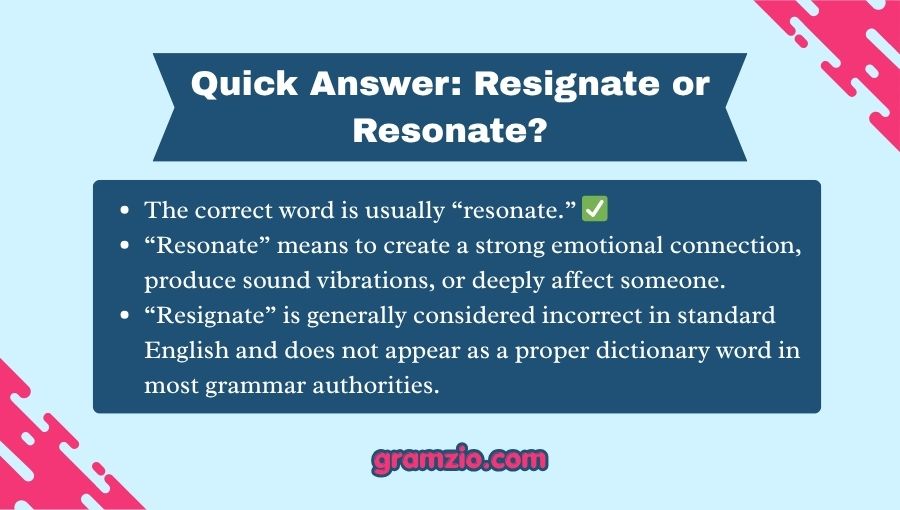
The correct word is usually “resonate.” ✅
“Resonate” means to create a strong emotional connection, produce sound vibrations, or deeply affect someone.
“Resignate” is generally considered incorrect in standard English and does not appear as a proper dictionary word in most grammar authorities.
Understanding the Basics of Resignate or Resonate
The confusion between these two terms comes from spelling similarity. However, only one word is accepted in standard English grammar.
| Form | Type | Meaning | Example | Correct/Incorrect |
|---|---|---|---|---|
| Resonate | Verb | To connect emotionally or produce vibrations | “Her speech resonated with the audience.” | ✅ Correct |
| Resignate | Incorrect Form | Not recognized in standard English | “His words resignated with me.” | ❌ Incorrect |
The key point is simple:
- Use resonate when talking about emotional impact or sound.
- Avoid using resignate because it is not a standard English word.
Correct Meanings and Uses of Resonate
What Does “Resonate” Mean? 🔊
The verb “resonate” has two main meanings:
- To produce or amplify sound vibrations
- To strongly connect with emotions, ideas, or experiences
Example 1: Sound Meaning
“The guitar strings resonated throughout the hall.”
Breakdown:
- “Guitar strings” are producing sound vibrations.
- “Resonated” describes the sound spreading strongly.
Example 2: Emotional Meaning
“Her story resonated with many people.”
Breakdown:
- The story emotionally connected with listeners.
- People related to the experience deeply.
Test Tip ✅
If the sentence involves:
- emotional connection
- impact
- meaning
- sound vibrations
then “resonate” is probably the correct choice.
Why “Resignate” Is Incorrect ❌
“Resignate” is often created accidentally because of:
- typing errors
- pronunciation confusion
- autocorrect problems
- misunderstanding of similar words
Major dictionaries such as Merriam-Webster and Cambridge Dictionary do not recognize “resignate” as a proper English word.
Incorrect Example
❌ “Your message resignated with me.”
Correct Version
✅ “Your message resonated with me.”
Test Tip ✅
If you cannot find the word in trusted dictionaries, avoid using it in professional writing.
Different Meanings of Resonate
Emotional Resonance ❤️
This is the most common modern use.
When something resonates emotionally, it creates a personal connection.
Examples
- “The movie resonated with young audiences.”
- “His advice resonated deeply with me.”
- “The article resonated across social media.”
This meaning is extremely popular in:
- blogs
- speeches
- marketing
- storytelling
- personal writing
Sound Resonance 🎵
In science and music, “resonate” refers to vibration and sound amplification.
Examples
- “The bell resonated through the building.”
- “The speaker resonated loudly.”
- “The walls resonated with music.”
This use appears frequently in:
- physics
- engineering
- music
- acoustics
Symbolic or Intellectual Resonance 🧠
Sometimes ideas resonate because they feel meaningful or familiar.
Examples
- “The quote resonated with readers.”
- “The message resonated across cultures.”
- “The campaign resonated with voters.”
Case Study Section
Workplace Email Example 📧
Imagine a manager sending a motivational email to employees.
Incorrect Version
❌ “Your hard work resignates with our company values.”
Problems:
- “Resignates” is not a recognized word.
- The sentence appears unprofessional.
- Readers may question the writer’s credibility.
Correct Version
✅ “Your hard work resonates with our company values.”
Why this works:
- “Resonates” correctly expresses alignment and connection.
- The sentence sounds polished and professional.
Social Media Example 📱
Incorrect Post
❌ “This song really resignated with me.”
Correct Post
✅ “This song really resonated with me.”
The corrected sentence clearly communicates emotional impact.
Grammar Rules Explanation
Why Is “Resonate” Correct?
“Resonate” comes from the Latin word resonare, meaning “to sound again.”
It functions as a standard English verb.
Verb Forms of Resonate
| Tense | Form |
|---|---|
| Base Form | Resonate |
| Past Tense | Resonated |
| Present Participle | Resonating |
| Third Person Singular | Resonates |
Examples
- “The idea resonates with people.”
- “The speech resonated yesterday.”
- “The message is resonating online.”
Why “Resignate” Fails Grammatically
“Resignate” is not accepted as a proper English verb because:
- it lacks dictionary recognition
- it has no standard verb history
- it is considered a spelling error
According to Merriam-Webster, “resonate” is the correct grammatical form.
Common Mistakes Section
Why Do People Confuse Resignate and Resonate? 🤔
Several factors contribute to this mistake.
Fast Typing
People type quickly and accidentally insert extra letters.
Autocorrect Issues
Some devices fail to recognize the intended word.
Similar Sound Patterns
“Resignate” sounds close to “resonate,” especially in casual speech.
Lack of Vocabulary Knowledge
Some writers have heard “resonate” but never seen it written correctly.
Similar Grammar Confusions Table
| Incorrect | Correct | Reason for Confusion |
|---|---|---|
| Resignate | Resonate | Similar spelling |
| Its | It’s | Apostrophe confusion |
| Your | You’re | Contraction confusion |
| Affect | Effect | Similar pronunciation |
| Loose | Lose | Typing mistake |
| Then | Than | Fast writing |
Usage in Different Contexts
Everyday Conversation 🗣️
People often use “resonate” in casual discussions.
Examples
- “That idea really resonates with me.”
- “Her experience resonated deeply.”
Professional Writing 💼
In business communication, accurate grammar matters.
Examples
- “The company mission resonates with customers.”
- “The presentation resonated with investors.”
Using the correct form improves professionalism.
Creative Writing ✍️
Authors and storytellers frequently use “resonate.”
Examples
- “The final scene resonated with readers.”
- “His words resonated like thunder.”
This creates emotional depth and impact.
Social Media and Texting 📲
Online users often use “resonate” to express relatability.
Examples
- “This meme resonates too much 😂”
- “That quote resonated with thousands.”
Because social media moves quickly, spelling mistakes like “resignate” happen often.
Why It Matters 🌟
Correct grammar is more important than many people realize.
Using “resonate” instead of “resignate” improves:
- communication clarity
- professionalism
- reader trust
- writing quality
- digital credibility
Small grammar mistakes can create confusion and weaken your message.
In academic, workplace, and professional environments, correct wording matters greatly.
“Clear language builds strong communication.”
When your writing resonates with readers, your message becomes more powerful and memorable.
Special Exception Section
Is “Resignate” Ever Correct?
In standard English grammar, “resignate” is considered incorrect.
However, there are rare situations where the word might appear:
- fictional writing
- usernames
- brand names
- internet slang
- typographical errors preserved in quotes
For example:
- a gaming username
- a creative company title
- a fictional language in a novel
Outside of these exceptions, avoid using “resignate.”
Quick Recap Checklist ✅
| Question | If Yes → Use |
|---|---|
| Are you talking about emotional connection? | Resonate |
| Are you describing sound vibrations? | Resonate |
| Are you writing professionally? | Resonate |
| Did you type “resignate”? | Correct it to “resonate” |
Practice Examples
Example 1
❌ “Her speech resignated with the audience.”
✅ “Her speech resonated with the audience.”
Example 2
❌ “The music resignated through the room.”
✅ “The music resonated through the room.”
Example 3
❌ “Your story resignates with many readers.”
✅ “Your story resonates with many readers.”
Deep Understanding of Resonance in Communication
Why Certain Messages Resonate
People connect emotionally with messages that feel:
- relatable
- authentic
- emotional
- inspiring
- meaningful
This emotional reaction is why marketers, speakers, and writers use the concept of resonance constantly.
Examples
A motivational speech resonates because:
- listeners identify with the struggle
- emotions feel genuine
- experiences feel shared
A song resonates because:
- lyrics reflect personal emotions
- memories become attached to the music
- rhythm creates emotional impact
Resonance in Psychology 🧠
Psychologists often discuss emotional resonance.
This happens when people emotionally mirror experiences or feelings.
Example
A person hearing a story about loss may feel emotional because the experience resonates with their own memories.
This form of resonance helps build:
- empathy
- connection
- understanding
Resonance in Marketing 📈
Modern brands aim to create messages that resonate with customers.
Marketing Example
Instead of simply advertising products, companies focus on emotional storytelling.
Example Sentence
“The campaign resonated with young consumers because it felt authentic.”
Brands that create emotional resonance often gain:
- customer loyalty
- trust
- engagement
- stronger branding
Resonance in Literature 📚
Writers use emotional resonance to make stories memorable.
Example
A tragic ending resonates because readers become emotionally invested in characters.
Classic literature often resonates across generations because human emotions remain universal.
How to Remember the Correct Word Easily 📝
A simple memory trick can help.
Memory Tip
Think of “resonate” as related to:
- sound
- response
- reaction
Both “resound” and “resonate” involve echoes and connection.
Helpful Phrase
✅ “Ideas resonate.”
❌ “Ideas resignate.”
Practice this sentence several times to build the habit.
Common Sentence Patterns With Resonate
Resonate With
This is the most common structure.
Examples
- “The message resonated with students.”
- “Her honesty resonated with readers.”
Deeply Resonate
Used for stronger emotional impact.
Examples
- “The story deeply resonated with me.”
- “His words deeply resonated online.”
Strongly Resonate
Used in formal or professional writing.
Examples
- “The campaign strongly resonated with voters.”
- “The brand strongly resonates with customers.”
Words Commonly Associated With Resonate
Using related words improves writing variety and SEO quality.
Synonyms of Resonate
| Word | Meaning |
|---|---|
| Connect | Create understanding |
| Echo | Reflect emotionally |
| Relate | Share similarity |
| Strike a chord | Create emotional response |
| Vibrate | Produce sound waves |
Mini Quiz Section 🎯
Choose the correct word.
Question 1
“The speaker’s message ______ with the audience.”
✅ Correct Answer: resonated
Question 2
“This song really ______ with me.”
✅ Correct Answer: resonates
Question 3
“The walls ______ with loud music.”
✅ Correct Answer: resonated
Expert Writing Advice
Professional editors recommend verifying unfamiliar words through trusted dictionaries before publishing content.
Reliable sources include:
- Merriam-Webster
- Oxford English Dictionary
- Cambridge Dictionary
Doing this helps eliminate spelling and grammar mistakes.
FAQs About Resignate or Resonate
Is “resignate” a real word?
No. “Resignate” is not recognized as a standard English word in major dictionaries.
What does “resonate” mean?
“Resonate” means to emotionally connect, strongly affect someone, or produce sound vibrations.
Why do people type “resignate”?
People confuse the word because of similar pronunciation, fast typing, and autocorrect mistakes.
Is “resonate with me” grammatically correct?
Yes. “Resonate with me” is completely correct and commonly used in English.
Can “resonate” be used in professional writing?
Absolutely. “Resonate” is widely used in business, academic, and professional communication.
How can I avoid this mistake?
Remember that “resonate” is the only correct standard English form. Checking dictionaries and proofreading carefully also helps.
Conclusion
The confusion between “resignate” and “resonate” is common, but the rule is actually very simple. ✅
“Resonate” is the correct English word and should be used when discussing emotional connection, meaningful impact, or sound vibration. “Resignate,” on the other hand, is generally considered incorrect in standard grammar and should be avoided in professional and academic writing.
Whether you are writing emails, blog posts, social media captions, essays, or business documents, using the correct word improves clarity and credibility. Small spelling differences can make a big impact on how readers view your communication.
The easiest way to remember the rule is this:
👉 If your message connects emotionally or echoes strongly, the word you need is “resonate.”
Mastering small grammar distinctions like this helps your writing sound polished, confident, and professional every single time. ✨
Also read: Complete vs Completed

Hi, I’m Elara Quinn. Working at gramzio.com, I use my 8 years of experience in linguistics to simplify difficult English rules, making them accessible and easy to learn for our global community.