Complete vs Completed: What’s the Real Difference? ✍️
Confusing English words can make even experienced writers pause for a second. One of the most common grammar mix-ups is “complete vs completed.” At first glance, both words seem almost identical because they come from the same root word. However, their meanings and grammatical functions are different.
You may have seen sentences like:
- “The task is complete.”
- “The task was completed.”
Both look correct, but they are used differently. That is where many English learners and even native speakers get confused. 🤔
Understanding the difference between complete and completed is important because using the wrong form can make your writing sound awkward or grammatically incorrect. Whether you are writing emails, assignments, blog posts, social media captions, or professional documents, knowing when to use each word improves clarity and confidence.
In this guide, you will learn the exact difference between complete vs completed, when to use each one, common mistakes to avoid, grammar rules, examples, tables, FAQs, and practical usage tips.
Quick Answer: Complete vs Completed ✅
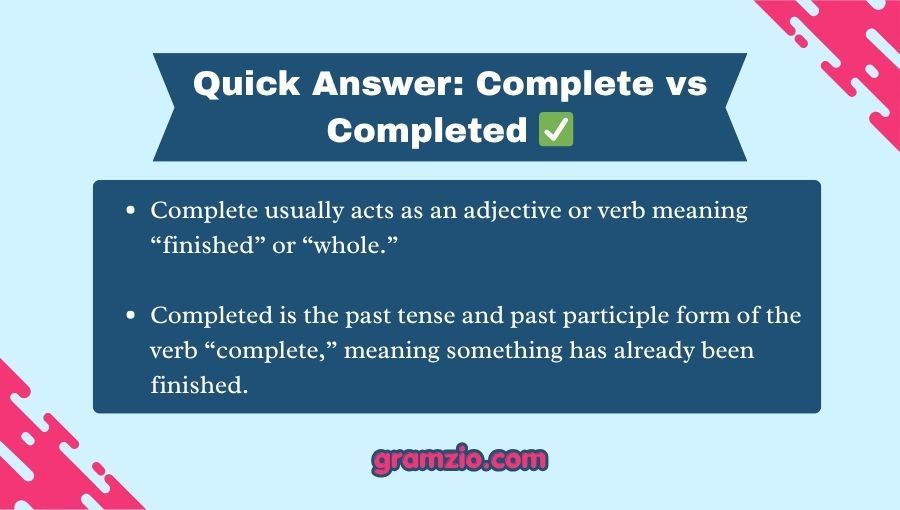
- Complete usually acts as an adjective or verb meaning “finished” or “whole.”
- Completed is the past tense and past participle form of the verb “complete,” meaning something has already been finished.
Simple Examples:
- “The project is complete.” ✅
- “The team completed the project.” ✅
In short:
- Use complete to describe a state.
- Use completed to describe an action that already happened.
Understanding the Basics of Complete vs Completed
The confusion happens because both words relate to finishing something. However, they work differently in grammar.
Core Difference
| Word | Type | Meaning | Example | Correct/Incorrect |
|---|---|---|---|---|
| Complete | Adjective/Verb | Finished or whole | “The form is complete.” | ✅ Correct |
| Completed | Verb (Past Tense/Past Participle) | Finished an action | “She completed the form.” | ✅ Correct |
Simple Breakdown
Complete = State or Condition
When something is already whole or finished, “complete” often works as an adjective.
Example:
- “Dinner is complete.” 🍽️
This sentence describes the condition of dinner.
Completed = Finished Action
When someone performs the action of finishing something, “completed” is used.
Example:
- “He completed dinner preparations.”
This sentence describes an action already performed.
Correct Meanings and Uses
Using “Complete” as an Adjective
As an adjective, complete means:
- finished
- whole
- lacking nothing
Examples
- “Your application is complete.”
- “The building is complete.”
- “We finally have a complete set.”
Sentence Breakdown
In the sentence:
“Your application is complete.”
- “application” = noun
- “is” = linking verb
- “complete” = adjective describing the noun
Test Tip 🧠
If you can replace the word with “finished” or “whole,” then “complete” is probably correct.
Example:
- “The project is finished.”
- “The project is complete.”
Both work correctly.
Using “Complete” as a Verb
“Complete” can also act as a verb meaning “to finish.”
Examples
- “Please complete the survey.”
- “She will complete the assignment tomorrow.”
- “I need to complete my homework.”
Sentence Breakdown
In:
“Please complete the survey.”
- “complete” = action verb
- It tells what someone should do.
Test Tip 🧠
If the word shows an action happening now or in the future, use “complete.”
Using “Completed” as a Past Tense Verb
“Completed” shows the action already happened.
Examples
- “They completed the report yesterday.”
- “I completed my training last week.”
- “She completed all her exams.”
Sentence Breakdown
In:
“I completed my training.”
- “completed” = past tense verb
- The action already happened.
Test Tip 🧠
Look for past-time clues like:
- yesterday
- last week
- earlier
- already
These usually signal “completed.”
Using “Completed” as a Past Participle
“Completed” is also used with helping verbs.
Examples
- “The task has been completed.”
- “The mission was completed successfully.”
- “All forms have been completed.”
Test Tip 🧠
If you see words like:
- has
- have
- had
- was
- were
- been
then “completed” is often correct.
Case Study: Real-Life Usage Example 📧
Imagine an employee sending an office email.
Incorrect Email
“I complete the report yesterday.”
This sentence sounds wrong because “yesterday” requires past tense.
Correct Email
“I completed the report yesterday.”
Now the grammar matches the timeline correctly.
Another Example
Incorrect
“The project has complete.”
Correct
“The project has been completed.”
OR
“The project is complete.”
Both are correct, but they mean slightly different things.
Why the Difference Matters
- “is complete” = describes condition
- “has been completed” = describes finished action
Professional communication depends on these distinctions.
Grammar Rules Explanation 📚
According to standard English grammar references like Merriam-Webster, verb tense and adjective usage determine whether “complete” or “completed” is correct.
Rule 1: Use “Complete” After Linking Verbs
Linking verbs include:
- is
- am
- are
- was
- were
Example
- “The assignment is complete.”
Here, “complete” describes the assignment.
Rule 2: Use “Completed” for Past Actions
Example
- “She completed the assignment.”
The sentence describes an action performed in the past.
Rule 3: Use “Completed” With Helping Verbs
Example
- “The assignment has been completed.”
The helping verbs require the past participle form.
Rule 4: Verb vs Adjective Difference
| Sentence | Word Type |
|---|---|
| “The work is complete.” | Adjective |
| “They completed the work.” | Verb |
Common Mistakes With Complete vs Completed ❌
People confuse these words for several reasons.
Why Mistakes Happen
Fast Typing
Quick typing often causes tense errors.
Autocorrect
Phones and apps sometimes suggest incorrect forms.
Lack of Grammar Knowledge
Many writers do not fully understand adjective vs verb usage.
Common Incorrect Sentences
| Incorrect | Correct |
|---|---|
| “The work is completed yesterday.” | “The work was completed yesterday.” |
| “I complete it already.” | “I completed it already.” |
| “The task has complete.” | “The task has been completed.” |
| “The file is completed.” | “The file is complete.” (usually better) |
Similar Grammar Confusions
| Confusing Words | Correct Usage |
|---|---|
| It’s vs Its | “It’s” = it is |
| Your vs You’re | “You’re” = you are |
| Then vs Than | Time vs comparison |
| Affect vs Effect | Verb vs noun |
| Complete vs Completed | State vs past action |
Usage in Different Contexts 🌍
Everyday Conversation
In casual speech, both words appear often.
Examples
- “My homework is complete.”
- “I completed my homework.”
Both are correct, but used differently.
Professional Writing
Professional communication requires proper tense usage.
Examples
- “The audit has been completed.”
- “The report is complete and ready for review.”
These sound polished and professional.
Creative Writing
Authors use both forms for rhythm and tone.
Example
“When the puzzle was finally complete, she smiled.”
OR
“He completed the puzzle before sunrise.”
Social Media and Texting
Short messages often skip grammar rules.
Informal Example
- “Finally completed it 😅”
More Formal
- “The project is complete 🎉”
Why It Matters ✨
Correct grammar improves communication in every area of life.
Clarity in Communication
Using the right word prevents confusion.
Compare:
- “The task is complete.”
- “The task completed.”
The second sentence sounds incomplete and awkward.
Professionalism
Correct grammar makes you appear more educated and reliable.
Employers, teachers, and clients notice proper writing.
Writing Accuracy in Digital Communication
Emails, texts, reports, and online posts spread quickly. Small grammar mistakes can affect credibility.
Short Quote 💬
“Clear writing reflects clear thinking.”
Special Exceptions and Edge Cases ⚠️
Sometimes both forms can technically work, but one sounds more natural.
Example
Correct but Less Natural
- “The file is completed.”
More Natural
- “The file is complete.”
Why?
Native English speakers usually prefer adjectives after linking verbs when describing a condition.
Rare Technical Usage
In legal or technical writing, “completed” may appear as an adjective.
Example
- “Completed applications will be reviewed.”
Here, “completed” describes applications that were finished earlier.
Complete vs Completed in Passive Voice
Passive voice often uses “completed.”
Examples
- “The bridge was completed in 2020.”
- “The forms have been completed.”
This structure focuses on the result rather than the person performing the action.
Active Voice vs Passive Voice
| Voice | Example |
|---|---|
| Active | “The team completed the project.” |
| Passive | “The project was completed by the team.” |
Sentence Pattern Guide 📝
Use “Complete” When:
- describing status
- describing condition
- using present/future action as verb
Examples
- “The meal is complete.”
- “Please complete the form.”
Use “Completed” When:
- describing past action
- using perfect tenses
- using passive voice
Examples
- “She completed the form.”
- “The form has been completed.”
Quick Recap Checklist ✅
| Question | If Yes → Use |
|---|---|
| Is it describing a condition? | Complete |
| Did the action already happen? | Completed |
| Is there a helping verb? | Completed |
| Is it a command/action? | Complete |
| Can “finished” replace it naturally? | Complete |
Practice Examples
Example 1
- “The assignment is ___.”
✅ Answer: complete
Example 2
- “She ___ the assignment yesterday.”
✅ Answer: completed
Example 3
- “The task has been ___.”
✅ Answer: completed
Advanced Grammar Insights 🔍
Understanding sentence structure helps avoid mistakes.
Predicate Adjectives
In:
“The report is complete.”
“Complete” is a predicate adjective because it follows a linking verb and describes the subject.
Past Participles
In:
“The report was completed.”
“Completed” acts as a past participle within a passive construction.
Common Patterns Native Speakers Use
Most Natural Expressions
Native Speakers Prefer:
- “The work is complete.”
- “I completed the work.”
These sound smoother than awkward mixed structures.
Memory Tricks to Remember the Difference 🧠
Trick 1: Think About Time
- Present condition → complete
- Past action → completed
Trick 2: Look for Helping Verbs
If you see:
- has
- have
- had
- was
- were
then “completed” is usually correct.
Trick 3: Replace the Word
Replace it mentally:
- whole/finished → complete
- finished earlier → completed
Mini Quiz 🎯
Choose the correct word.
1.
“The project was ______ last month.”
✅ completed
2.
“The project is now ______.”
✅ complete
3.
“Please ______ the registration form.”
✅ complete
4.
“All exams have been ______.”
✅ completed
FAQs: Complete vs Completed
Is “complete” or “completed” correct?
Both are correct, but they serve different grammar functions. “Complete” usually describes a condition, while “completed” describes an action already finished.
Can “complete” be used as a verb?
Yes. “Complete” can act as a verb meaning “to finish.”
Example:
- “Please complete the assignment.”
Is “The work is completed” grammatically correct?
Yes, but native speakers often prefer:
- “The work is complete.”
The adjective form sounds more natural in many situations.
What tense is “completed”?
“Completed” is the past tense and past participle form of the verb “complete.”
Why do people confuse complete vs completed?
The confusion happens because both words come from the same root and relate to finishing something. Fast typing, autocorrect, and grammar uncertainty also contribute.
Which form is better for professional writing?
Both work, but choose based on sentence structure:
- “The report is complete.” ✅
- “The report has been completed.” ✅
Both are professional and grammatically correct.
Final Comparison Table 📊
| Situation | Correct Word |
|---|---|
| Describing a finished condition | Complete |
| Talking about past action | Completed |
| Giving instructions | Complete |
| Using passive voice | Completed |
| Using helping verbs | Completed |
Conclusion 🎉
Understanding complete vs completed is easier once you know the difference between a condition and an action. The word complete usually describes something that is finished or whole, while completed refers to an action that has already happened.
Remember these simple rules:
- Use complete for status or description.
- Use completed for past actions or passive constructions.
Small grammar choices make a big difference in communication. Whether you are writing an email, preparing a school assignment, creating professional documents, or posting online, choosing the correct word improves clarity, professionalism, and confidence.
Mastering grammar is not about memorizing endless rules. It is about understanding how words function in real sentences. Once you learn that distinction, using complete and completed becomes simple and natural.
Also read: Cartel vs Mafia

Hi, I’m Dexter Rhodes. At gramzio.com, I apply my 10 years of experience in copy-editing to ensure every guide we publish is accurate, professional, and follows the highest editorial standards.