Annunciate vs Enunciate: What’s the Difference and Which One Should You Use? 🤔
Have you ever wondered about the correct usage of annunciate vs enunciate when speaking or writing? 🤔 Many people get confused between these two similar-sounding words, especially when trying to improve their pronunciation or communication skills. You might hear someone say “annunciate clearly” in a meeting, while others insist on “enunciate your words.” So, which one is actually correct?
The confusion around annunciate vs enunciate is extremely common, even among fluent English speakers. This mix-up usually happens because both words sound alike and are used in similar situations involving speech clarity. However, only one of them is considered correct in standard English, especially in professional and formal contexts.
In this detailed guide, we will break down annunciate vs enunciate in the simplest way possible. You will learn their meanings, differences, correct usage, and how to avoid common mistakes—so you can communicate with clarity and confidence. 💡
Quick Answer: Annunciate vs Enunciate
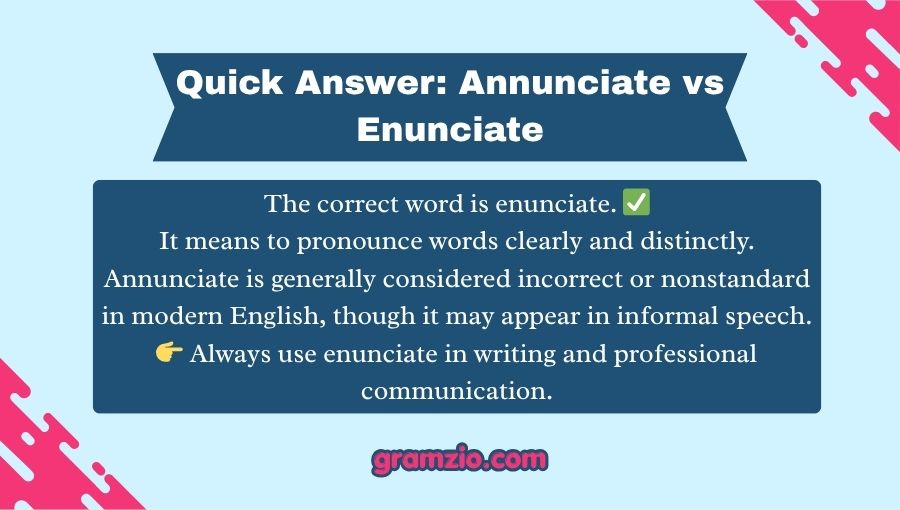
The correct word is enunciate. ✅
It means to pronounce words clearly and distinctly.
Annunciate is generally considered incorrect or nonstandard in modern English, though it may appear in informal speech.
👉 Always use enunciate in writing and professional communication.
Understanding the Basics: Annunciate vs Enunciate
At the core, the confusion comes down to correctness vs misuse.
| Feature | Annunciate ❌ | Enunciate ✅ |
|---|---|---|
| Form | Nonstandard/Incorrect | Standard English |
| Type | Verb (misused) | Verb |
| Meaning | Intended as “pronounce clearly” | To speak clearly and distinctly |
| Example | “Please annunciate your words.” | “Please enunciate your words.” |
| Correct/Incorrect | Incorrect usage | Correct usage |
💡 Key Insight:
Even though “annunciate” might sound right, it is not accepted in formal grammar.
Correct Meanings & Uses
What Does “Enunciate” Mean? 🗣️
Enunciate means to pronounce words clearly so that each sound is distinct and understandable.
✅ Examples:
- “She speaks slowly to enunciate every word clearly.”
- “Public speakers must enunciate to be understood.”
🔍 Sentence Breakdown:
- Subject: She
- Verb: enunciate
- Purpose: clarity in speech
👉 The focus is always on clear pronunciation.
Is “Annunciate” Ever Correct? ❌
In modern standard English, annunciate is not considered correct.
However, it may appear:
- In informal speech
- As a mistaken variation of “enunciate”
❌ Example:
- “He needs to annunciate better.”
👉 This should be corrected to:
- “He needs to enunciate better.”
✅ Test Tip
If you’re unsure which word to use:
👉 Ask yourself: Am I talking about clear pronunciation?
- If YES → Use enunciate
- If you think of “annunciate” → Replace it immediately
Case Study: Real-Life Usage
📧 Workplace Email Example
Incorrect Version:
“Please annunciate your points clearly during the meeting.”
Correct Version:
“Please enunciate your points clearly during the meeting.”
💼 Why This Matters:
- The incorrect version may reduce your credibility
- The correct version reflects professionalism and strong language skills
Grammar Rules Explanation
According to standard dictionaries like Merriam-Webster, enunciate is the correct verb used to describe clear pronunciation.
📘 Rule Breakdown:
- Enunciate comes from Latin enuntiare, meaning “to declare or pronounce clearly.”
- Annunciate is likely a mistaken blend influenced by “announce.”
👉 Important Rule:
Only enunciate is recognized in formal grammar and writing standards.
Common Mistakes 🚫
Why Do People Confuse Annunciate vs Enunciate?
Several reasons explain this common error:
- ⌨️ Fast typing – leads to accidental spelling errors
- 📱 Autocorrect issues – may not flag incorrect usage
- 📚 Lack of knowledge – misunderstanding of correct form
- 🗣️ Pronunciation similarity – both words sound alike
Similar Grammar Confusions
| Incorrect ❌ | Correct ✅ | Reason |
|---|---|---|
| Its | It’s | Missing apostrophe |
| Your | You’re | Contraction confusion |
| Then | Than | Misuse in comparisons |
| Annunciate | Enunciate | Nonstandard vs correct |
Usage in Different Contexts
🗣️ Everyday Conversation
- “Can you enunciate that word again?”
💼 Professional Writing
- “Employees should enunciate clearly during presentations.”
✍️ Creative Writing
- “He enunciated each word with precision and care.”
📱 Social Media/Texting
- “Bro, enunciate pls 😂”
👉 Even in casual settings, using the correct form improves clarity.
Why It Matters (Important Section) 🌟
Using the correct word—enunciate—is more than just grammar accuracy. It directly impacts communication quality.
🎯 Key Benefits:
- Clarity in communication
- Professionalism in writing and speech
- Improved credibility
- Better understanding in digital communication
💬 Quote:
“Clear speech reflects clear thinking.”
👉 When you enunciate well, your ideas become stronger and more impactful.
Special Exception
There are no widely accepted exceptions where “annunciate” is considered correct in standard English.
However:
- It may appear in regional dialects
- It might be used incorrectly in casual speech
👉 In all formal contexts, stick with enunciate.
Quick Recap Checklist ✅
| Question | If Yes → Use |
|---|---|
| Are you talking about clear pronunciation? | Enunciate ✅ |
| Are you writing formally or professionally? | Enunciate ✅ |
| Are you unsure about “annunciate”? | Avoid it ❌ |
🧠 Practice Examples:
- “Please ______ your words during the speech.”
👉 Answer: Enunciate - “She struggled to ______ clearly.”
👉 Answer: Enunciate - “The teacher asked students to ______ properly.”
👉 Answer: Enunciate
FAQs: Annunciate vs Enunciate❓
1. Is “annunciate” a real word?
“Annunciate” exists but is considered nonstandard and incorrect in modern English usage.
2. What is the correct word: annunciate or enunciate?
The correct word is enunciate, which means to pronounce words clearly.
3. Why do people say “annunciate”?
People often confuse it due to:
- Similar pronunciation
- Influence from the word “announce”
- Habitual misuse
4. Can I use “annunciate” in informal speech?
You might hear it informally, but it’s best to avoid it to maintain accuracy and clarity.
5. What is an example of enunciate in a sentence?
“She enunciated every word carefully to ensure understanding.”
6. Is “enunciate” used in professional settings?
Yes, enunciate is widely used in professional communication, presentations, and public speaking.
Conclusion
Understanding the difference between annunciate vs enunciate is simple once you know the rule:
👉 Always use “enunciate” for clear and correct communication.
While “annunciate” may sound familiar, it does not meet the standards of modern English grammar. Choosing the correct word not only improves your writing but also strengthens your confidence in speaking.
Clear language leads to clear thinking—and clear thinking leads to success. 🚀
So next time you speak or write, remember: enunciate, don’t annunciate.
Also read: Envision or Invision

Hi, I’m Grayson Finch. I’m part of the gramzio.com team with 9 years of experience in grammar education. I am dedicated to teaching professional communication and helping you master the art of writing.