Smooth vs Smoothe: The Complete Grammar Guide You Need
Have you ever paused while writing and wondered about Smooth vs Smoothe? 🤔 You’re not alone. Many English learners, writers, and even native speakers get confused by this pair because they look almost identical. One extra letter can make you second-guess your writing, especially in emails, social media posts, or professional documents.
The confusion around Smooth vs Smoothe often comes from how English spelling evolved over time. Some words in older English had an extra “e” at the end, and that historical spelling still tricks modern writers. But here’s the truth: only one of these forms is correct in standard modern English.
In this detailed guide, you’ll learn the exact difference between smooth and smoothe, when to use the correct form, why the confusion exists, and how to avoid making this common grammar mistake again. By the end, you’ll feel confident using the right spelling in any situation—whether you’re writing casually or professionally. ✍️
Quick Answer: Smooth vs Smoothe
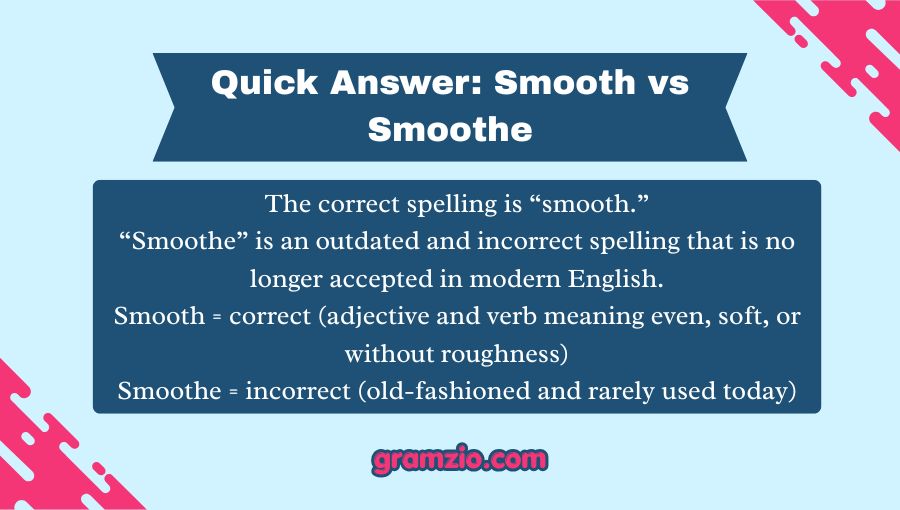
The correct spelling is “smooth.”
“Smoothe” is an outdated and incorrect spelling that is no longer accepted in modern English.
- Smooth = correct (adjective and verb meaning even, soft, or without roughness)
- Smoothe = incorrect (old-fashioned and rarely used today)
👉 In simple terms: Always use smooth, never smoothe in modern writing.
Understanding the Basics: Smooth vs Smoothe
To fully understand Smooth vs Smoothe, we need to break down what “smooth” actually means and why the confusion exists.
What Does “Smooth” Mean?
The word smooth can be used as:
- Adjective: A surface that is even or not rough
- Example: The table has a smooth surface.
- Verb: To make something even or remove bumps
- Example: She smoothed her dress before the interview.
- Adverb (rare usage): Smoothly
- Example: The car runs smoothly on the highway.
What About “Smoothe”?
“Smoothe” is an archaic spelling that was used in older forms of English. Over time, English simplified many words, and the final “e” was removed.
Today, “smoothe” is considered incorrect in all standard dictionaries, including modern references like Merriam-Webster and Oxford English Dictionary (except for historical mention).
Comparison Table: Smooth vs Smoothe
| Feature | Smooth | Smoothe |
|---|---|---|
| Form | Modern spelling | Archaic spelling |
| Type | Adjective / Verb | Obsolete variant |
| Meaning | Even, soft, without roughness | Same meaning (historical only) |
| Example | The wall is smooth. | The wall is smoothe. |
| Correct/Incorrect | ✅ Correct | ❌ Incorrect today |
Correct Meanings & Uses of “Smooth”
1. Smooth as an Adjective ✨
Used to describe texture, motion, or appearance.
Examples:
- The ice was smooth and shiny.
- He has a smooth voice that relaxes listeners.
👉 Sentence breakdown:
- smooth = describing quality (no roughness)
2. Smooth as a Verb 🔧
Used when making something even or fixing irregularities.
Examples:
- She smoothed her hair before leaving.
- The designer smoothed the edges of the table.
👉 Sentence breakdown:
- smoothed = past tense action of making something even
Test Tip 🧠
If you can replace the word with “even” or “flat” (adjective use) or “make even” (verb use), then “smooth” is correct.
Case Study: Real-Life Usage Example
Imagine this workplace email:
❌ Incorrect:
Please smoothe the document before sending it to the client.
✅ Correct:
Please smooth the document before sending it to the client.
What happened here?
The writer used “smoothe,” thinking it looked more formal. However, in professional communication, incorrect spelling reduces credibility.
👉 A hiring manager or client may view such mistakes as lack of attention to detail.
Grammar Rules Explanation
So why is “smoothe” incorrect?
According to standard English grammar rules and dictionaries like Merriam-Webster, the correct modern form is “smooth”.
Historical Reason
In Middle English, many verbs ended with an “e” (like “love → loven”). Over time, English simplified spelling rules:
- Drop silent letters
- Standardize verb/adjective forms
So:
- Old English: smoothe
- Modern English: smooth
Modern Rule
👉 Only “smooth” is accepted in:
- Academic writing
- Business communication
- Digital content
- Standard dictionaries
Common Mistakes
Many people still mistakenly write smoothe. Here’s why:
Why This Mistake Happens
- ⚡ Fast typing leads to accidental extra letters
- 📱 Autocorrect may not always catch archaic spellings
- 📚 Lack of awareness of modern spelling rules
Similar Grammar Confusions
| Incorrect | Correct | Reason |
|---|---|---|
| smoothe | smooth | outdated spelling |
| alot | a lot | spacing error |
| your | you’re | contraction confusion |
| its | it’s | apostrophe misuse |
| recieve | receive | spelling rule exception |
Usage in Different Contexts
1. Everyday Conversation 🗣️
- That cream makes your skin feel smooth.
2. Professional Writing 💼
- Ensure the presentation transitions are smooth and clear.
3. Creative Writing ✍️
- The smooth waves kissed the shore under the moonlight.
4. Social Media/Texting 📱
- This filter gives a smooth finish!
Why It Matters (Important Section)
Correct spelling is not just grammar—it reflects your communication skills.
Using smooth vs smoothe correctly matters because:
- It improves clarity in communication
- It enhances professional credibility
- It ensures writing accuracy in digital content
“Good writing is clear thinking made visible.” ✨
Even a small spelling mistake can change how your message is perceived.
Special Exception
There are no modern exceptions where “smoothe” is accepted in standard English. However:
- It may appear in historical texts
- It may be used intentionally in branding or creative stylization
But in formal English writing, always stick to smooth.
Quick Recap Checklist
| Question | If Yes → Use |
|---|---|
| Are you writing modern English? | smooth |
| Is it academic or professional? | smooth |
| Is it historical text analysis? | smoothe (only as reference) |
Practice Examples
- The floor is ___ and shiny. → smooth
- She wants to ___ out the wrinkles. → smooth
- He wrote “smoothe” in the report. → incorrect usage
FAQs: Smooth vs Smoothe
1. Is “smoothe” ever correct?
No, “smoothe” is an outdated spelling and is not accepted in modern English.
2. What is the correct spelling: smooth or smoothe?
The correct spelling is smooth.
3. Why do people write “smoothe”?
It often happens due to typing habits or confusion with older English spelling.
4. Is “smooth” both a noun and verb?
Yes, “smooth” can be used as an adjective and a verb depending on context.
5. Does Merriam-Webster accept “smoothe”?
No, modern dictionaries recognize only “smooth.”
6. How can I remember the correct form?
Think: “smooth = modern = correct.” No extra “e” needed.
Conclusion
Understanding Smooth vs Smoothe is simple once you know the rule: only “smooth” is correct in modern English. The version “smoothe” belongs to older language history and should not be used in everyday writing, academic work, or professional communication.
By remembering this small but important distinction, you improve your grammar accuracy and make your writing look more polished and professional. Whether you’re describing a surface, a process, or a feeling, smooth is always the right choice.
So next time you pause before writing it, remember this rule—and keep your English as smooth as your writing style should be. ✨
Also read: People Do or People Does

Hi, I’m Grayson Finch. I’m part of the gramzio.com team with 9 years of experience in grammar education. I am dedicated to teaching professional communication and helping you master the art of writing.