Pre vs Post: Understanding the Difference, Usage, and Grammar Rules 📘
Pre vs Post is a common grammar topic that often confuses writers, students, and even professionals. Have you ever paused while writing and wondered whether to use pre or post? 🤔 You’re not alone. These two small prefixes appear in everyday phrases like pre-workout, post-meeting, and pre-order, yet their meanings can easily be mixed up.
The confusion around Pre vs Post usually comes from their similar structure and frequent use in both formal and informal writing. Many people are unsure about when to attach them to words, when to use hyphens, and how their meanings change depending on context.
This guide will break down Pre vs Post in a simple, clear, and practical way. By the end, you’ll fully understand the difference and be able to use both terms confidently in emails, conversations, academic writing, and more. ✍️
Quick Answer: Pre vs Post
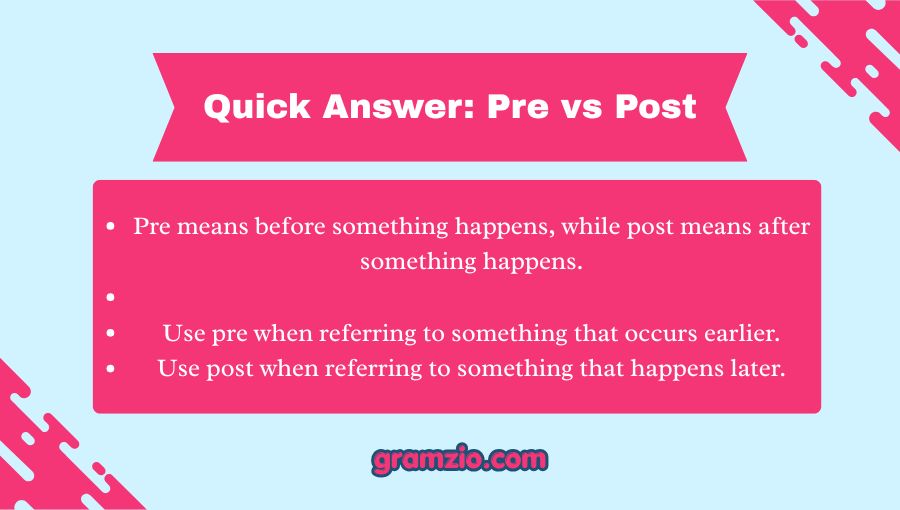
Pre means before something happens, while post means after something happens.
- Use pre when referring to something that occurs earlier.
- Use post when referring to something that happens later.
Understanding the Basics of Pre vs Post
At their core, both pre and post are prefixes. This means they are added to the beginning of words to modify their meaning.
| Form | Type | Meaning | Example | Correct/Incorrect |
|---|---|---|---|---|
| Pre | Prefix | Before | pre-meeting discussion | ✅ Correct |
| Post | Prefix | After | post-meeting summary | ✅ Correct |
| Pre | Prefix | Before | pre dinner snack (missing hyphen) | ❌ Incorrect |
| Post | Prefix | After | post workout routine | ❌ Incorrect |
👉 Notice how hyphenation matters in clarity.
Correct Meanings & Uses
What Does “Pre” Mean?
The prefix pre comes from Latin, meaning before. It indicates that something happens prior to a specific event.
Examples:
- Pre-order → Order before release
- Pre-school → Education before formal schooling
- Pre-workout → Before exercise
Sentence Breakdown:
- I completed my pre-workout routine before heading to the gym.
- pre-workout = before workout
- It shows timing clearly.
🧠 Test Tip:
If you can replace pre with “before” and the sentence still makes sense, it’s correct.
What Does “Post” Mean?
The prefix post also comes from Latin, meaning after. It refers to something happening following an event.
Examples:
- Post-meeting notes → Notes after a meeting
- Post-graduation plans → Plans after graduation
- Post-surgery care → Care after surgery
Sentence Breakdown:
- She shared post-meeting feedback with the team.
- post-meeting = after meeting
- Indicates sequence clearly.
🧠 Test Tip:
Replace post with “after.” If it still makes sense, you’re using it correctly.
Case Study Section
Real-Life Workplace Example 💼
Scenario: You are writing an email to your team.
❌ Incorrect:
Please review the meeting notes and share your pre-feedback.
✔️ Correct:
Please review the meeting notes and share your post-meeting feedback.
Why?
- “Pre-feedback” would mean feedback before something happens.
- Since the meeting already occurred, “post-meeting” is the correct choice.
This shows how choosing between pre and post directly impacts clarity.
Grammar Rules Explanation
According to standard English grammar references like Merriam-Webster, prefixes like pre and post are generally attached directly to words without spaces. However, hyphens are used in certain situations.
Key Rules:
- Use a hyphen when clarity is needed
- pre-existing condition
- post-election analysis
- Avoid spacing
- ❌ pre meeting
- ✔️ pre-meeting
- Closed compounds are sometimes acceptable
- preschool (no hyphen)
- postwar (no hyphen)
- Follow dictionary standards when unsure
Common Mistakes Section 🚫
Why Mistakes Happen
- Fast typing ⌨️
- Autocorrect errors 📱
- Lack of grammar awareness
Common Errors with Pre vs Post
| Mistake | Why It’s Wrong | Correct Form |
|---|---|---|
| pre meeting | Missing hyphen | pre-meeting |
| post workout | Missing hyphen | post-workout |
| pre-feedback (wrong context) | Incorrect timing | post-feedback |
Similar Grammar Confusions
| Confusion | Meaning Difference |
|---|---|
| it’s / its | it is vs possession |
| your / you’re | ownership vs you are |
| then / than | time vs comparison |
| affect / effect | verb vs noun |
Usage in Different Contexts
Everyday Conversation 🗣️
- Let’s have a pre-dinner snack.
- We’ll discuss this post-lunch.
Professional Writing 💼
- Please complete the pre-assessment form.
- Submit your post-training evaluation.
Creative Writing ✍️
- In the post-apocalyptic world, survival was uncertain.
- Her pre-performance anxiety was intense.
Social Media & Texting 📱
- Pre-party vibes 🎉
- Post-vacation blues 😢
Why It Matters (Important Section)
Using Pre vs Post correctly is essential for:
- ✅ Clear communication
- ✅ Professional credibility
- ✅ Accurate writing
Even a small mistake can confuse your reader.
📌 “Good writing is clear thinking made visible.”
Special Exception Section
Some words no longer require hyphens because they are widely accepted as single words:
- preschool
- postwar
- preexisting
👉 Always check a trusted dictionary when unsure.
Quick Recap Checklist ✅
| Question | If Yes → Use |
|---|---|
| Does it mean before something? | Pre |
| Does it mean after something? | Post |
| Is clarity needed? | Use hyphen |
Practice Examples:
- ______-event preparation → Pre-event
- ______-launch review → Post-launch
- ______-exam stress → Pre-exam
FAQs: Pre vs Post
What is the main difference between pre and post?
Pre means before an event, while post means after an event.
Should I always use a hyphen with pre and post?
Not always. Use a hyphen when needed for clarity or when the word is not commonly written as a single word.
Is “preworkout” correct or “pre-workout”?
Both can be correct depending on usage, but “pre-workout” is often clearer and preferred in formal writing.
Can pre and post be used in formal writing?
Yes, they are widely used in professional and academic contexts.
What is an example of incorrect usage?
Using “pre-meeting” when referring to something that happens after the meeting is incorrect.
Are pre and post always prefixes?
Yes, in grammar, they function as prefixes attached to base words.
Conclusion
Understanding Pre vs Post is easier than it seems. Once you remember that pre means before and post means after, you can avoid most mistakes. The key is to focus on timing and context. ✨
Also, pay attention to hyphenation and follow standard grammar rules to ensure clarity. Whether you are writing an email, a blog post, or even a quick message, using these prefixes correctly will make your communication more precise and professional.
Mastering small grammar details like this can make a big difference in how your writing is perceived. So next time you hesitate between pre and post, just ask yourself one simple question: Is it before or after? 😉
That one question will always guide you to the right answer.
Also read: Each Is or Each Are

Hi, I’m Grayson Finch. I’m part of the gramzio.com team with 9 years of experience in grammar education. I am dedicated to teaching professional communication and helping you master the art of writing.