NUANCE SYNONYMS: Powerful Words to Express Subtle Meaning
Have you ever tried to explain a small difference in meaning but couldn’t find the right word? That’s exactly where NUANCE synonyms become useful. When people search for nuance synonyms, they are usually trying to improve their writing, sound more natural in English, or express ideas with more precision.
For example, instead of saying “there is a nuance in her tone,” you might want a clearer or richer expression depending on the situation. In everyday life, we constantly notice small differences in meaning, emotion, or tone—but we often lack the vocabulary to describe them well.
Using nuance synonyms helps improve essays, conversations, storytelling, and even professional communication. It allows your language to sound more natural, expressive, and intelligent. In this guide, you’ll learn many useful alternatives and how to use them correctly in real-life situations.
QUICK DEFINITION
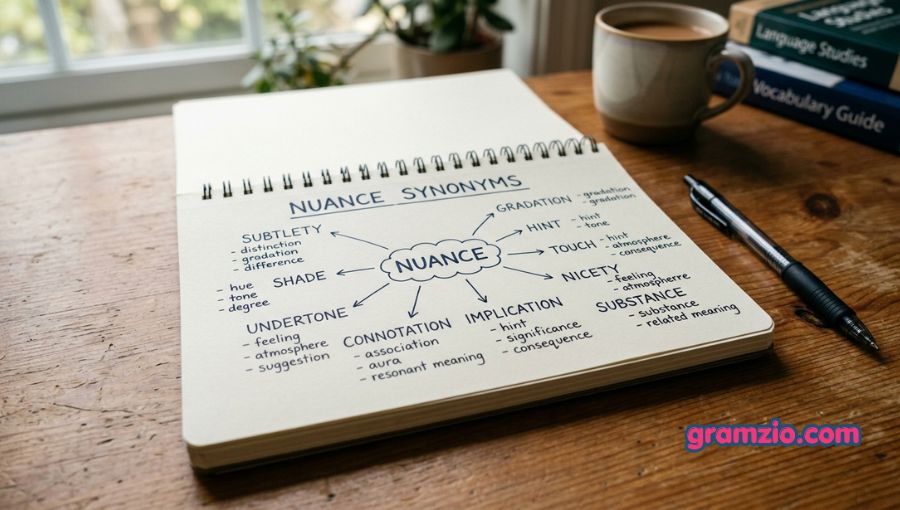
Nuance synonyms are words that describe small differences in meaning, feeling, tone, or expression. They help explain subtle details that are not easy to notice. These words improve clarity in speaking and writing by showing fine levels of meaning.
LIST OF NUANCE SYNONYMS
Nuance
Meaning:
- A small difference in meaning or feeling.
Examples:
- I noticed a nuance in her voice.
- This word has a different nuance in context.
Subtlety
Meaning:
- A small and not obvious detail.
Examples:
- The subtlety of his joke made me smile.
- She understood the subtlety in the message.
Shade
Meaning:
- A slight difference in meaning or feeling.
Examples:
- There is a shade of sadness in his reply.
- The colors have a shade of meaning.
Distinction
Meaning:
- A clear small difference between things.
Examples:
- I see a distinction between the two ideas.
- There is a distinction in their tone.
Gradation
Meaning:
- A step-by-step change in meaning or tone.
Examples:
- The gradation of colors is smooth.
- There is a gradation in his emotion.
Inflection
Meaning:
- A change in voice that shows feeling.
Examples:
- Her inflection showed surprise.
- I noticed an inflection in his speech.
Undertone
Meaning:
- A hidden or soft meaning.
Examples:
- There is an undertone of anger.
- His words had a sad undertone.
Implication
Meaning:
- A hidden meaning not said directly.
Examples:
- I understood the implication quickly.
- Her words carried a strong implication.
Connotation
Meaning:
- An emotional meaning of a word.
Examples:
- The word has a negative connotation.
- This term has a positive connotation.
Flavor
Meaning:
- A feeling or style in meaning.
Examples:
- The story has a modern flavor.
- His speech adds a political flavor.
Tint
Meaning:
- A slight touch of color or feeling.
Examples:
- There is a tint of humor in her comment.
- His voice had a tint of fear.
Hint
Meaning:
- A small clue or suggestion.
Examples:
- She gave a hint of the answer.
- There is a hint of truth in it.
Trace
Meaning:
- A very small amount of something.
Examples:
- I found a trace of doubt.
- There is a trace of excitement.
Touch
Meaning:
- A small added feeling or detail.
Examples:
- The story has a touch of sadness.
- He added a touch of humor.
Whisper
Meaning:
- A very soft or hidden feeling.
Examples:
- There is a whisper of doubt.
- I heard a whisper of truth.
Suggestion
Meaning:
- A small idea or signal.
Examples:
- There is a suggestion of danger.
- Her tone gave a suggestion of anger.
Variation
Meaning:
- A change from the normal form.
Examples:
- There is a variation in meaning.
- The song has a variation in tone.
Refinement
Meaning:
- A more careful and improved detail.
Examples:
- His refinement in speech is clear.
- The design shows refinement.
Delicacy
Meaning:
- A soft and careful detail.
Examples:
- The delicacy of her tone is nice.
- There is delicacy in his writing.
Fineness
Meaning:
- A very small and precise detail.
Examples:
- The fineness of the fabric is clear.
- I noticed the fineness of meaning.
Sensitivity
Meaning:
- The ability to notice small changes.
Examples:
- He showed sensitivity in speech.
- Her sensitivity helped in understanding.
Complexity
Meaning:
- Many small parts in meaning.
Examples:
- The complexity of his idea is high.
- There is complexity in the message.
Depth
Meaning:
- A deep level of meaning.
Examples:
- The depth of her words is strong.
- I like the depth in this poem.
Layer
Meaning:
- One level in a deeper meaning.
Examples:
- There is a layer of humor.
- The story has many layers.
Dimension
Meaning:
- A different level of meaning.
Examples:
- There is a new dimension to this idea.
- The debate has many dimensions.
Aspect
Meaning:
- One part of a whole idea.
Examples:
- This aspect of the story is sad.
- We must study every aspect.
Facet
Meaning:
- One side of a complex idea.
Examples:
- This is one facet of the problem.
- Each facet is interesting.
Texture
Meaning:
- The feel or style of meaning.
Examples:
- The texture of the story is soft.
- I like the texture of his writing.
Tone
Meaning:
- The feeling in speech or writing.
Examples:
- The tone of her message is kind.
- His tone changed quickly.
Coloring
Meaning:
- The emotional style of meaning.
Examples:
- The story has emotional coloring.
- His words add coloring to the idea.
Slant
Meaning:
- A particular point of view.
Examples:
- The article has a political slant.
- There is a slant in his opinion.
Bent
Meaning:
- A natural direction in thinking.
Examples:
- He has a creative bent.
- There is a serious bent in her view.
Spin
Meaning:
- A way of presenting meaning.
Examples:
- The news has a positive spin.
- She gave a new spin to the idea.
Interpretation
Meaning:
- A personal understanding of meaning.
Examples:
- My interpretation is different.
- Her interpretation is clear.
Reading
Meaning:
- A way of understanding something.
Examples:
- His reading of the text is deep.
- I have a different reading.
Meaning-shade
Meaning:
- A slight difference in meaning.
Examples:
- There is a meaning-shade in the phrase.
- I noticed a meaning-shade in her words.
Fine point
Meaning:
- A very small important detail.
Examples:
- He explained a fine point.
- This fine point matters.
Detail
Meaning:
- A small part of information.
Examples:
- I noticed every detail.
- The detail is important.
Differentiation
Meaning:
- Showing differences between things.
Examples:
- Differentiation helps understanding.
- There is clear differentiation here.
Variance
Meaning:
- A change or difference.
Examples:
- There is variance in meaning.
- The results show variance.
Modulation
Meaning:
- A controlled change in tone.
Examples:
- His modulation is smooth.
- I like her voice modulation.
Resonance
Meaning:
- A strong emotional effect.
Examples:
- The words have emotional resonance.
- There is resonance in her speech.
Echo
Meaning:
- A repeated or reflected meaning.
Examples:
- His words echo old ideas.
- There is an echo of truth.
Subtle difference
Meaning:
- A very small change between things.
Examples:
- There is a subtle difference here.
- I see a subtle difference in tone.
Micro-difference
Meaning:
- A very tiny difference.
Examples:
- I noticed a micro-difference.
- There is a micro-difference in meaning.
Fine distinction
Meaning:
- A very precise difference.
Examples:
- He explained a fine distinction.
- There is a fine distinction here.
Shading
Meaning:
- A slight change in meaning or tone.
Examples:
- The shading of meaning is clear.
- There is shading in her tone.
Overlay
Meaning:
- A layer added to meaning.
Examples:
- There is an emotional overlay.
- The idea has a cultural overlay.
Context shift
Meaning:
- A change in meaning based on situation.
Examples:
- There is a context shift here.
- The context shift changes meaning.
How to Use NUANCE SYNONYMS – Complete Guide
Use nuance synonyms when you want to express small but important differences in meaning. In formal writing, stronger words like implication or connotation work better, while casual speech may use hint or shade.
Mild words (like touch or hint) soften meaning, while strong words (like implication or undertone) make ideas more serious. Choosing the right tone changes how your message is understood.
- Use synonyms in essays to avoid repetition
- Match word strength with emotional tone
- Choose simple words for speaking, advanced for writing
- Use “undertone” for hidden emotions
- Use “shade” for slight differences
- Practice by rewriting sentences with synonyms
COMMON MISTAKES
- Using strong words in casual situations
- Repeating the same synonym too often
- Choosing a word without checking tone
- Confusing “hint” and “implication”
- Ignoring context when selecting synonyms
EXAMPLE SENTENCES
- I noticed a subtle difference in his tone.
- Her words carried a strong undertone of anger.
- There is a hint of sadness in the story.
- The article has a political slant.
- I saw a fine distinction between the two ideas.
- His speech has emotional resonance.
- There is a shade of humor in her reply.
- The message has a hidden implication.
- I like the depth of his explanation.
- The story has many layers of meaning.
- Her interpretation of the text is unique.
- I found a trace of doubt in his voice.
CONCLUSION
Understanding nuance synonyms helps you express ideas more clearly and naturally. These words let you describe small differences in meaning, tone, and feeling with precision. By learning and practicing them, you can improve both your writing and speaking skills. Vocabulary growth is not just about learning new words—it is about using the right word at the right time. Keep practicing these synonyms in real conversations and writing to build strong communication skills.
Also read: Throughout Synonym

Hi, I’m Grayson Finch. I’m part of the gramzio.com team with 9 years of experience in grammar education. I am dedicated to teaching professional communication and helping you master the art of writing.