May vs Might: What’s the Difference? A Complete Grammar Guide 📘✨
May vs Might is one of the most common grammar topics that confuses English learners and even native speakers. 🤔 Have you ever stopped while writing a sentence and wondered whether you should use may or might? Since both words express possibility and sometimes seem interchangeable, it’s easy to choose the wrong one. However, they are not always used in the same way, and selecting the correct modal verb can make your writing clearer, more accurate, and more professional.
Whether you’re writing an email, preparing for an English exam, creating business documents, or simply having a conversation, understanding May vs Might will help you communicate with greater confidence. The good news is that the difference is much simpler than it appears. In this complete guide, you’ll learn the meanings, grammar rules, practical examples, common mistakes, expert tips, and real-life uses of May vs Might, so you can use both words correctly in any situation. ✨
Quick Answer: May vs Might
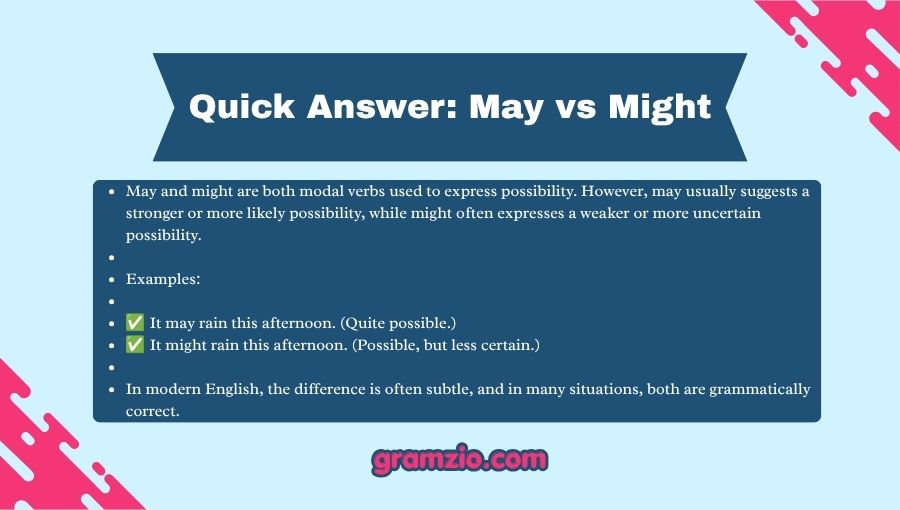
May and might are both modal verbs used to express possibility. However, may usually suggests a stronger or more likely possibility, while might often expresses a weaker or more uncertain possibility.
Examples:
- ✅ It may rain this afternoon. (Quite possible.)
- ✅ It might rain this afternoon. (Possible, but less certain.)
In modern English, the difference is often subtle, and in many situations, both are grammatically correct.
Understanding the Basics of May vs Might
Both may and might belong to the group of modal auxiliary verbs. They never change form and are always followed by the base form of the main verb.
Comparison Table
| Feature | May | Might |
|---|---|---|
| Form | Modal verb | Modal verb |
| Type | Auxiliary verb | Auxiliary verb |
| Main Meaning | Possibility, permission | Possibility, uncertainty |
| Example | You may leave now. | We might visit tomorrow. |
| Correct Usage | ✅ May I ask a question? | ✅ I might call later. |
| Incorrect Usage | ❌ May goes home. | ❌ Might goes home. |
Core Difference
Generally:
- May = More likely possibility or formal permission.
- Might = Less certain possibility or hypothetical situations.
Think of it this way:
🟢 May = “There is a good chance.”
🟡 Might = “It’s possible, but I’m not sure.”
Correct Meanings and Uses
Using “May” for Possibility 🌤️
One of the most common uses of may is expressing possibility.
Examples
- The package may arrive today.
- She may join us later.
- It may be too late.
Sentence Breakdown
The package may arrive today.
- Subject: The package
- Modal verb: may
- Base verb: arrive
- Time expression: today
The speaker believes the event has a reasonable chance of happening.
✅ Test Tip
Ask yourself:
Do I think this is reasonably likely?
If yes, may is usually an excellent choice.
Using “May” for Permission ✅
May is also commonly used to give or ask for permission.
Examples
- May I come in?
- You may start the test.
- Students may use calculators.
These sentences sound polite and formal.
Test Tip
If the sentence means allowed to, use may.
Using “Might” for Possibility 🌧️
Might also expresses possibility, but usually with more uncertainty.
Examples
- I might stay home tonight.
- They might cancel the event.
- We might see snow this weekend.
The speaker is less confident.
Sentence Breakdown
I might stay home tonight.
- Subject: I
- Modal verb: might
- Base verb: stay
Nothing is certain.
Test Tip
If you’re expressing doubt or uncertainty, might often fits better.
Using “Might” in Hypothetical Situations
Might frequently appears in conditional sentences.
Examples
- If I had more time, I might travel more.
- If she studied harder, she might pass.
These situations are imaginary or uncertain.
Using “Might Have”
“Might have” refers to uncertain events in the past.
Examples:
- She might have forgotten.
- They might have left early.
- I might have made a mistake.
The speaker does not know what actually happened.
Using “May Have”
“May have” also refers to possible past events.
Examples:
- He may have missed the train.
- The meeting may have ended already.
Both “may have” and “might have” are acceptable, although “might have” often sounds slightly less certain.
Case Study: Workplace Email Example 💼
Imagine Sarah is emailing her manager.
Version 1
I may be late because of heavy traffic.
This suggests Sarah believes being late is fairly likely.
Version 2
I might be late because of heavy traffic.
This sounds slightly more uncertain.
Perhaps traffic will clear quickly.
Why It Matters
Both sentences are correct.
The difference lies in the speaker’s confidence.
Business communication often benefits from choosing the modal verb that best reflects certainty.
Grammar Rules Explained
According to respected grammar references such as Merriam-Webster and standard English grammar guides, may and might are modal auxiliary verbs.
Important grammar rules include:
Rule 1
Always use the base verb after may or might.
✅ She may arrive.
❌ She may arrives.
Rule 2
Do not add “to.”
✅ We might leave.
❌ We might to leave.
Rule 3
Modal verbs never change.
Correct:
- may
- might
Incorrect:
- mays
- mights
Rule 4
Questions invert the modal.
✅ May I help you?
✅ Might they come?
Rule 5
Negative forms
- may not
- might not (or mightn’t in some varieties of British English)
Examples:
- She may not agree.
- They might not come.
Common Mistakes
Many learners confuse May vs Might because both describe possibility.
Other reasons include:
- ⚡ Fast typing
- 📱 Autocorrect
- 📚 Limited grammar knowledge
- 🌍 Influence from another language
- ✍️ Similar meanings
Frequent Errors
❌ May she comes.
✅ May she come?
❌ They might goes tomorrow.
✅ They might go tomorrow.
❌ I may to visit.
✅ I may visit.
Similar Grammar Confusions
| Confusing Pair | Correct Difference |
|---|---|
| It’s / Its | Contraction vs possession |
| Your / You’re | Possessive vs “you are” |
| Their / There | Possession vs place |
| Then / Than | Time vs comparison |
| Affect / Effect | Verb vs noun |
| Who’s / Whose | Contraction vs possession |
Usage in Different Contexts
Everyday Conversation ☕
People often use both naturally.
Examples:
- I may go shopping.
- I might order pizza.
- We may watch a movie.
- We might stay home.
Professional Writing 💼
Professional communication benefits from precise wording.
Examples:
- The project may require additional funding.
- The schedule might change depending on weather.
Academic Writing 🎓
Academic writing often uses modal verbs to avoid making absolute claims.
Example:
- These findings may suggest a relationship.
Creative Writing 📖
Authors use may and might to create suspense.
Example:
The old house might hold forgotten secrets.
Social Media and Texting 📱
People usually choose whichever sounds more natural.
Examples:
- Might post later.
- May delete this tomorrow 😂
Why It Matters 🌟
Understanding May vs Might improves every aspect of communication.
Clarity
Readers understand exactly how certain you are.
Professionalism
Accurate grammar creates a stronger impression in emails, reports, and presentations.
Writing Accuracy
Small grammar choices improve overall readability.
Digital Communication
Online communication spreads quickly.
Using the correct modal verb helps prevent misunderstanding.
“Clear writing reflects clear thinking.”
That simple principle applies to every form of communication.
Special Exceptions
There are very few true exceptions.
Formal Permission
Today, may remains the preferred choice.
Example:
- May I leave early?
Although many people say:
- Can I leave early?
Both are widely accepted in everyday conversation, but may is traditionally more formal.
Historical Use
Historically, might served as the past tense form of may.
Example:
- She said she might come.
Modern English often treats both as separate modal verbs with overlapping meanings.
Quick Recap Checklist ✅
| Question | If Yes → Use |
|---|---|
| Is it formal permission? | May |
| Is the possibility fairly strong? | May |
| Is the possibility weaker? | Might |
| Is it hypothetical? | Might |
| Are you expressing uncertainty? | Might |
| Is either acceptable? | Sometimes both |
Practice Examples
Example 1
There is a good chance the meeting will end early.
✅ The meeting may end early.
Example 2
I’m not very sure we’ll win.
✅ We might win.
Example 3
Permission
✅ May I borrow your pen?
Additional Examples
May
- She may call tonight.
- We may visit New York.
- You may begin.
- The answer may surprise you.
- It may snow tomorrow.
Might
- He might forget.
- I might skip dessert.
- They might be waiting.
- We might need more chairs.
- The flight might be delayed.
Memory Trick 🧠
Remember this simple tip:
May = More likely
Might = More uncertain
Although this rule is not perfect for every sentence, it helps most English learners.
Practice Quiz
Choose the best answer.
1.
_____ I use your phone?
Answer:
✅ May
2.
It _____ rain later, but the sky looks clear.
Answer:
✅ Might
3.
The results _____ surprise everyone.
Answer:
✅ May
4.
If we left now, we _____ catch the train.
Answer:
✅ Might
5.
Employees _____ park in the visitor lot.
Answer:
✅ May
FAQs: May vs Might
1. What is the difference between may and might?
May usually expresses a stronger possibility or formal permission, while might often indicates a weaker possibility or a hypothetical situation.
2. Can may and might be used interchangeably?
Yes. In many everyday situations, both are acceptable. However, may generally sounds slightly more certain than might.
3. Which is more formal: may or might?
May is more commonly used in formal requests for permission.
Example:
May I ask a question?
4. Is “might” the past tense of “may”?
Historically, yes. In modern English, might is more commonly treated as its own modal verb expressing uncertainty or hypothetical meaning.
5. Is it wrong to say “May I?” instead of “Can I?”
No. In fact, May I? is traditionally considered the more formal and grammatically appropriate way to ask for permission.
6. Which word should I use in business writing?
Choose the word that matches your intended meaning.
- Use may for stronger possibility or permission.
- Use might for greater uncertainty or hypothetical situations.
Conclusion
Understanding May vs Might does not have to be difficult. Both words are valuable modal verbs that express possibility, but they differ in the level of certainty they convey. In general, may suggests a stronger likelihood or is used to ask for or grant permission, while might usually signals greater uncertainty or appears in hypothetical situations. Both are followed by the base form of the main verb, making their grammar straightforward once you know the rule.
As you practice, focus less on memorizing exceptions and more on understanding the meaning you want to express. Reading well-written English, listening to native speakers, and using these modal verbs in your own writing will quickly build confidence.
The next time you hesitate between may and might, remember this simple guide: choose may when the possibility feels stronger or when giving permission, and choose might when the possibility is more uncertain or hypothetical. Small grammar choices like these make your communication clearer, more polished, and more effective. ✨
Also read: Shiny or Shiney

Hi, I’m Elara Quinn. Working at gramzio.com, I use my 8 years of experience in linguistics to simplify difficult English rules, making them accessible and easy to learn for our global community.