Sale vs Sail: What’s the Difference? 🚤🛍️ A Complete Grammar Guide
Have you ever felt confused about Sale vs Sail while writing a sentence quickly? 🤔 You are not alone. Many English learners and even native speakers mix up these two words because they sound exactly the same when spoken. These words are called homophones—words that share pronunciation but have completely different meanings and spellings.
The confusion around Sale vs Sail happens because both words are identical in sound but totally different in usage. One refers to buying, selling, and discounts, while the other is related to boats, ships, and movement on water.
Using the wrong word can completely change the meaning of your sentence. For example, writing “The store is having a huge sail today” can create a funny mental image of a boat sail in a shopping mall 😄.
In this guide, you will learn the complete difference between Sale vs Sail, how to use each word correctly, and how to avoid common mistakes with confidence.
Quick Answer: Sale vs Sail
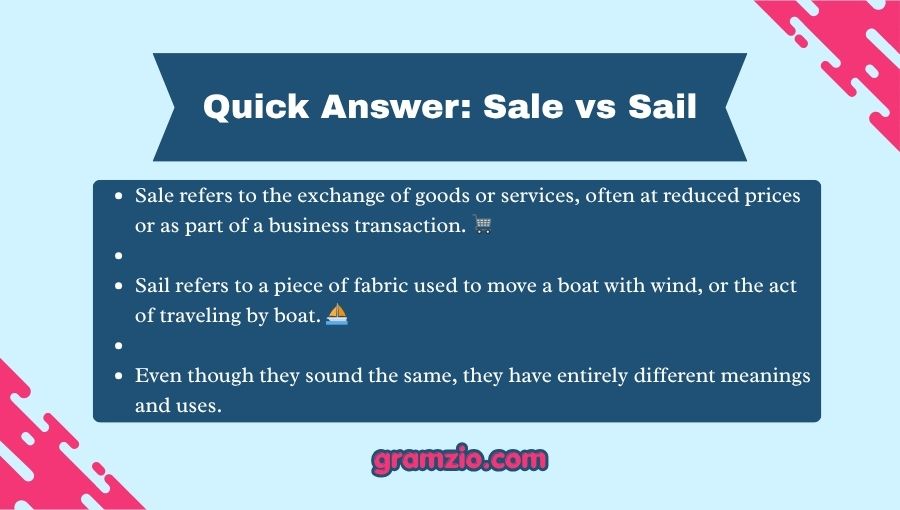
Sale refers to the exchange of goods or services, often at reduced prices or as part of a business transaction. 🛒
Sail refers to a piece of fabric used to move a boat with wind, or the act of traveling by boat. ⛵
Even though they sound the same, they have entirely different meanings and uses.
Understanding the Basics: Sale vs Sail
The core difference is simple:
- Sale = shopping, business, discounts
- Sail = boats, wind, movement on water
Here is a quick comparison:
| Form | Type | Meaning | Example | Correct/Incorrect |
|---|---|---|---|---|
| Sale | Noun | Exchange of goods or discounted shopping event | The shoes are on sale. | ✅ Correct |
| Sail | Noun/Verb | Boat fabric or traveling by water | We sail every summer. | ✅ Correct |
| Sail | Used instead of sale in shopping context | The store has a sail. | ❌ Incorrect | |
| Sale | Used instead of sail in boating context | We sale across the lake. | ❌ Incorrect |
The key point: pronunciation is the same, but context changes everything.
Correct Meanings & Uses
What Does “Sale” Mean? 🛍️
The word sale is a noun. It usually refers to the act of selling something or a period when items are offered at reduced prices.
Examples:
- The clothing store is having a summer sale.
- The company completed the sale of its products.
- We found laptops on sale.
Sentence breakdown:
The clothing store is having a summer sale.
- Store → place of business
- Summer → time period
- Sale → discount event
Meaning: the store is offering special prices.
Test Tip ✅
If your sentence talks about:
- prices
- shopping
- discounts
- buying and selling
Use sale.
What Does “Sail” Mean? ⛵
Sail can be a noun or a verb.
As a noun:
- the large piece of cloth attached to a boat
As a verb:
- to travel across water in a boat
Examples:
- The boat’s sail caught the wind.
- We sail every weekend.
- They sailed across the ocean.
Sentence breakdown:
The boat’s sail caught the wind.
- Boat → water vehicle
- Sail → fabric used for movement
- Wind → power source
Meaning: the cloth helped move the boat.
Test Tip ✅
Ask yourself:
“Am I talking about boats, oceans, or movement on water?”
If yes, choose sail.
Case Study Section 📖
Imagine this workplace email:
Incorrect:
“Our company sail increased during the holiday season.”
This sounds strange because companies do not travel on boats.
Correct:
“Our company sale increased during the holiday season.”
Now the sentence clearly means business transactions improved.
Another example:
Incorrect conversation:
Sarah: “Let’s sale around the island.”
Mike: “Sale what?”
Correct conversation:
Sarah: “Let’s sail around the island.”
Now it makes perfect sense.
This demonstrates how one wrong word can completely change meaning.
Grammar Rules Explanation
According to standard dictionaries such as Merriam-Webster, sale and sail are separate words with different origins and grammatical roles.
Grammar rule:
Choose words based on meaning, not pronunciation.
Because these are homophones, pronunciation cannot help you decide.
Grammar experts generally suggest identifying the context:
Business context → sale
Water or boating context → sail
English contains many homophones, so understanding meaning is more important than relying on sound.
Common Mistakes ❌
People confuse Sale vs Sail for several reasons:
Fast typing
Writers type quickly and select the wrong spelling.
Autocorrect
Phones sometimes replace intended words automatically.
Lack of knowledge
Some people know the pronunciation but not the spelling difference.
Similar sound
Because both words sound identical, mistakes happen naturally.
Here are similar confusing word pairs:
| Confusing Words | Meaning Difference |
|---|---|
| It’s / Its | Contraction vs possession |
| Your / You’re | Possession vs “you are” |
| Their / There | Possession vs place |
| To / Too | Direction vs extra |
| Sale / Sail | Shopping vs boating |
| Brake / Break | Stop vs damage |
Learning common homophones reduces writing errors.
Usage in Different Contexts
Everyday Conversation
Sale:
“That jacket is on sale.”
Sail:
“I want to sail next summer.”
Professional Writing
Sale:
“Our quarterly sales increased by 20%.”
Sail:
“The research team will sail to the island.”
Creative Writing
Sale:
“The market sale attracted thousands.”
Sail:
“The white sail danced beneath the sunset.”
Creative writers often use sail for imagery and emotion. 🌅
Social Media and Texting
Texting often creates errors:
“Big sail today at the mall!”
People understand the intended meaning, but technically it should be:
“Big sale today at the mall!”
Quick typing often creates these mistakes.
Why It Matters ⭐
Correct word choice matters more than many people realize.
Using sale and sail correctly improves:
Clarity in communication
People immediately understand your message.
Professionalism
Errors in emails or reports can appear careless.
Writing accuracy in digital communication
Online messages spread quickly. Correct language creates trust.
Consider this quote:
“Clear writing creates clear thinking.”
A single spelling choice can affect how readers perceive you.
Whether writing emails, social posts, or business content, accuracy matters.
Special Exception
There are a few rare situations where context changes expectations.
Brand names
Some businesses intentionally use unusual spellings.
For example:
- Sail Telecom
- Sail Magazine
In these cases, Sail is a proper name rather than a grammar choice.
Always respect official brand spellings.
Quick Recap Checklist ✅
Before choosing sale or sail, ask these questions:
| Question | If Yes → Use |
|---|---|
| Am I discussing shopping? | Sale |
| Am I discussing discounts? | Sale |
| Am I discussing business transactions? | Sale |
| Am I discussing boats? | Sail |
| Am I discussing ocean travel? | Sail |
| Am I mean movement across water? | Sail |
Practice examples:
- The furniture store is having a huge _____.
Answer: Sale
- They plan to _____ across the bay.
Answer: Sail
- The boat’s _____ ripped in strong wind.
Answer: Sail
Frequently Asked Questions (FAQs)
Is it “for sale” or “for sail”?
The correct phrase is for sale because it means available to purchase.
Example:
“The house is for sale.”
Why do sale and sail sound identical?
They are homophones. Homophones share pronunciation but have different meanings and spellings.
Can sail be used as a verb?
Yes.
Example:
“We sail every summer.”
Here, it describes traveling on water.
Is sale always related to discounts?
No.
A sale can mean any transaction involving selling goods, not only discounts.
How can I remember Sale vs Sail?
Use this trick:
Sale → Store
Both contain business-related ideas.
Sail → Sea
Both connect with water. 🌊
Which word appears more often in business writing?
Sale appears much more often because business communication frequently discusses products and transactions.
Conclusion
The confusion around Sale vs Sail is understandable because both words sound exactly the same. However, their meanings are completely different. Sale belongs to shopping, business transactions, and discounted prices. Sail belongs to boats, oceans, and traveling across water.
A simple way to remember the difference is this:
🛍️ Sale = Store
⛵ Sail = Sea
When you focus on context instead of pronunciation, choosing the correct word becomes easy. Small grammar details may seem minor, but they strongly affect clarity, professionalism, and communication quality.
The next time you write one of these words, pause for a second and ask yourself: Am I buying something or crossing the ocean? That one question can keep your writing smooth sailing. 🚤
Also read: Entwined vs Intertwined

Hi, I’m Willa Sterling. I work at gramzio.com as a senior editor. With 15 years of experience in academic and formal grammar, I provide the expert insights you need to make your writing flawless.