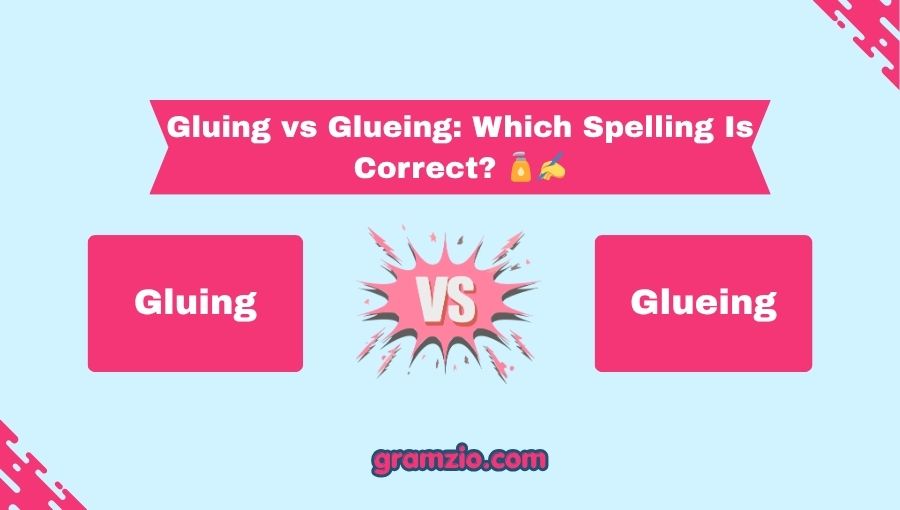
Gluing vs Glueing: Which Spelling Is Correct? 🧴✍️
Have you ever typed a sentence like “I am glueing the paper together” and suddenly felt unsure whether the spelling looked right? You’re not alone. English spelling often creates confusion because many words do not follow patterns perfectly. One common question writers ask is: Gluing vs Glueing — which one is correct? 🤔
The confusion makes sense. The base word is glue, so many people naturally assume adding -ing should create glueing. It feels logical because the original word ends in “e.” However, English spelling rules sometimes remove letters before adding suffixes. That is where uncertainty begins.
Writers, students, bloggers, and professionals frequently search for the answer because using the wrong spelling can affect clarity and credibility. The good news is that the rule behind this word is actually simple once you understand it.
In this guide, you will learn the difference between Gluing vs Glueing, why one spelling is standard, when mistakes happen, and how to remember the correct form forever.
Quick Answer: Gluing vs Glueing
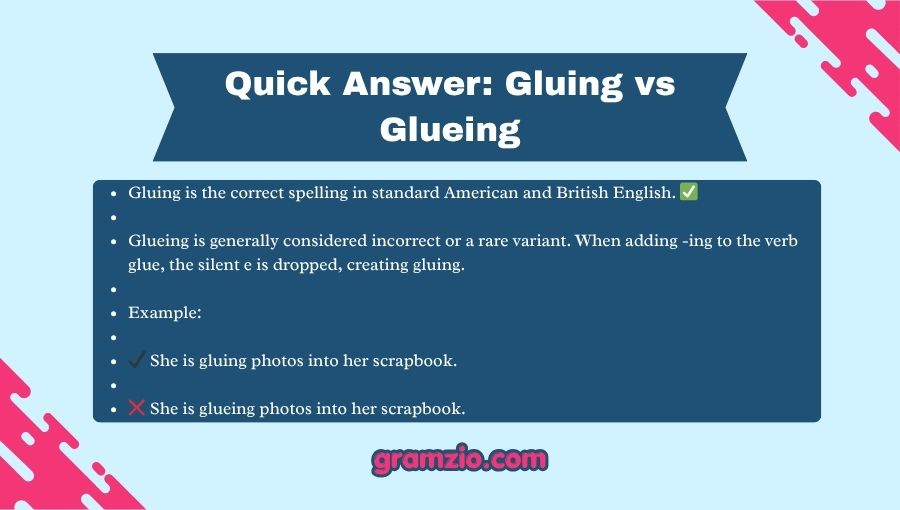
Gluing is the correct spelling in standard American and British English. ✅
Glueing is generally considered incorrect or a rare variant. When adding -ing to the verb glue, the silent e is dropped, creating gluing.
Example:
✔ She is gluing photos into her scrapbook.
❌ She is glueing photos into her scrapbook.
Understanding the Basics of Gluing vs Glueing
The confusion comes from adding -ing to a word ending with e.
Most English verbs ending in silent e follow a common rule:
Drop the final silent “e” before adding “-ing.”
Examples:
- make → making
- write → writing
- dance → dancing
- glue → gluing
Comparison Table
| Form | Type | Meaning | Example | Correct/Incorrect |
|---|---|---|---|---|
| Gluing | Present participle/gerund | Attaching things with glue | He is gluing cardboard pieces. | ✅ Correct |
| Glueing | Misspelling/rare variant | Intended to mean attaching with glue | She is glueing paper together. | ❌ Incorrect |
The rule is straightforward once you know it.
Correct Meanings and Uses
What Does “Gluing” Mean?
Gluing means attaching objects together using glue or adhesive.
Sentence:
Sarah is gluing the broken vase pieces together.
Breakdown:
- Sarah = subject
- is = helping verb
- gluing = action happening now
- vase pieces = object
This sentence shows an ongoing action.
Examples:
✔ The children are gluing decorations onto cards.
✔ I spent the afternoon gluing labels on boxes.
✔ Workers are gluing wooden panels together.
Test Tip 📝
If the root word ends with a silent e, try removing it before adding -ing.
If the new word still sounds natural, you probably formed it correctly.
Why “Glueing” Feels Correct
Many people think:
glue + ing = glueing
That appears logical because the original word visibly contains e.
But English spelling is influenced by pronunciation and readability, not only visible letter patterns.
Removing the e creates a cleaner word:
gluing
The pronunciation remains exactly the same.
Case Study Section
Imagine an employee writing an email at work:
Incorrect version:
“I am glueing the labels onto the product packages now.”
The manager notices the spelling and corrects it.
Correct version:
“I am gluing the labels onto the product packages now.”
Although the mistake is small, spelling errors in professional writing can affect perception.
Readers often associate proper spelling with:
✅ attention to detail
✅ professionalism
✅ strong communication skills
In business environments, small grammar choices matter.
Grammar Rules Explanation
The reason gluing is correct comes from a standard English spelling rule.
When a verb ends with a silent e, the e is usually dropped before adding -ing.
Examples:
| Base Verb | Add -ing | Result |
|---|---|---|
| write | remove e | writing |
| make | remove e | making |
| dance | remove e | dancing |
| glue | remove e | gluing |
Language authorities and dictionaries such as Merriam-Webster follow this standard pattern.
The final e disappears because it is silent and unnecessary once -ing is added.
Common Mistakes
Why do people write glueing?
Several reasons contribute to confusion.
Fast Typing ⌨️
People type quickly and simply attach -ing without thinking about spelling rules.
Autocorrect Issues 📱
Some systems fail to flag uncommon errors.
Lack of Knowledge 📚
Many writers never learned the silent-e rule.
Similar Grammar Confusions Table
| Incorrect Pair | Correct Difference |
|---|---|
| its / it’s | Possession vs contraction |
| your / you’re | Possession vs “you are” |
| affect / effect | Verb vs noun |
| then / than | Time vs comparison |
| gluing / glueing | Correct spelling vs misspelling |
These mistakes happen because English often contains lookalike words.
Usage in Different Contexts
Everyday Conversation
People often use gluing casually.
Examples:
“The kids are gluing pictures into albums.”
“I am gluing the toy back together.”
Professional Writing
In workplaces, precision matters.
Example:
“The assembly team is gluing protective seals onto the products.”
Correct spelling improves credibility.
Creative Writing
Authors may use the word descriptively.
Example:
“Rain seemed to be gluing fallen leaves against the sidewalk.” 🍂
Creative writing can use the term metaphorically.
Social Media and Texting
Fast typing increases errors.
Example:
“Currently gluing my school project together 😂”
Many users accidentally write glueing because they rush.
Why It Matters (Important)
You may wonder:
“Does one extra letter really matter?”
Yes, it does.
Correct spelling affects communication quality.
Clarity in Communication
Proper spelling prevents distraction.
Readers focus on your message rather than errors.
Professionalism
Correct writing creates stronger first impressions.
Digital Writing Accuracy
Online communication depends heavily on text.
Small mistakes can influence how others view expertise.
“Good writing reflects careful thinking.”
That idea remains true in school, business, and online communication.
Special Exception
Interestingly, Glueing occasionally appears in older texts or rare regional references.
Sometimes niche technical communities preserve unusual spellings.
Brand names may also intentionally use unconventional forms for style purposes.
Example:
A company could theoretically create:
“Glueing Solutions Inc.”
Businesses sometimes break language rules deliberately for branding.
However, standard grammar still prefers gluing.
Quick Recap Checklist ✅
| Question | If Yes → Use |
|---|---|
| Are you adding -ing to the verb glue? | Gluing |
| Does the base word end with silent e? | Remove e |
| Are you writing professionally? | Gluing |
| Are you following standard grammar? | Gluing |
Practice examples:
- She is ______ photos into her journal.
Answer: gluing
- We spent an hour ______ decorations on the wall.
Answer: gluing
- The artist is ______ pieces together.
Answer: gluing
Frequently Asked Questions (FAQs)
Is gluing or glueing correct?
Gluing is correct. Standard English removes the silent e before adding -ing.
Why isn’t glueing correct?
Because English spelling rules usually drop silent e before adding -ing.
Is glueing used in British English?
No. British English also generally uses gluing.
Does pronunciation change?
No. Both spellings would sound the same, but only gluing is standard.
Is gluing a verb?
Yes. It is the present participle form of glue.
Example:
“They are gluing posters on the wall.”
Why do spell-checkers sometimes miss glueing?
Some tools use broad dictionaries or fail to catch uncommon variants.
Always proofread manually.
Conclusion
English spelling can sometimes feel tricky, and Gluing vs Glueing is a perfect example. At first glance, glueing appears logical because it keeps the original word unchanged. However, standard grammar follows a different path.
The rule is simple: when a verb ends with a silent e, remove the e before adding -ing. That transforms glue into gluing, just as write becomes writing and make becomes making.
Remember this whenever you write emails, school assignments, articles, or social posts. Small spelling choices create stronger communication and a more polished impression. ✨
One missing letter may seem tiny, but good writing is often built on tiny details.
Also read: On Tuesday Morning vs In The Tuesday Morning

Hi, I’m Grayson Finch. I’m part of the gramzio.com team with 9 years of experience in grammar education. I am dedicated to teaching professional communication and helping you master the art of writing.