On Tuesday Morning vs In The Tuesday Morning: Complete Grammar Guide (With Clear Examples & Rules)
The confusion between “On Tuesday Morning vs In The Tuesday Morning” is very common among English learners, especially when using prepositions with time expressions. Have you ever paused while writing a sentence like “I will call you ___ Tuesday morning” and wondered whether it should be “on Tuesday morning” or “in the Tuesday morning”? 🤔 You’re not alone. Many people struggle with choosing the correct structure because English prepositions change depending on how time is expressed.
The confusion mainly comes from the fact that English uses different prepositions depending on whether we are talking about specific days, general time periods, or descriptive phrases. While “on Tuesday morning” is commonly correct, “in the Tuesday morning” often feels unnatural or grammatically incorrect in standard usage.
This article will break down everything you need to know about “On Tuesday Morning vs In The Tuesday Morning”, including grammar rules, real-life examples, common mistakes, case studies, and practical usage tips. By the end, you’ll confidently know which form to use and why. ✨
Quick Answer: On Tuesday Morning vs In The Tuesday Morning
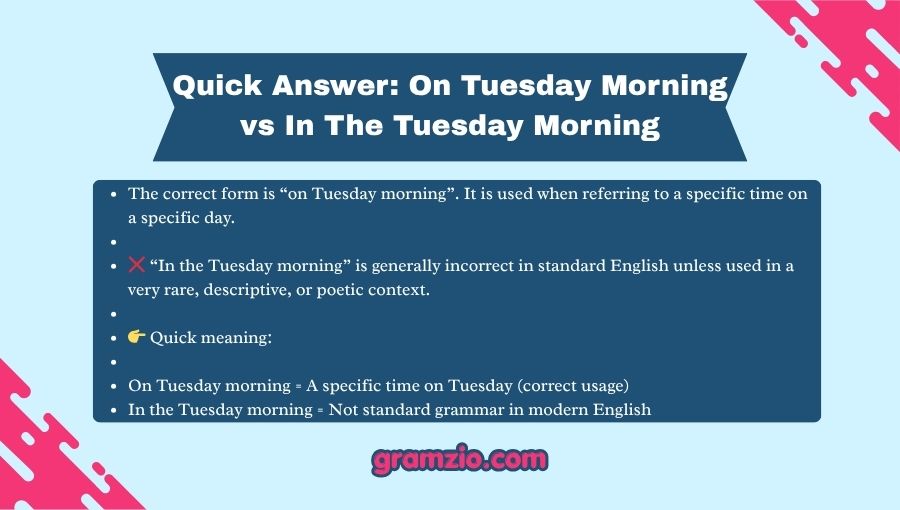
The correct form is “on Tuesday morning”. It is used when referring to a specific time on a specific day.
❌ “In the Tuesday morning” is generally incorrect in standard English unless used in a very rare, descriptive, or poetic context.
👉 Quick meaning:
- On Tuesday morning = A specific time on Tuesday (correct usage)
- In the Tuesday morning = Not standard grammar in modern English
Understanding the Basics: On Tuesday Morning vs In The Tuesday Morning
To understand the difference, we need to break down how English uses prepositions of time.
1. Why “On Tuesday Morning” is Correct
We use “on” for:
- Specific days (on Monday, on Friday)
- Specific dates (on 5th June)
- Specific day + time combinations
So when we say:
👉 “on Tuesday morning”
We mean:
- A specific part of Tuesday (morning)
- A defined point in time
Example:
- I will meet you on Tuesday morning. ✔️
- The meeting is scheduled on Tuesday morning. ✔️
2. Why “In the Tuesday Morning” Sounds Incorrect
The phrase “in the Tuesday morning” is not standard in English grammar.
We use “in” for:
- Months (in June)
- Years (in 2026)
- Longer periods (in the morning, in the evening)
So we say:
✔️ in the morning
✔️ in the evening
✔️ in the afternoon
But NOT:
❌ in the Tuesday morning (because Tuesday is already specific and does not require “in” + article)
Comparison Table: On Tuesday Morning vs In The Tuesday Morning
| Form | Type | Meaning | Example | Correct/Incorrect |
|---|---|---|---|---|
| On Tuesday morning | Prepositional phrase | Specific time on a specific day | I will travel on Tuesday morning | ✔️ Correct |
| In the Tuesday morning | Incorrect structure | Not standard English usage | ❌ In the Tuesday morning I left early | ❌ Incorrect |
| In the morning | Time expression | General morning time | I wake up in the morning | ✔️ Correct |
| On Monday morning | Prepositional phrase | Specific time reference | The class is on Monday morning | ✔️ Correct |
Correct Meanings & Uses
H3: “On Tuesday Morning” in Daily Use
This is the correct and natural form in English.
Examples:
- She called me on Tuesday morning 📞
- We left on Tuesday morning for the airport ✈️
- The accident happened on Tuesday morning 🚗
Sentence Breakdown:
- “On” = preposition of time
- “Tuesday” = specific day
- “morning” = part of the day
👉 Together, they form a precise time reference.
H3: Why “In the Morning” Alone is Different
We use “in the morning” when the day is NOT specified.
Examples:
- I study in the morning 📚
- He goes jogging in the morning 🏃
But once you add a day, “on” becomes necessary:
✔️ on Tuesday morning
❌ in Tuesday morning
Test Tip 🧠
Ask yourself:
👉 Is the time tied to a specific day?
- Yes → Use ON
- No → Use IN
Example:
- Tuesday morning → ON Tuesday morning ✔️
- Morning in general → IN the morning ✔️
Case Study Section: Real-Life Usage
Workplace Email Example 📧
❌ Incorrect:
We will have the meeting in the Tuesday morning.
✔️ Correct:
We will have the meeting on Tuesday morning.
Why it matters:
In professional communication, incorrect prepositions can make writing sound unprofessional or unclear.
Conversation Example 💬
A:
- “When are you coming?”
B:
- ❌ “In the Tuesday morning.”
- ✔️ “On Tuesday morning.”
👉 Native speakers always prefer the second version.
Grammar Rules Explanation
According to standard English grammar references (such as Merriam-Webster style guidelines and general ESL grammar rules):
- “On” is used for days and specific time points
- “In” is used for longer or general time periods
Rule Summary:
- ON = specific days (on Monday, on Tuesday morning)
- IN = general time (in the morning, in 2026)
- AT = exact time (at 5 PM)
👉 Therefore:
✔️ on Tuesday morning
❌ in the Tuesday morning
Common Mistakes
Many learners confuse prepositions due to similar patterns.
Why These Mistakes Happen:
- Fast typing ⌨️
- Autocorrect errors 📱
- Translating from native language 🌍
- Lack of grammar awareness 📘
Common Confusion Table
| Incorrect Form | Correct Form |
|---|---|
| in the Tuesday morning | on Tuesday morning |
| in Monday morning | on Monday morning |
| at Tuesday morning | on Tuesday morning |
| on the morning (general) | in the morning |
Usage in Different Contexts
1. Everyday Conversation 🗣️
- I’ll see you on Tuesday morning.
2. Professional Writing 💼
- The report will be submitted on Tuesday morning.
3. Creative Writing ✍️
- The silence broke on Tuesday morning, when everything changed.
4. Social Media/Texting 📱
- Traveling on Tuesday morning ✈️✨
Why It Matters (Important)
Correct grammar is not just about rules—it affects how others perceive your communication.
Key reasons:
- Improves clarity 🧠
- Enhances professionalism 💼
- Builds credibility ✨
- Avoids misunderstandings ❌
“Good grammar is the foundation of clear communication.”
A small mistake like “in the Tuesday morning” can make writing sound unnatural or less polished.
Special Exception
In rare cases, creative writing or poetry might bend grammar rules for stylistic effect.
Example:
- “In the Tuesday morning light, everything felt different…”
👉 This is poetic usage, not standard grammar.
So:
- Standard English → on Tuesday morning ✔️
- Artistic writing → in the Tuesday morning (rare exception) 🎨
Quick Recap Checklist
| Question | If Yes → Use |
|---|---|
| Is it a specific day? | ON Tuesday morning |
| Is it general morning time? | IN the morning |
| Is it exact time? | AT 9 AM |
Practice Examples:
- I will arrive ___ Tuesday morning.
✔️ on Tuesday morning - She studies ___ the morning.
✔️ in the morning - The event starts ___ Monday morning.
✔️ on Monday morning
FAQs: On Tuesday Morning vs In The Tuesday Morning
1. Is “in the Tuesday morning” correct?
No. It is not standard English and should be avoided.
2. Why do we say “on Tuesday morning”?
Because “on” is used for specific days and time combinations.
3. Can I ever use “in the Tuesday morning”?
Only in rare poetic or stylistic writing—not in normal English.
4. What is the difference between “in the morning” and “on Tuesday morning”?
“In the morning” is general, while “on Tuesday morning” refers to a specific day.
5. Is it wrong to say “on morning”?
Yes. You must specify a day (e.g., on Tuesday morning).
6. What is the easiest way to remember this rule?
Think: Day = ON, General time = IN
Conclusion
Understanding the difference between “On Tuesday Morning vs In The Tuesday Morning” is essential for clear and correct English communication. The correct and natural form is always “on Tuesday morning”, as it follows standard grammar rules for specific time references.
On the other hand, “in the Tuesday morning” is not commonly used in modern English and should be avoided unless you are writing creatively or poetically.
By remembering a simple rule—ON for specific days and IN for general time—you can eliminate confusion and improve your writing instantly. ✨
Mastering such small grammar details can significantly improve your fluency, professionalism, and confidence in English communication. Keep practicing, and soon these choices will become automatic.
Also read: Correct vs Correctly

Hi, I’m Willa Sterling. I work at gramzio.com as a senior editor. With 15 years of experience in academic and formal grammar, I provide the expert insights you need to make your writing flawless.