Newfound or New Found: Which One Is Correct? 🤔
Have you ever written a sentence like “I have a new found love for reading” and paused, wondering if it should actually be “newfound” instead? You’re not alone. The confusion between newfound or new found is incredibly common, even among experienced writers. ✍️
At first glance, both versions seem logical. After all, “new” and “found” are perfectly valid words on their own. So why would combining them into a single word make a difference? The answer lies in how English evolves and how compound words function in modern grammar.
Understanding whether to use newfound or new found is not just about correctness—it’s also about clarity and professionalism. Whether you’re writing an email, a blog post, or even a social media caption, using the right form helps you communicate more effectively. 💡
In this guide, we’ll break down everything you need to know about newfound or new found, including meanings, grammar rules, real-life examples, and common mistakes—so you’ll never second-guess yourself again.
Quick Answer: Newfound or New Found ✅
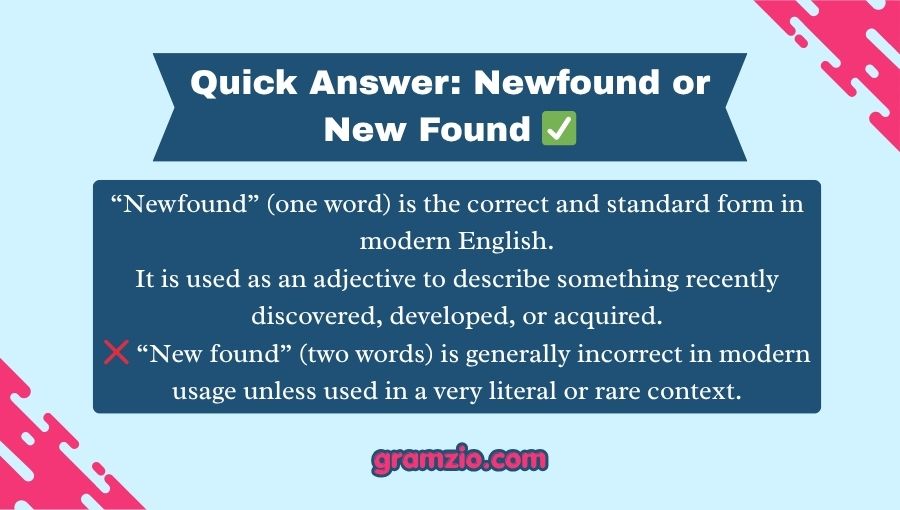
“Newfound” (one word) is the correct and standard form in modern English.
It is used as an adjective to describe something recently discovered, developed, or acquired.
❌ “New found” (two words) is generally incorrect in modern usage unless used in a very literal or rare context.
Understanding the Basics: Newfound or New Found
Let’s simplify the difference.
- Newfound → A compound adjective (correct form)
- New found → Outdated or incorrect in most contexts
Comparison Table
| Form | Type | Meaning | Example Sentence | Correct/Incorrect |
|---|---|---|---|---|
| Newfound | Compound adjective | Recently discovered or developed | She has a newfound confidence. | ✅ Correct |
| New found | Phrase (rare use) | Literally “newly found” (rare/literal usage) | He found a new found object in the cave. | ⚠️ Rare/Incorrect |
👉 Key takeaway: In almost all cases, “newfound” is the correct choice.
Correct Meanings & Uses
1. What Does “Newfound” Mean? 💡
“Newfound” describes something that has recently appeared, been discovered, or developed.
Examples:
- She gained a newfound confidence after the presentation.
- He has a newfound appreciation for nature. 🌿
- Their team showed newfound strength this season.
Sentence Breakdown:
👉 “She gained a newfound confidence.”
- Newfound = recently developed
- Confidence = noun being described
✔️ The compound adjective modifies the noun clearly and smoothly.
2. Is “New Found” Ever Correct? ⚠️
In very rare cases, “new found” can appear if you are literally describing something that was just found.
Example (rare/literal):
- The archaeologist examined a new found artifact.
However, even here, modern grammar still prefers “newfound artifact.”
👉 Test Tip 🧠:
If you can replace the phrase with “recently discovered”, then use “newfound” (one word).
Case Study 📊
Workplace Email Example
❌ Incorrect:
I have a new found interest in project management.
✅ Correct:
I have a newfound interest in project management.
Why It Matters:
- The correct version looks polished and professional.
- The incorrect version may appear outdated or careless.
Grammar Rules Explanation 📚
According to standard dictionaries like Merriam-Webster, “newfound” is recognized as a compound adjective.
Why “Newfound” Works:
- English often combines words to form compound adjectives.
- Over time, commonly used combinations become a single word.
Examples of similar patterns:
- Newborn (not “new born”) 👶
- Full-time (not “full time” in adjective form)
- Well-known
👉 “Newfound” follows this same evolution.
Why “New Found” Fails:
- It splits a compound adjective unnecessarily.
- It disrupts readability and modern usage standards.
Common Mistakes 🚫
Why Do People Confuse “Newfound or New Found”?
- Fast typing ⌨️
- Autocorrect errors 🤖
- Lack of grammar awareness 📖
Similar Grammar Confusions Table
| Confusing Pair | Correct Usage Example | Common Mistake |
|---|---|---|
| It’s / Its | It’s raining today. | Its raining today ❌ |
| Your / You’re | You’re amazing. | Your amazing ❌ |
| Everyday / Every day | I wear these shoes every day. | Everyday I wear these ❌ |
| Newfound / New found | She has newfound courage. | New found courage ❌ |
Usage in Different Contexts 🌍
1. Everyday Conversation
- “I’ve developed a newfound love for cooking.” 🍳
2. Professional Writing
- “The company experienced newfound growth after the merger.”
3. Creative Writing
- “With his newfound strength, he faced the storm bravely.” 🌩️
4. Social Media/Texting
- “Gym life = my newfound obsession 💪🔥”
Why It Matters (Important Section) ⭐
Using newfound correctly improves:
- ✅ Clarity in communication
- ✅ Professional credibility
- ✅ Writing accuracy
Even small grammar choices can shape how others perceive your writing.
💬 “Good writing is clear thinking made visible.”
Special Exception ⚠️
There are no widely accepted exceptions where “new found” is preferred over “newfound.”
However:
- In very old texts or poetic writing, you might see “new found.”
- Some brand names or stylistic choices may intentionally separate the words.
👉 Still, in modern standard English, “newfound” is the rule.
Quick Recap Checklist ✅
| Question | If Yes → Use |
|---|---|
| Is it describing something recently developed? | Newfound |
| Can you replace it with “recently discovered”? | Newfound |
| Are you writing modern English? | Newfound |
Practice Examples 📝
- She has a ______ confidence.
→ ✅ Newfound - They discovered a ______ passion for art.
→ ✅ Newfound - He showed ______ determination.
→ ✅ Newfound
FAQs: Newfound or New Found❓
1. Is it “newfound” or “new found”?
The correct form is “newfound” (one word). It is the standard compound adjective in modern English.
2. What does “newfound” mean?
“Newfound” means something recently discovered, developed, or gained.
3. Can I ever use “new found”?
Only in rare, literal contexts, but even then, “newfound” is preferred.
4. Is “newfound” formal or informal?
It is suitable for both formal and informal writing.
5. Why is “newfound” one word?
Because it has evolved into a compound adjective, similar to “newborn” or “well-known.”
6. How can I remember the correct form?
Use this trick:
👉 If it describes a feeling, quality, or idea, always write “newfound.”
Conclusion
The confusion between newfound or new found is easy to understand—but even easier to fix once you know the rule. In modern English, “newfound” is the correct and widely accepted form, used to describe something recently discovered or developed.
While “new found” may appear logical, it is outdated and rarely appropriate in today’s writing. Choosing the correct form not only improves your grammar but also enhances clarity and professionalism in your communication.
Whether you are writing emails, essays, or social media posts, sticking with “newfound” ensures your message is polished and accurate. ✨
👉 Remember this simple rule:
If it describes something newly developed, always use “newfound.”
Mastering small details like this can make a big difference—because great writing is built on getting the little things right.
Also read: Annunciate vs Enunciate

Hi, I’m Willa Sterling. I work at gramzio.com as a senior editor. With 15 years of experience in academic and formal grammar, I provide the expert insights you need to make your writing flawless.